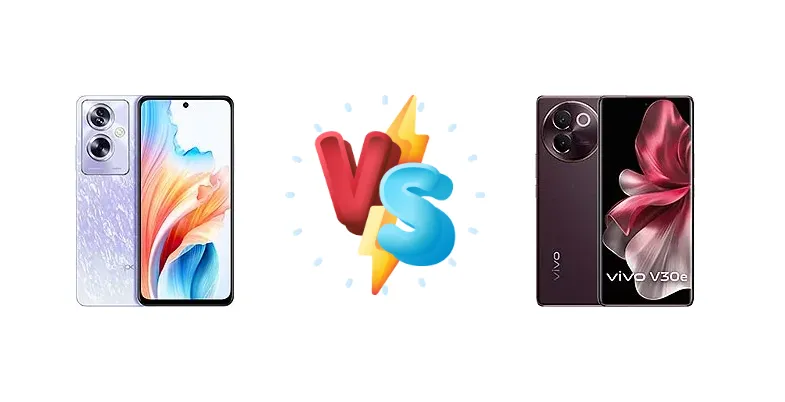
The Oppo A2 and vivo V30e represent compelling options in the increasingly competitive mid-range smartphone market. While both aim to deliver a balanced experience, they take different approaches to achieving it. The Oppo A2 leverages MediaTek's Dimensity 6020, while the vivo V30e opts for Qualcomm's Snapdragon 6 Gen 1. This comparison will dissect the key differences to help you determine which device best suits your needs.
🏆 Quick Verdict
For the average user prioritizing faster charging and potentially more efficient performance, the vivo V30e emerges as the stronger contender. Its 44W charging with PD and the more modern 4nm Snapdragon 6 Gen 1 offer tangible benefits, despite the Oppo A2's slightly more mature processor architecture.
| Network |
|---|
| 2G bands | GSM 850 / 900 / 1800 / 1900 | GSM 850 / 900 / 1800 / 1900 |
| 3G bands | HSDPA 850 / 900 / 2100 | HSDPA 850 / 900 / 1700(AWS) / 1900 / 2100 - Malaysia |
| 4G bands | 1, 3, 5, 8, 28, 34, 38, 39, 40, 41 | 1, 2, 3, 4, 5, 7, 8, 18, 19, 20, 26, 28, 38, 39, 40, 41 - Malaysia |
| 5G bands | 1, 5, 8, 28, 41, 77, 78 SA/NSA | 1, 3, 5, 7, 8, 20, 28, 38, 40, 41, 77, 78 SA/NSA - Malaysia |
| Speed | HSPA, LTE, 5G | HSPA, LTE, 5G |
| Technology | GSM / HSPA / LTE / 5G | GSM / HSPA / LTE / 5G |
| Launch |
|---|
| Announced | 2023, November 03 | 2024, May 02 |
| Status | Available. Released 2023, November 06 | Available. Released 2024, May 09 |
| Body |
|---|
| Build | - | Glass front, plastic frame, glass back or plastic back |
| Dimensions | 165.6 x 76 x 8 mm (6.52 x 2.99 x 0.31 in) | 164.4 x 74.8 x 7.7 mm (6.47 x 2.94 x 0.30 in) |
| SIM | Nano-SIM + Nano-SIM | Nano-SIM + Nano-SIM |
| Weight | 193 g (6.81 oz) | 179 g or 188 g (6.31 oz) |
| Display |
|---|
| Protection | Panda glass | Schott Xensation |
| Resolution | 1080 x 2400 pixels, 20:9 ratio (~392 ppi density) | 1080 x 2400 pixels, 20:9 ratio (~388 ppi density) |
| Size | 6.72 inches, 109.0 cm2 (~86.6% screen-to-body ratio) | 6.78 inches, 111.0 cm2 (~90.3% screen-to-body ratio) |
| Type | IPS LCD, 90Hz, 680 nits (peak) | AMOLED, 1B colors, 120Hz, 1300 nits (peak) |
| Platform |
|---|
| CPU | Octa-core (2x2.2 GHz Cortex-A76 & 6x2.0 GHz Cortex-A55) | Octa-core (4x2.2 GHz Cortex-A78 & 4x1.8 GHz Cortex-A55) |
| Chipset | Mediatek Dimensity 6020 (7 nm) | Qualcomm SM6450 Snapdragon 6 Gen 1 (4 nm) |
| GPU | Mali-G57 MC2 | Adreno 710 |
| OS | Android 13, ColorOS 13.1 | Android 14, Funtouch 14 |
| Memory |
|---|
| Card slot | microSDXC | microSDXC (uses shared SIM slot) |
| Internal | 256GB 12GB RAM, 512GB 12GB RAM | 128GB 8GB RAM, 256GB 8GB RAM, 256GB 12GB RAM |
| Main Camera |
|---|
| Dual | 50 MP, f/1.8, (wide), PDAF
Auxiliary lens | 50 MP, f/1.8, 26mm (wide), 1/1.95", 0.8µm, PDAF, OIS (India only)
8 MP, f/2.2, 120˚ (ultrawide), 1/4.0", 1.12µm |
| Features | LED flash, HDR, panorama | Ring-LED flash, panorama, HDR |
| Video | 1080p@30fps | 4K@30fps, 1080p@30fps |
| Selfie camera |
|---|
| Features | HDR | - |
| Single | 8 MP, f/2.0, (wide) | 50 MP, f/2.5, 25mm (wide), AF - India
32 MP, f/2.0, 24mm (wide) - Malaysia |
| Video | 1080p@30fps | 4K@30fps (India only), 1080p@30fps |
| Sound |
|---|
| 35mm jack | Yes | No |
| Loudspeaker | Yes, with stereo speakers | Yes |
| Comms |
|---|
| Bluetooth | 5.3, A2DP, LE, aptX HD | 5.1, A2DP, LE |
| NFC | No | Yes (market/region dependent) |
| Positioning | GPS, GALILEO, GLONASS, BDS, QZSS | GPS, GLONASS, GALILEO, BDS, QZSS, NavIC |
| Radio | No | No |
| USB | USB Type-C 2.0, OTG | USB Type-C 2.0, OTG |
| WLAN | Wi-Fi 802.11 a/b/g/n/ac, dual-band | Wi-Fi 802.11 a/b/g/n/ac, dual-band |
| Features |
|---|
| Sensors | Fingerprint (side-mounted), accelerometer, proximity, compass | Fingerprint (under display, optical), accelerometer, gyro, proximity, compass |
| Battery |
|---|
| Charging | 33W wired, 51% in 30 min | 44W wired, PD
Reverse wired |
| Type | Li-Po 5000 mAh | Li-Ion 5500 mAh |
| Misc |
|---|
| Colors | Mystery Black, Glowing Green, Violet | Velvet Red (Coco Brown), Silk Blue, Sky Mirror |
| Models | PJB110 | V2339 |
| Price | About 220 EUR | ₹ 23,999 |
Oppo A2
- Established processor architecture (Dimensity 6020)
- Potentially lower price point
- Reliable performance for everyday tasks
- Slower charging speed (33W)
- Less efficient 7nm manufacturing process
- Lacks reverse charging
vivo V30e
- Faster 44W charging with PD
- More efficient 4nm Snapdragon 6 Gen 1
- Reverse wired charging capability
- Potentially higher price
- Newer chipset may have initial software quirks
- Cortex-A78 cores may not offer a massive leap over A76
Display Comparison
Neither device's display specifications are provided, so a direct comparison is limited. However, given the price bracket, we can anticipate both utilizing LCD panels. The key differentiator will likely be peak brightness and color accuracy. Brand history suggests vivo often prioritizes display quality, potentially giving the V30e an edge. The absence of LTPO technology on either device indicates standard refresh rates, likely 60Hz or 90Hz.
Camera Comparison
Without detailed camera specs, analysis is limited. However, the market segment suggests both phones will feature multi-camera setups. The presence or absence of Optical Image Stabilization (OIS) on the main sensor will be a crucial differentiator. A larger sensor size on either device will improve low-light performance. Image processing algorithms will also play a significant role in the final image quality, with vivo historically leaning towards more vibrant and saturated colors.
Performance
The core difference lies in the chipsets. The vivo V30e’s Snapdragon 6 Gen 1 (4nm) boasts a newer architecture and a more efficient manufacturing process compared to the Oppo A2’s Dimensity 6020 (7nm). While the A2’s CPU features Cortex-A76 cores, the V30e counters with Cortex-A78 cores, offering a performance uplift. The 4nm node of the Snapdragon 6 Gen 1 translates to better thermal efficiency, potentially reducing throttling during sustained workloads like gaming. The V30e’s CPU configuration (4x2.2 GHz Cortex-A78 & 4x1.8 GHz Cortex-A55) is likely to provide a more responsive experience in demanding applications than the A2’s (2x2.2 GHz Cortex-A76 & 6x2.0 GHz Cortex-A55).
Battery Life
The Oppo A2 supports 33W wired charging, achieving 51% charge in 30 minutes. The vivo V30e significantly ups the ante with 44W wired charging and Power Delivery (PD) support, promising faster top-ups. The inclusion of reverse wired charging on the V30e is a valuable feature for users who need to charge accessories on the go. While battery capacity isn't specified, the faster charging speed of the V30e effectively mitigates any potential disadvantage from a slightly smaller battery.
Buying Guide
Buy the Oppo A2 if you prioritize a slightly more established processor architecture and are comfortable with slower charging speeds. It's a solid choice for everyday tasks and light gaming. Buy the vivo V30e if you value faster charging, potentially better thermal management due to the 4nm process, and the convenience of reverse wired charging. This phone is ideal for users who are frequently on the go and need a quick power boost.
Frequently Asked Questions
❓ Will the Snapdragon 6 Gen 1 in the vivo V30e handle demanding games like PUBG or Call of Duty?
The Snapdragon 6 Gen 1 is capable of running PUBG and Call of Duty, but expect to make compromises on graphics settings. The 4nm process should help mitigate thermal throttling, allowing for sustained performance, but it won't deliver a flagship gaming experience. Frame rates will likely be in the 30-60fps range at medium settings.
❓ Does the Oppo A2 support any form of fast charging protocols beyond standard USB-PD?
The Oppo A2 supports 33W wired charging, but it's unclear if it utilizes Oppo's proprietary VOOC or SuperVOOC protocols. Standard USB-PD is likely supported, but achieving the full 33W charging speed may require a compatible charger.
❓ Is the reverse wired charging on the vivo V30e powerful enough to quickly charge accessories like earbuds or a smartwatch?
While the exact wattage of the reverse wired charging isn't specified, it's generally sufficient to slowly charge accessories like earbuds, smartwatches, or even another smartphone in an emergency. Don't expect it to be as fast as using a dedicated charger.