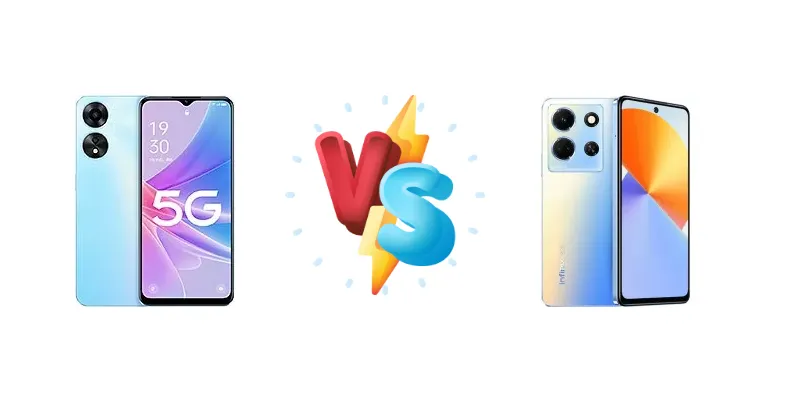
The sub-$200 smartphone market is fiercely competitive, and the Oppo A1x and Infinix Note 30 5G represent compelling options. While both aim to deliver essential smartphone functionality, they diverge significantly in chipset choice and charging capabilities, making one a better fit for power users and the other for those prioritizing basic connectivity.
🏆 Quick Verdict
For the average user seeking a balance of performance and convenience, the Infinix Note 30 5G emerges as the stronger contender. Its newer Dimensity 6080 chipset, coupled with significantly faster 45W charging, provides a more responsive experience and reduces downtime compared to the Oppo A1x’s Dimensity 700 and 10W charging.
| Network |
|---|
| 2G bands | GSM 850 / 900 / 1800 / 1900 | GSM 850 / 900 / 1800 / 1900 |
| 3G bands | HSDPA 850 / 900 / 2100 | HSDPA 850 / 900 / 1700(AWS) / 1900 / 2100 |
| 4G bands | 1, 3, 5, 8, 28, 34, 38, 39, 40, 41 | 1, 2, 3, 4, 5, 7, 8, 12, 17, 20, 28, 38, 40, 41, 66 |
| 5G bands | 1, 5, 8, 28, 41, 77, 78 SA/NSA | 1, 3, 5, 7, 8, 12, 22, 28, 38, 40, 41, 66, 77, 78 |
| Speed | HSPA, LTE, 5G | HSPA, LTE, 5G |
| Technology | GSM / CDMA / HSPA / CDMA2000 / LTE / 5G | GSM / HSPA / LTE / 5G |
| | CDMA2000 1x | - |
| Launch |
|---|
| Announced | 2023, March 31 | 2023, May 22 |
| Status | Available. Released 2023, March 31 | Available. Released 2023, May 22 |
| Body |
|---|
| Build | - | Glass front, plastic frame, glass or leather back |
| Dimensions | 163.8 x 75.1 x 8 mm (6.45 x 2.96 x 0.31 in) | 168.5 x 76.5 x 8.5 mm (6.63 x 3.01 x 0.33 in) |
| SIM | Nano-SIM + Nano-SIM | Nano-SIM + Nano-SIM |
| Weight | 186 g (6.56 oz) | 205 g (7.23 oz) |
| | IP54 | - |
| Display |
|---|
| Resolution | 720 x 1612 pixels, 20:9 ratio (~269 ppi density) | 1080 x 2460 pixels (~396 ppi density) |
| Size | 6.56 inches, 103.4 cm2 (~84.0% screen-to-body ratio) | 6.78 inches, 109.2 cm2 (~84.7% screen-to-body ratio) |
| Type | IPS LCD, 90Hz, 480 nits (typ), 600 nits (HBM) | IPS LCD, 120Hz, 580 nits (peak) |
| Platform |
|---|
| CPU | Octa-core (2x2.2 GHz Cortex-A76 & 6x2.0 GHz Cortex-A55) | Octa-core (2x2.4 GHz Cortex-A76 & 6x2.0 GHz Cortex-A55) |
| Chipset | Mediatek Dimensity 700 (7 nm) | Mediatek Dimensity 6080 (6 nm) |
| GPU | Mali-G57 MC2 | Mali-G57 MC2 |
| OS | Android 12, ColorOS 12.1 | Android 13 |
| Memory |
|---|
| Card slot | microSDXC | microSDXC (dedicated slot) |
| Internal | 128GB 6GB RAM, 128GB 8GB RAM | 128GB 4GB RAM, 256GB 8GB RAM |
| | UFS 2.2 | - |
| Main Camera |
|---|
| Dual | 13 MP, f/2.2, 25mm (wide), PDAF
Auxiliary lens | - |
| Features | LED flash, HDR, panorama | Quad-LED flash, HDR, panorama |
| Triple | - | 108 MP, f/1.75, 26mm (wide), 1/1.67", 0.64µm, PDAF
Auxiliary lenses |
| Video | 1080p@30fps | 1440p@30fps, 1080p@30/60fps |
| Selfie camera |
|---|
| Features | - | Dual-LED flash, HDR |
| Single | 8 MP, f/2.0, 27mm (wide) | 16 MP, f/2.0, (wide) |
| Video | 1080p@30fps | 1080p@30fps |
| Sound |
|---|
| 3.5mm jack | Yes | - |
| 35mm jack | Yes | Yes |
| Loudspeaker | Yes, with stereo speakers | Yes, with dual speakers |
| Comms |
|---|
| Bluetooth | 5.3, A2DP, LE, aptX | Yes |
| NFC | No | Yes |
| Positioning | GPS, GALILEO, GLONASS, BDS, QZSS | GPS |
| Radio | No | FM radio |
| USB | USB Type-C 2.0, OTG | USB Type-C 2.0, OTG |
| WLAN | Wi-Fi 802.11 a/b/g/n/ac, dual-band | Wi-Fi 802.11 a/b/g/n/ac, dual-band, Wi-Fi Direct |
| Features |
|---|
| Sensors | Fingerprint (side-mounted), accelerometer, proximity, compass | Fingerprint (side-mounted), accelerometer, gyro, proximity, compass |
| Battery |
|---|
| Charging | 10W wired | 45W wired, bypass charging |
| Type | Li-Po 5000 mAh | 5000 mAh |
| Misc |
|---|
| Colors | Black, Blue | Magic Black, Interstellar Blue, Sunset Gold |
| Models | PHJ110 | X6711 |
| Price | About 180 EUR | - |
Oppo A1x
- Potentially lower price point (depending on region)
- Reliable Mediatek Dimensity 700 chipset for basic tasks
- Simple and straightforward user experience
- Extremely slow 10W charging
- Older Dimensity 700 chipset offers limited performance headroom
- Likely lower display brightness and contrast
Infinix Note 30 5G
- Faster and more efficient Dimensity 6080 chipset
- Significantly faster 45W charging with bypass charging
- Brighter and higher contrast display (607 nits, 1521:1)
- May be slightly more expensive than the Oppo A1x
- Camera performance is likely average for the price range
- Software experience can vary (Infinix UI)
Display Comparison
The Infinix Note 30 5G boasts a notably brighter display, reaching a measured 607 nits, compared to the Oppo A1x which lacks published brightness data. This higher peak brightness translates to better visibility outdoors under direct sunlight. Furthermore, the Note 30 5G’s 1521:1 contrast ratio suggests deeper blacks and more vibrant colors. While both likely utilize IPS LCD panels given the price point, the Infinix’s display specifications indicate a superior viewing experience, particularly for media consumption.
Camera Comparison
Without detailed camera specifications beyond the presence of cameras, a direct comparison is limited. However, given the market positioning, it’s reasonable to assume both phones feature primary sensors around the 13-50MP range. The absence of OIS information suggests neither phone will excel in low-light photography. The focus should be on image processing algorithms, which are brand-specific and difficult to assess without sample images. The inclusion of a 2MP macro lens on either device is largely a marketing tactic, offering minimal practical benefit due to the low resolution and fixed focus.
Performance
Both devices utilize Mediatek Dimensity chipsets, but the Infinix Note 30 5G’s Dimensity 6080 (6nm) represents a generational leap over the Oppo A1x’s Dimensity 700 (7nm). The 6nm process node inherently offers improved power efficiency and thermal characteristics. While both CPUs share the same core configuration (2x2.4/2.2 GHz Cortex-A76 & 6x2.0 GHz Cortex-A55), the 6080’s architecture improvements and higher clock speeds on the A76 cores will result in noticeably faster application loading times and smoother multitasking. The Infinix also benefits from potentially faster RAM speeds, though this isn't specified in the provided data.
Battery Life
The charging disparity is the most significant difference. The Infinix Note 30 5G’s 45W wired charging with bypass charging (allowing charging while in use) dramatically reduces charging times compared to the Oppo A1x’s sluggish 10W charging. While battery capacity isn’t specified for either device, the faster charging of the Infinix mitigates the impact of a potentially smaller battery. Users who frequently find themselves needing to top up their phone will greatly appreciate the Note 30 5G’s charging speed.
Buying Guide
Buy the Oppo A1x if you need a basic, reliable smartphone for essential tasks like calls, messaging, and light social media use, and are unconcerned with fast charging or demanding applications. Buy the Infinix Note 30 5G if you prioritize faster performance for gaming and multitasking, a brighter and more vibrant display, and the convenience of rapid 45W charging, making it ideal for users who are always on the go.
Frequently Asked Questions
❓ Does the Infinix Note 30 5G’s Dimensity 6080 chipset get hot during extended gaming sessions?
The Dimensity 6080’s 6nm process node is more efficient than the Oppo A1x’s Dimensity 700’s 7nm node, meaning it generates less heat under load. While sustained gaming will inevitably cause some warming, the 6080 is less prone to significant throttling, providing a more consistent gaming experience. However, thermal performance will also depend on the phone’s cooling system, which isn’t specified.
❓ Is the 10W charging on the Oppo A1x realistically usable for someone who uses their phone heavily throughout the day?
10W charging is exceptionally slow by modern standards. A full charge from 0% can take upwards of 3-4 hours. For heavy users, this is impractical and will likely require overnight charging. The Infinix Note 30 5G’s 45W charging is a far more convenient solution, allowing for a significant charge in a short amount of time.
❓ Will the Infinix Note 30 5G support VoLTE/VoWiFi on all carriers?
Carrier compatibility can vary significantly by region. It's crucial to check with your specific carrier to confirm VoLTE and VoWiFi support for the Infinix Note 30 5G before purchasing, as these features are essential for modern voice calling and Wi-Fi calling functionality.