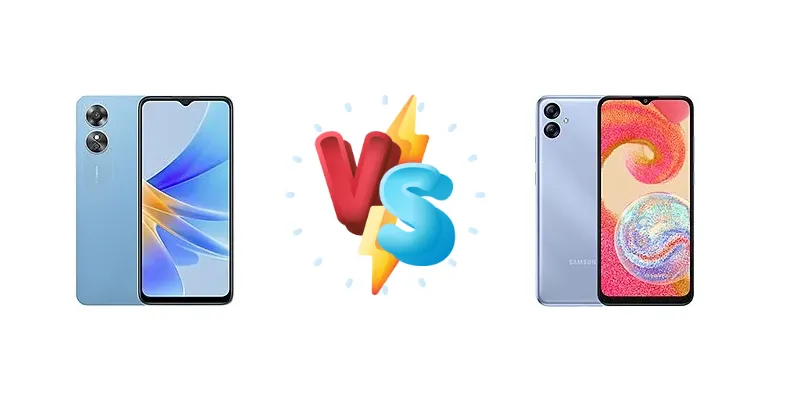
The Oppo A17 and Samsung Galaxy A04e represent the very bottom of the smartphone price spectrum. Both aim to deliver basic functionality at an incredibly affordable price point. However, despite appearing similar on paper, a crucial difference in their chipsets – the MediaTek Helio G35 in the Oppo A17 versus the Helio P35 in the Samsung – dictates which phone offers a smoother user experience.
🏆 Quick Verdict
For the average user prioritizing responsiveness, the Oppo A17 emerges as the better choice. While both phones share a similar design and display quality, the Helio G35 chipset provides a slight, but noticeable, performance edge in everyday tasks and light gaming, making it a more future-proof option.
| Network |
|---|
| 2G bands | GSM 850 / 900 / 1800 / 1900 | GSM 850 / 900 / 1800 / 1900 |
| 3G bands | HSDPA 850 / 900 / 2100 | HSDPA 850 / 900 / 2100 |
| 4G bands | 1, 3, 5, 8, 38, 40, 41 | 1, 3, 5, 7, 8, 20, 28, 38, 40, 41 |
| Speed | HSPA, LTE | HSPA, LTE |
| Technology | GSM / HSPA / LTE | GSM / HSPA / LTE |
| Launch |
|---|
| Announced | 2022, September 26 | 2022, October 21 |
| Status | Available. Released 2022, September 26 | Available. Released 2022, November 07 |
| Body |
|---|
| Build | - | Glass front, plastic back, plastic frame |
| Dimensions | 164.2 x 75.6 x 8.3 mm (6.46 x 2.98 x 0.33 in) | 164.2 x 75.9 x 9.1 mm (6.46 x 2.99 x 0.36 in) |
| SIM | Nano-SIM + Nano-SIM | · Nano-SIM· Nano-SIM + Nano-SIM |
| Weight | 189 g (6.67 oz) | 188 g (6.63 oz) |
| | IPX4 water resistance | - |
| Display |
|---|
| Resolution | 720 x 1612 pixels, 20:9 ratio (~269 ppi density) | 720 x 1600 pixels, 20:9 ratio (~270 ppi density) |
| Size | 6.56 inches, 103.4 cm2 (~83.3% screen-to-body ratio) | 6.5 inches, 102.0 cm2 (~81.8% screen-to-body ratio) |
| Type | IPS LCD | PLS LCD |
| Platform |
|---|
| CPU | Octa-core (4x2.3 GHz Cortex-A53 & 4x1.8 GHz Cortex-A53) | Octa-core (4x2.3 GHz Cortex-A53 & 4x1.8 GHz Cortex-A53) |
| Chipset | Mediatek MT6765 Helio G35 (12 nm) | Mediatek MT6765 Helio P35 (12 nm) |
| GPU | PowerVR GE8320 | PowerVR GE8320 |
| OS | Android 12, ColorOS 12.1 | Android 12, One UI Core 4.1 |
| Memory |
|---|
| Card slot | microSDXC | microSDXC (dedicated slot) |
| Internal | 64GB 3GB RAM, 64GB 4GB RAM, 128GB 6GB RAM | 32GB 2GB RAM, 32GB 3GB RAM, 32GB 4GB RAM, 64GB 2GB RAM, 64GB 3GB RAM, 64GB 4GB RAM, 128GB 4GB RAM |
| | eMMC 5.1 | - |
| Main Camera |
|---|
| Dual | 50 MP, f/1.8, (wide), PDAF
Auxiliary lens | 13 MP, f/2.2, (wide), AF
Auxiliary lens |
| Features | LED flash, HDR, panorama | LED flash |
| Single | 5 MP, f/2.2, (wide) | 5 MP, f/2.2 |
| Video | 1080p@30fps | 1080p@30fps |
| Selfie camera |
|---|
| Features | HDR | - |
| Single | 5 MP, f/2.2, (wide) | 5 MP, f/2.2 |
| Video | Yes | Yes |
| Sound |
|---|
| 3.5mm jack | Yes | Yes |
| 35mm jack | Yes | Yes |
| Loudspeaker | Yes | Yes |
| Comms |
|---|
| Bluetooth | Yes | 5.0, A2DP, LE |
| NFC | No | No |
| Positioning | GPS | GPS, GLONASS, GALILEO, BDS |
| Radio | FM radio | Unspecified |
| USB | microUSB 2.0 | USB Type-C 2.0, OTG |
| WLAN | Wi-Fi 802.11 a/b/g/n/ac, dual-band | Wi-Fi 802.11 b/g/n, Wi-Fi Direct |
| Features |
|---|
| Sensors | Fingerprint (side-mounted), accelerometer, proximity | Accelerometer, proximity |
| Battery |
|---|
| Type | Li-Po 5000 mAh | Li-Po 5000 mAh |
| Misc |
|---|
| Colors | Midnight Black, Lake Blue, Sunlight Orange | Black, Copper, Light Blue |
| Models | CPH2477 | SM-A042F, SM-A042F/DS, SM-A042M, SM-A042M/DS |
| Price | € 159.99 / $ 168.76 / ₹ 8,999 | ₹ 7,999 |
| SAR EU | - | 0.29 W/kg (head) 1.11 W/kg (body) |
Oppo A17
- Slightly better performance due to Helio G35 chipset
- Potentially smoother gaming experience
- More responsive user interface
- Brand recognition may be lower than Samsung
- Camera quality likely similar to the A04e
Samsung Galaxy A04e
- Strong brand recognition and trust
- Potentially wider availability
- Competitive pricing
- Helio P35 chipset offers less performance
- May exhibit more lag during multitasking
- Gaming performance will be limited
Display Comparison
Both the Oppo A17 and Samsung Galaxy A04e likely feature similar LCD panels, given their price bracket. Specific details like peak brightness and color accuracy are not provided, but we can assume they prioritize power efficiency over visual fidelity. Bezels are expected to be relatively thick on both devices. The display experience will be functional for basic consumption, but not ideal for media viewing or gaming in bright sunlight.
Camera Comparison
Camera performance on both devices will be limited. Details regarding sensor size and lens apertures are unavailable. It's highly probable that both phones feature a primary camera alongside basic depth or macro sensors. Given the market segment, image processing will likely prioritize speed over quality, resulting in acceptable photos in good lighting conditions but struggles in low light. The inclusion of a 2MP macro camera on either device is largely a marketing tactic, offering minimal practical benefit due to the low resolution and lack of optical image stabilization (OIS).
Performance
The core difference lies in the chipsets. The Oppo A17 utilizes the MediaTek Helio G35, while the Samsung Galaxy A04e employs the Helio P35. Both are octa-core processors with the same Cortex-A53 core configuration (4x2.3 GHz & 4x1.8 GHz). However, the 'G' in Helio G35 signifies a focus on gaming, suggesting slightly improved GPU performance. While the CPU clock speeds are identical, the G35's GPU is likely optimized for smoother frame rates in less demanding titles. This translates to a more fluid experience when scrolling through social media feeds or launching apps on the Oppo A17. The RAM configuration is not specified, but both likely use LPDDR4X to balance performance and cost.
Battery Life
Battery capacity is not specified for either device. However, given their target market, both likely house batteries in the 4000-5000 mAh range. Charging wattage is also unknown, but we can anticipate relatively slow charging speeds – likely around 10-15W. Real-world battery life will depend heavily on usage patterns, but both phones should comfortably last a full day with moderate use, prioritizing essential functions over intensive gaming or video streaming.
Buying Guide
Buy the Oppo A17 if you need a slightly more responsive device for daily tasks like browsing, social media, and messaging, and occasionally playing less demanding mobile games. The Helio G35 offers a small performance boost. Buy the Samsung Galaxy A04e if you prioritize brand recognition and are looking for the absolute lowest possible price, understanding that performance will be adequate but not exceptional. It's a solid choice for basic communication and minimal app usage.
Frequently Asked Questions
❓ Will the Samsung Galaxy A04e struggle with popular apps like WhatsApp and Facebook?
While the Samsung Galaxy A04e can run apps like WhatsApp and Facebook, the Helio P35 chipset may exhibit noticeable lag when switching between them or when the apps are heavily loaded with media. The Oppo A17, with its Helio G35, will likely handle these tasks more smoothly.
❓ Is the gaming performance on either of these phones suitable for demanding titles like PUBG Mobile?
Neither the Oppo A17 nor the Samsung Galaxy A04e are well-suited for demanding games like PUBG Mobile. While you might be able to run them at the lowest settings, expect significant frame rate drops and a generally poor gaming experience. The Helio G35 in the Oppo A17 offers a slight advantage for less intensive games.
❓ How much storage do these phones typically come with, and can it be expanded?
These phones typically come with 32GB or 64GB of internal storage. Thankfully, both the Oppo A17 and Samsung Galaxy A04e support microSD card expansion, allowing you to add up to 1TB of additional storage for photos, videos, and apps.
❓ Which phone is likely to receive more software updates?
Samsung generally provides more consistent and longer-term software support than Oppo, even for its entry-level devices. While neither phone is guaranteed frequent updates, the Galaxy A04e is more likely to receive security patches and potentially one major Android version update.