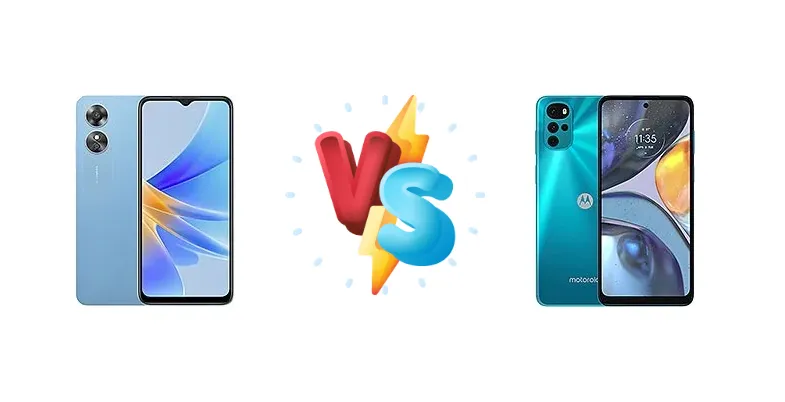
The Oppo A17 and Motorola Moto G22 represent the fiercely competitive sub-$150 smartphone market. Both devices aim to deliver essential smartphone functionality at an accessible price point, but they differ in key areas like charging capabilities and chipset variations. This comparison dissects these differences to determine which phone provides the best overall experience for budget-minded consumers.
🏆 Quick Verdict
For most users, the Motorola Moto G22 emerges as the slightly better choice. While both phones share the same core CPU architecture, the Moto G22’s inclusion of 20W (in India) or 15W charging significantly reduces downtime, a crucial advantage for users prioritizing convenience. The performance difference between the Helio G35 and G37 is minimal in everyday tasks.
| Network |
|---|
| 2G bands | GSM 850 / 900 / 1800 / 1900 | GSM 850 / 900 / 1800 / 1900 |
| 3G bands | HSDPA 850 / 900 / 2100 | HSDPA 850 / 900 / 1900 / 2100 |
| 4G bands | 1, 3, 5, 8, 38, 40, 41 | 1, 3, 5, 7, 8, 20, 38, 40, 41 |
| Speed | HSPA, LTE | HSPA 42.2/5.76 Mbps, LTE Cat4 150/50 Mbps |
| Technology | GSM / HSPA / LTE | GSM / HSPA / LTE |
| Launch |
|---|
| Announced | 2022, September 26 | 2022, March 04 |
| Status | Available. Released 2022, September 26 | Available. Released 2022, March 04 |
| Body |
|---|
| Build | - | Glass front, plastic frame, plastic back |
| Dimensions | 164.2 x 75.6 x 8.3 mm (6.46 x 2.98 x 0.33 in) | 164 x 75 x 8.5 mm (6.46 x 2.95 x 0.33 in) |
| SIM | Nano-SIM + Nano-SIM | · Nano-SIM· Nano-SIM + Nano-SIM |
| Weight | 189 g (6.67 oz) | 185 g (6.53 oz) |
| | IPX4 water resistance | Water-repellent design |
| Display |
|---|
| Resolution | 720 x 1612 pixels, 20:9 ratio (~269 ppi density) | 720 x 1600 pixels, 20:9 ratio (~268 ppi density) |
| Size | 6.56 inches, 103.4 cm2 (~83.3% screen-to-body ratio) | 6.5 inches, 103.5 cm2 (~84.2% screen-to-body ratio) |
| Type | IPS LCD | IPS LCD, 90Hz |
| Platform |
|---|
| CPU | Octa-core (4x2.3 GHz Cortex-A53 & 4x1.8 GHz Cortex-A53) | Octa-core (4x2.3 GHz Cortex-A53 & 4x1.8 GHz Cortex-A53) |
| Chipset | Mediatek MT6765 Helio G35 (12 nm) | Mediatek MT6765V/CB Helio G37 (12 nm) |
| GPU | PowerVR GE8320 | PowerVR GE8320 |
| OS | Android 12, ColorOS 12.1 | Android 12 |
| Memory |
|---|
| Card slot | microSDXC | microSDXC (dedicated slot) |
| Internal | 64GB 3GB RAM, 64GB 4GB RAM, 128GB 6GB RAM | 64GB 4GB RAM, 128GB 4GB RAM |
| | eMMC 5.1 | - |
| Main Camera |
|---|
| Dual | 50 MP, f/1.8, (wide), PDAF
Auxiliary lens | - |
| Features | LED flash, HDR, panorama | LED flash, HDR, panorama |
| Quad | - | 50 MP, f/1.8, (wide), 0.64µm, PDAF
8 MP, f/2.2, 118˚ (ultrawide), 1/4.0", 1.12µm
2 MP (macro)
Auxiliary lens |
| Single | 5 MP, f/2.2, (wide) | - |
| Video | 1080p@30fps | 1080p@30fps |
| Selfie camera |
|---|
| Features | HDR | HDR |
| Single | 5 MP, f/2.2, (wide) | 16 MP, f/2.5, (wide), 1.0µm |
| Video | Yes | 1080p@30fps |
| Sound |
|---|
| 3.5mm jack | Yes | Yes |
| 35mm jack | Yes | Yes |
| Loudspeaker | Yes | Yes |
| Comms |
|---|
| Bluetooth | Yes | 5.0, A2DP, LE |
| NFC | No | Yes (market/region dependent) |
| Positioning | GPS | GPS, GLONASS, GALILEO |
| Radio | FM radio | Unspecified |
| USB | microUSB 2.0 | USB Type-C 2.0 |
| WLAN | Wi-Fi 802.11 a/b/g/n/ac, dual-band | Wi-Fi 802.11 a/b/g/n/ac, dual-band, Wi-Fi Direct |
| Features |
|---|
| Sensors | Fingerprint (side-mounted), accelerometer, proximity | Fingerprint (side-mounted), accelerometer, gyro, proximity, compass |
| Battery |
|---|
| Charging | - | 20W wired (India)
15W wired (Global) |
| Type | Li-Po 5000 mAh | Li-Po 5000 mAh |
| Misc |
|---|
| Colors | Midnight Black, Lake Blue, Sunlight Orange | Pearl White, Iceberg Blue, Cosmic Black, Mint Green |
| Models | CPH2477 | XT2231-1, XT2231-2, XT2231-5 |
| Price | € 159.99 / $ 168.76 / ₹ 8,999 | About 120 EUR |
Oppo A17
- Potentially lower price point
- Simple and straightforward user experience
- Reliable MediaTek Helio G35 chipset for basic tasks
- Slow charging speeds
- Limited performance headroom for demanding apps
- Likely basic camera performance
Motorola Moto G22
- Faster charging (15W/20W)
- Slightly improved GPU performance with Helio G37
- Potentially better image processing speed
- May be slightly more expensive than the Oppo A17
- Still limited by the 12nm process and RAM capacity
- Camera quality dependent on sensor details (unspecified)
Display Comparison
Neither Oppo nor Motorola provide detailed display specifications beyond resolution. Given the price bracket, both likely utilize LCD panels. The absence of high refresh rates or advanced features like LTPO is expected. Bezels are likely to be substantial on both devices, impacting the overall screen-to-body ratio. Color accuracy will likely be standard for this segment, prioritizing power efficiency over color fidelity.
Camera Comparison
Camera details are sparse, but it’s safe to assume both phones feature a multi-camera setup with a primary sensor and supporting lenses. The focus should be on the main sensor’s megapixel count and aperture. The inclusion of 2MP macro or depth sensors on either device is largely marketing fluff and offers limited practical benefit. Image processing will likely prioritize scene optimization and basic HDR, rather than advanced computational photography features. Without specific sensor details, it’s difficult to definitively declare a winner, but the G37’s slightly improved GPU could contribute to faster image processing times.
Performance
Both the Oppo A17 and Motorola Moto G22 are powered by MediaTek’s Helio G35 and Helio G37 chipsets, respectively, both fabricated on a 12nm process. Critically, both CPUs share the same core configuration: an octa-core setup with four Cortex-A53 cores clocked at 2.3 GHz and another four at 1.8 GHz. The Helio G37 offers a slight GPU advantage, potentially translating to marginally better performance in less demanding games, but the difference will be negligible in typical usage scenarios. RAM configurations are not specified, but both will likely offer options around 3-4GB, which is sufficient for basic multitasking. Thermal management will be passive, relying on the phone’s chassis to dissipate heat, meaning sustained heavy workloads could lead to throttling.
Battery Life
Battery capacity is not specified for either device. However, the Motorola Moto G22’s charging capabilities are a significant differentiator. Offering 20W wired charging (in India) or 15W globally, the Moto G22 can replenish its battery much faster than the Oppo A17, which lacks fast charging support. This translates to less time tethered to a wall outlet and greater convenience for users on the go. Even with a similar battery capacity, the faster charging speed of the Moto G22 provides a tangible advantage.
Buying Guide
Buy the Oppo A17 if you prioritize a consistently lower price and are comfortable with slower charging speeds. It’s a solid option for users who primarily need a phone for basic communication and light social media use. Buy the Motorola Moto G22 if you value faster charging, even if it means spending a little more. This phone is better suited for users who actively use their phones throughout the day and need to quickly top up the battery.
Frequently Asked Questions
❓ Is the Helio G37 in the Moto G22 powerful enough for PUBG Mobile?
The Helio G37 can run PUBG Mobile, but expect to play at lower graphics settings (Balanced or Low) and frame rates to maintain a stable experience. The chipset isn't designed for demanding gaming, and prolonged sessions may result in noticeable throttling.
❓ Does the Motorola Moto G22 support reverse wireless charging?
No, neither the Oppo A17 nor the Motorola Moto G22 are expected to support reverse wireless charging. This feature is typically reserved for higher-end smartphones.
❓ What type of charging port do both phones use?
Both the Oppo A17 and Motorola Moto G22 utilize a USB-C port for charging and data transfer. This is standard for most modern smartphones.
❓ How much storage do these phones typically come with, and is it expandable?
Both phones typically offer 32GB or 64GB of internal storage. Crucially, both devices support microSD card expansion, allowing users to increase storage capacity for photos, videos, and other files.