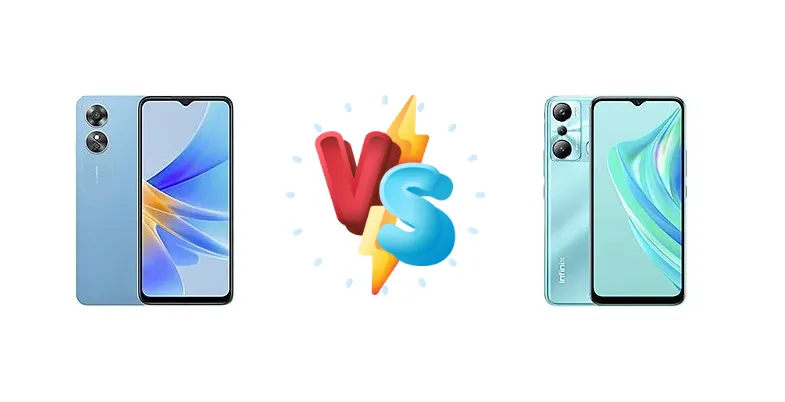
The Oppo A17 and Infinix Hot 20i represent the fiercely competitive sub-$150 smartphone market. Both aim to deliver essential smartphone functionality at an accessible price point, but they take different approaches to achieving this. The Oppo A17 focuses on a slightly more refined design, while the Infinix Hot 20i emphasizes features like reverse charging. This comparison dives deep into the specifications to determine which device offers the best value.
🏆 Quick Verdict
For most users, the Oppo A17 emerges as the slightly better choice. Its Helio G35 chipset, while not a powerhouse, offers a consistent performance edge over the potentially variable Helio G25/A22 configurations found in the Infinix Hot 20i. This translates to a smoother user experience, particularly with multitasking and moderately demanding apps.
| Network |
|---|
| 2G bands | GSM 850 / 900 / 1800 / 1900 | GSM 850 / 900 / 1800 / 1900 |
| 3G bands | HSDPA 850 / 900 / 2100 | HSDPA 900 / 2100 |
| 4G bands | 1, 3, 5, 8, 38, 40, 41 | 1, 3, 7, 8, 20 |
| Speed | HSPA, LTE | HSPA, LTE |
| Technology | GSM / HSPA / LTE | GSM / HSPA / LTE |
| Launch |
|---|
| Announced | 2022, September 26 | 2022, September 28 |
| Status | Available. Released 2022, September 26 | Available. Released 2022, September 28 |
| Body |
|---|
| Build | - | Glass front, plastic back, plastic frame |
| Dimensions | 164.2 x 75.6 x 8.3 mm (6.46 x 2.98 x 0.33 in) | 164.8 x 76.4 x 8.8 mm (6.49 x 3.01 x 0.35 in) |
| SIM | Nano-SIM + Nano-SIM | Nano-SIM + Nano-SIM |
| Weight | 189 g (6.67 oz) | 195 g (6.88 oz) |
| | IPX4 water resistance | - |
| Display |
|---|
| Resolution | 720 x 1612 pixels, 20:9 ratio (~269 ppi density) | 720 x 1612 pixels, 20:9 ratio (~267 ppi density) |
| Size | 6.56 inches, 103.4 cm2 (~83.3% screen-to-body ratio) | 6.6 inches, 104.6 cm2 (~83.1% screen-to-body ratio) |
| Type | IPS LCD | IPS LCD, 500 nits (peak) |
| Platform |
|---|
| CPU | Octa-core (4x2.3 GHz Cortex-A53 & 4x1.8 GHz Cortex-A53) | Octa-core (4x2.0 GHz Cortex-A53 & 4x1.5 GHz Cortex-A53) / Quad-core 2.0 GHz Cortex-A53 |
| Chipset | Mediatek MT6765 Helio G35 (12 nm) | Mediatek MT6762G Helio G25 (12 nm) / Mediatek MT6761 Helio A22 (12 nm) |
| GPU | PowerVR GE8320 | PowerVR GE8320 |
| OS | Android 12, ColorOS 12.1 | Android 12 or Android 12 (Go edition), XOS 10.6 |
| Memory |
|---|
| Card slot | microSDXC | microSDXC (dedicated slot) |
| Internal | 64GB 3GB RAM, 64GB 4GB RAM, 128GB 6GB RAM | 64GB 2GB RAM, 64GB 3GB RAM, 64GB 4GB RAM, 128GB 4GB RAM, 128GB 6GB RAM |
| | eMMC 5.1 | - |
| Main Camera |
|---|
| Dual | 50 MP, f/1.8, (wide), PDAF
Auxiliary lens | - |
| Features | LED flash, HDR, panorama | Dual-LED flash |
| Single | 5 MP, f/2.2, (wide) | 8 MP |
| Triple | - | 13 MP, f/1.8, (wide), AF
Auxiliary lenses |
| Video | 1080p@30fps | 1080p@30fps |
| Selfie camera |
|---|
| Features | HDR | LED flash |
| Single | 5 MP, f/2.2, (wide) | 8 MP |
| Video | Yes | 1080p@30fps |
| Sound |
|---|
| 3.5mm jack | Yes | Yes |
| 35mm jack | Yes | Yes |
| Loudspeaker | Yes | Yes |
| Comms |
|---|
| Bluetooth | Yes | Yes |
| NFC | No | No |
| Positioning | GPS | GPS |
| Radio | FM radio | FM radio |
| USB | microUSB 2.0 | microUSB 2.0, OTG |
| WLAN | Wi-Fi 802.11 a/b/g/n/ac, dual-band | Wi-Fi 802.11 a/b/g/n/ac, dual-band |
| Features |
|---|
| Sensors | Fingerprint (side-mounted), accelerometer, proximity | Fingerprint (rear-mounted), accelerometer, proximity |
| Battery |
|---|
| Charging | - | 10W wired
5W reverse wired |
| Type | Li-Po 5000 mAh | Li-Ion 5000 mAh |
| Misc |
|---|
| Colors | Midnight Black, Lake Blue, Sunlight Orange | Wilderness Black, Luna Blue, Energy Green, Sunset Gold |
| Models | CPH2477 | X665C, X665E |
| Price | € 159.99 / $ 168.76 / ₹ 8,999 | About 120 EUR |
Oppo A17
- Potentially better performance with Helio G35
- More consistent chipset configuration
- Likely more refined software experience
- Charging speed not specified
- Camera specs unknown
Infinix Hot 20i
- Reverse wired charging capability
- Potentially lower price point
- Availability of multiple chipset options
- Inconsistent performance due to chipset variations (G25/A22)
- Helio A22 configuration is significantly underpowered
- 10W charging is relatively slow
Display Comparison
Neither device boasts a standout display. Both are likely utilizing LCD panels, typical for this price bracket. Detailed display specs (resolution, brightness) are missing, but the focus here is on processing power, not visual fidelity. Bezels are expected to be noticeable on both, and color accuracy will likely be standard for budget phones. The absence of high refresh rates or advanced panel technologies like LTPO is expected.
Camera Comparison
Camera performance will be similar on both devices, leaning towards basic functionality. Both are likely to feature a primary camera alongside depth and potentially macro sensors. The Oppo A17’s camera specs are unknown, but the Infinix Hot 20i’s likely includes a standard configuration with a main sensor and auxiliary lenses. Image processing will be basic, and low-light performance will be limited. The inclusion of a 2MP macro camera on either device is largely a marketing tactic, offering minimal practical benefit due to the low resolution and lack of optical image stabilization (OIS).
Performance
The core difference lies in the chipsets. The Oppo A17’s Mediatek Helio G35 (12nm) features an octa-core CPU with a 2.3 GHz peak clock speed on its Cortex-A53 cores. The Infinix Hot 20i is more complex, potentially shipping with either the Helio G25 (12nm) or the Helio A22 (12nm). The G25 has an octa-core CPU peaking at 2.0 GHz, while the A22 is a quad-core 2.0 GHz processor. The G35’s higher clock speed and additional cores provide a tangible advantage in multi-tasking and app responsiveness. The potential for the Hot 20i to ship with the significantly less powerful A22 is a major concern for performance-sensitive users. RAM configurations are not specified, but LPDDR4X is the likely standard, limiting memory bandwidth.
Battery Life
Battery capacity is not specified for either device, but both likely house around a 5000mAh battery, standard for this segment. The Infinix Hot 20i distinguishes itself with 10W wired charging and 5W reverse wired charging. This reverse charging capability allows the Hot 20i to act as a power bank for other devices, a unique feature in this price range. The Oppo A17’s charging speed is not specified, but is likely to be 10W as well. Real-world battery life will depend heavily on usage patterns, but both should comfortably last a full day with moderate use.
Buying Guide
Buy the Oppo A17 if you prioritize consistent performance and a slightly more polished software experience. It's ideal for users who primarily need a reliable device for calls, messaging, social media, and light web browsing. Buy the Infinix Hot 20i if reverse charging is a must-have feature for you, or if you find a significantly lower price point that outweighs the performance difference. It's a good option for users who frequently need to top up other devices on the go.
Frequently Asked Questions
❓ What chipset will I actually get in the Infinix Hot 20i – the G25 or the A22?
This is a significant concern. The Infinix Hot 20i is sold with either the Helio G25 or the Helio A22, and the specific version can vary by region and retailer. The A22 is considerably less powerful, so confirming the chipset before purchase is crucial. Look for this information in the product description or contact the seller directly.
❓ Is the reverse charging on the Infinix Hot 20i useful for more than just emergencies?
While 5W reverse charging isn't fast, it's surprisingly useful for topping up accessories like Bluetooth earbuds, smartwatches, or even a friend's phone in a pinch. It won't fully charge a device quickly, but it can provide a significant boost when an outlet isn't available.
❓ Will either of these phones struggle with popular apps like WhatsApp, Facebook, and YouTube?
Both phones should handle basic usage of apps like WhatsApp, Facebook, and YouTube without major issues. However, the Oppo A17 with its Helio G35 will likely offer a smoother experience, especially when multitasking or running these apps alongside others. The Infinix Hot 20i with the Helio A22 may exhibit noticeable lag.