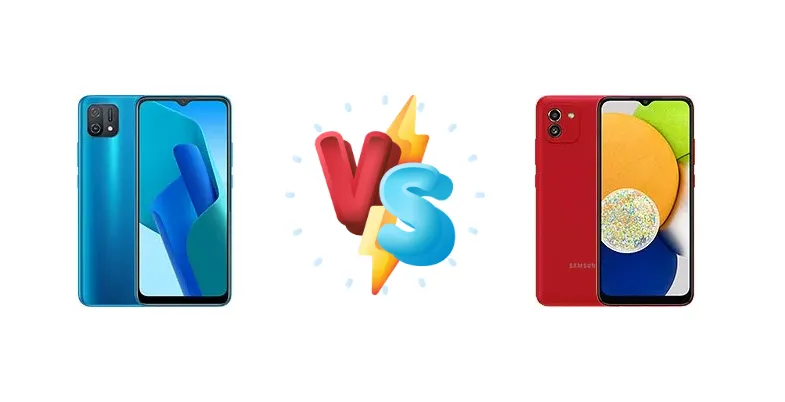
The Oppo A16K and Samsung Galaxy A03 represent the very bottom of the smartphone price spectrum. Both aim to deliver essential functionality at an incredibly affordable price point, but they achieve this with different chipsets and design philosophies. This comparison dissects their key differences to help you determine which device best suits your needs.
🏆 Quick Verdict
For the average user prioritizing basic tasks and occasional social media, the Samsung Galaxy A03 edges out the Oppo A16K. The Unisoc T606’s Cortex-A75 cores provide a noticeable performance boost in everyday use, making the A03 feel more responsive despite both phones sharing similar price tags.
| Network |
|---|
| 2G bands | GSM 850 / 900 / 1800 / 1900 | GSM 850 / 900 / 1800 / 1900 |
| 3G bands | HSDPA 850 / 900 / 2100 | HSDPA 850 / 900 / 2100 |
| 4G bands | 1, 3, 5, 7, 8, 20, 28, 38, 40, 41 | 1, 3, 5, 7, 8, 20, 28, 38, 40, 41 |
| Speed | HSPA, LTE | HSPA 42.2/5.76 Mbps, LTE Cat4 150/50 Mbps |
| Technology | GSM / HSPA / LTE | GSM / HSPA / LTE |
| Launch |
|---|
| Announced | 2021, November 08 | 2021, November 26 |
| Status | Available. Released 2021, November 08 | Available. Released 2022, January 21 |
| Body |
|---|
| Build | Glass front, plastic back, plastic frame | Glass front, plastic back, plastic frame |
| Dimensions | 164 x 75.4 x 7.9 mm (6.46 x 2.97 x 0.31 in) | 164.2 x 75.9 x 9.1 mm (6.46 x 2.99 x 0.36 in) |
| SIM | Nano-SIM + Nano-SIM | · Nano-SIM· Nano-SIM + Nano-SIM |
| Weight | 175 g (6.17 oz) | 196 g (6.91 oz) |
| Display |
|---|
| Protection | Corning Gorilla Glass 3 | - |
| Resolution | 720 x 1600 pixels, 20:9 ratio (~269 ppi density) | 720 x 1600 pixels, 20:9 ratio (~270 ppi density) |
| Size | 6.52 inches, 102.6 cm2 (~83.0% screen-to-body ratio) | 6.5 inches, 102.0 cm2 (~81.8% screen-to-body ratio) |
| Type | IPS LCD, 480 nits (typ) | PLS LCD |
| Platform |
|---|
| CPU | Octa-core (4x2.3 GHz Cortex-A53 & 4x1.8 GHz Cortex-A53) | Octa-core (2x1.6 GHz Cortex-A75 & 6x1.6 GHz Cortex-A55) |
| Chipset | Mediatek MT6765G Helio G35 (12 nm) | Unisoc T606 (12 nm) |
| GPU | PowerVR GE8320 | Mali-G57 MP1 |
| OS | Android 11, ColorOS 11.1 | Android 11, upgradable to Android 13, One UI core 5 |
| Memory |
|---|
| Card slot | microSDXC | microSDXC (dedicated slot) |
| Internal | 32GB 2GB RAM, 32GB 3GB RAM, 64GB 4GB RAM, 128GB 8GB RAM | 32GB 2GB RAM, 32GB 3GB RAM, 32GB 4GB RAM, 64GB 4GB RAM, 64GB 3GB RAM, 128GB 4GB RAM |
| | eMMC 5.1 | eMMC 5.1 |
| Main Camera |
|---|
| Dual | - | 48 MP, f/1.8, (wide), AF
Auxiliary lens |
| Features | LED flash, HDR, panorama | LED flash |
| Single | 13 MP, f/2.2, 26mm (wide), 1/3.1", 1.12µm, PDAF | 5 MP, f/2.2 |
| Video | 1080p@30fps | 1080p@30fps |
| Selfie camera |
|---|
| Features | HDR | - |
| Single | 5 MP, f/2.4, 27mm (wide) | 5 MP, f/2.2 |
| Video | 1080p@30fps | Yes |
| Sound |
|---|
| 3.5mm jack | Yes | Yes |
| 35mm jack | Yes | Yes |
| Loudspeaker | Yes | Yes |
| Comms |
|---|
| Bluetooth | 5.0, A2DP, LE, aptX | 5.0, A2DP, LE |
| NFC | No | No |
| Positioning | GPS, GLONASS, GALILEO, BDS | GPS |
| Radio | Unspecified | Unspecified |
| USB | microUSB 2.0, OTG | microUSB 2.0 |
| WLAN | Wi-Fi 802.11 a/b/g/n/ac, dual-band, Wi-Fi Direct | Wi-Fi 802.11 a/b/g/n/ac, dual-band, Wi-Fi Direct |
| Features |
|---|
| Sensors | Accelerometer, proximity, compass | Accelerometer, proximity |
| Battery |
|---|
| Charging | 10W wired | - |
| Type | Li-Po 4230 mAh | Li-Po 5000 mAh |
| Misc |
|---|
| Colors | Black, Blue | Black, Blue, Red |
| Models | CPH2349 | SM-A035F, SM-A035F/DS, SM-A035M, SM-A035G |
| Price | About 550 EUR | € 119.90 / £ 88.00 / ₹ 11,990 |
| SAR EU | - | 0.20 W/kg (head) 1.35 W/kg (body) |
Oppo A16K
- Potentially better sustained performance for long gaming sessions (though limited by GPU)
- Simpler software experience (typical of Oppo)
- Likely a slightly lower price point
- Older CPU architecture (Cortex-A53)
- Slower app loading times compared to the A03
- Less responsive user interface
Samsung Galaxy A03
- More modern CPU architecture (Cortex-A75)
- Snappier app launches and multitasking
- More responsive user interface
- Potentially shorter peak performance durations
- Samsung’s One UI can be resource-intensive
- May be slightly more expensive
Display Comparison
Neither the Oppo A16K nor the Samsung Galaxy A03 are display champions. Both likely utilize LCD panels, typical for this price bracket. Detailed display specs (resolution, brightness) are missing, but the focus here is on performance. The absence of high refresh rates or advanced panel technologies like LTPO is expected. Bezels are likely substantial on both devices, maximizing screen real estate within a compact form factor.
Camera Comparison
Camera performance is likely to be similar on both devices, with both likely featuring a primary sensor and a depth sensor. Given the price point, image quality will be heavily reliant on software processing. The absence of Optical Image Stabilization (OIS) is a given. The focus should be on the primary sensor resolution, which is not specified in the provided data. Any 2MP macro or depth sensors are unlikely to deliver significant value. Image processing style will likely differ between Oppo and Samsung, potentially influencing color accuracy and dynamic range.
Performance
The core difference lies in the chipsets. The Oppo A16K’s Mediatek Helio G35 features four Cortex-A53 cores clocked at 2.3 GHz and another four at 1.8 GHz. This configuration prioritizes sustained performance, meaning it can maintain a consistent level of processing power for longer periods. However, the Samsung Galaxy A03’s Unisoc T606 employs a more modern architecture with two Cortex-A75 cores at 1.6 GHz and six Cortex-A55 cores, also at 1.6 GHz. The A75 cores offer significantly higher single-core performance, resulting in snappier app launches and a more fluid user experience. While the G35 has a higher clock speed on some cores, the architectural advantage of the T606 is more impactful for daily tasks. Both are built on a 12nm process, suggesting similar power efficiency.
Battery Life
Both devices feature 10W wired charging, indicating similar charging speeds. The actual battery capacity is not provided, but given the target market, both are likely in the 4000-5000 mAh range. The Helio G35’s potentially better sustained performance might translate to slightly longer video playback times, but the Unisoc T606’s more efficient architecture could offset this in typical usage scenarios. Expect a full charge to take well over two hours with the included chargers.
Buying Guide
Buy the Oppo A16K if you prioritize a slightly simpler software experience and are comfortable with a chipset geared towards sustained, albeit lower, performance. Buy the Samsung Galaxy A03 if you value quicker app loading times and a more modern CPU architecture for smoother multitasking and a more responsive user interface, even if it means potentially shorter peak performance durations.
Frequently Asked Questions
❓ Will the Unisoc T606 in the Galaxy A03 struggle with demanding games like PUBG Mobile?
While the Unisoc T606 is a capable chip for basic gaming, PUBG Mobile will likely require low graphics settings and potentially frame rate limitations for a smooth experience. The Helio G35 in the A16K will face similar constraints, but the A03’s CPU may provide slightly better frame rate stability.
❓ Is the 10W charging on either phone fast enough for daily use?
10W charging is quite slow by modern standards. Expect a full charge to take over two hours. Neither phone is designed for quick top-ups; overnight charging is recommended. The battery life itself will be more important than charging speed for these devices.
❓ How much storage do these phones typically come with, and can it be expanded?
These phones typically ship with 32GB or 64GB of internal storage. Both the Oppo A16K and Samsung Galaxy A03 almost certainly feature a dedicated microSD card slot for storage expansion, allowing you to add up to 1TB of additional storage.
❓ Which phone is likely to receive more software updates?
Samsung generally provides longer software support for its devices, even at the entry-level. While neither phone is guaranteed frequent updates, the Galaxy A03 is more likely to receive at least one major Android version update and security patches for a longer period than the Oppo A16K.