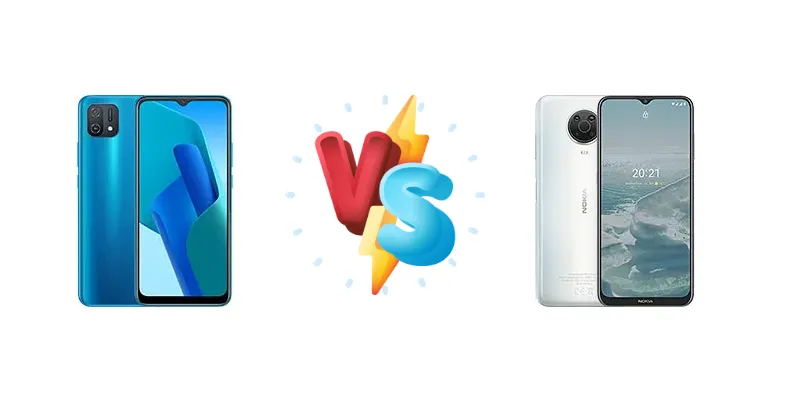
The Oppo A16K and Nokia G20 occupy a similar price bracket, targeting first-time smartphone buyers or those seeking a reliable secondary device. Both rely on the Mediatek Helio G35 chipset, making a direct hardware comparison less impactful. This review focuses on how software, brand philosophy, and subtle design choices differentiate these two contenders.
🏆 Quick Verdict
For the average user prioritizing a clean Android experience and potential for longer software support, the Nokia G20 is the better choice. While both phones offer identical core performance due to the Helio G35, Nokia’s commitment to updates and streamlined software gives it an edge.
| Network |
|---|
| 2G bands | GSM 850 / 900 / 1800 / 1900 | GSM 850 / 900 / 1800 / 1900 |
| 3G bands | HSDPA 850 / 900 / 2100 | HSDPA 850 / 900 / 1900 / 2100 - International |
| 4G bands | 1, 3, 5, 7, 8, 20, 28, 38, 40, 41 | 1, 3, 5, 7, 8, 20, 28, 38, 40, 41 - International |
| Speed | HSPA, LTE | HSPA 42.2/5.76 Mbps, LTE Cat4 150/50 Mbps |
| Technology | GSM / HSPA / LTE | GSM / HSPA / LTE |
| | - | 1, 2, 3, 4, 5, 7, 8, 12, 17, 28, 66 - LATAM |
| Launch |
|---|
| Announced | 2021, November 08 | 2021, April 08 |
| Status | Available. Released 2021, November 08 | Available. Released 2021, May 17 |
| Body |
|---|
| Build | Glass front, plastic back, plastic frame | - |
| Dimensions | 164 x 75.4 x 7.9 mm (6.46 x 2.97 x 0.31 in) | 164.9 x 76 x 9.2 mm (6.49 x 2.99 x 0.36 in) |
| SIM | Nano-SIM + Nano-SIM | · Nano-SIM· Nano-SIM + Nano-SIM |
| Weight | 175 g (6.17 oz) | 197 g (6.95 oz) |
| | - | Splash protection |
| Display |
|---|
| Protection | Corning Gorilla Glass 3 | - |
| Resolution | 720 x 1600 pixels, 20:9 ratio (~269 ppi density) | 720 x 1600 pixels, 20:9 ratio (~269 ppi density) |
| Size | 6.52 inches, 102.6 cm2 (~83.0% screen-to-body ratio) | 6.52 inches, 102.6 cm2 (~81.9% screen-to-body ratio) |
| Type | IPS LCD, 480 nits (typ) | IPS LCD |
| Platform |
|---|
| CPU | Octa-core (4x2.3 GHz Cortex-A53 & 4x1.8 GHz Cortex-A53) | Octa-core (4x2.3 GHz Cortex-A53 & 4x1.8 GHz Cortex-A53) |
| Chipset | Mediatek MT6765G Helio G35 (12 nm) | Mediatek MT6765G Helio G35 (12 nm) |
| GPU | PowerVR GE8320 | PowerVR GE8320 |
| OS | Android 11, ColorOS 11.1 | Android 11, upgradable to Android 13 |
| Memory |
|---|
| Card slot | microSDXC | microSDXC (dedicated slot) |
| Internal | 32GB 2GB RAM, 32GB 3GB RAM, 64GB 4GB RAM, 128GB 8GB RAM | 64GB 4GB RAM, 128GB 4GB RAM |
| | eMMC 5.1 | - |
| Main Camera |
|---|
| Features | LED flash, HDR, panorama | LED flash, HDR, panorama |
| Quad | - | 48 MP, f/1.8, (wide), PDAF
5 MP, (ultrawide)
2 MP (macro)
Auxiliary lens |
| Single | 13 MP, f/2.2, 26mm (wide), 1/3.1", 1.12µm, PDAF | 8 MP, (wide) |
| Video | 1080p@30fps | 1080p@30fps |
| Selfie camera |
|---|
| Features | HDR | - |
| Single | 5 MP, f/2.4, 27mm (wide) | 8 MP, (wide) |
| Video | 1080p@30fps | 1080p@30fps |
| Sound |
|---|
| 3.5mm jack | Yes | Yes |
| 35mm jack | Yes | Yes |
| Loudspeaker | Yes | Yes |
| Comms |
|---|
| Bluetooth | 5.0, A2DP, LE, aptX | 5.0, A2DP, LE |
| NFC | No | Yes (market/region dependent) |
| Positioning | GPS, GLONASS, GALILEO, BDS | GPS, GLONASS, BDS |
| Radio | Unspecified | FM radio |
| USB | microUSB 2.0, OTG | USB Type-C 2.0, OTG |
| WLAN | Wi-Fi 802.11 a/b/g/n/ac, dual-band, Wi-Fi Direct | Wi-Fi 802.11 b/g/n |
| Features |
|---|
| Sensors | Accelerometer, proximity, compass | Fingerprint (side-mounted), accelerometer, gyro, proximity |
| Battery |
|---|
| Charging | 10W wired | 10W wired |
| Type | Li-Po 4230 mAh | Li-Po 5050 mAh |
| Misc |
|---|
| Colors | Black, Blue | Glacier, Night |
| Models | CPH2349 | TA-1336, TA-1343, TA-1347, TA-1372, TA-1365 |
| Price | About 550 EUR | About 90 EUR |
| SAR | - | 1.01 W/kg (head) 1.02 W/kg (body) |
| SAR EU | - | 0.49 W/kg (head) 1.13 W/kg (body) |
Oppo A16K
- Potentially more aggressive price point.
- Oppo’s ColorOS offers customization options.
- May include bundled accessories.
- ColorOS can be resource-intensive.
- Less certain long-term software support.
- Potential for bloatware.
Nokia G20
- Clean Android One experience.
- Guaranteed software updates and security patches.
- Nokia’s reputation for build quality.
- May be slightly more expensive.
- Android One offers less customization.
- 10W charging is slow.
Display Comparison
Both the Oppo A16K and Nokia G20 lack detailed display specifications in the provided data. However, given their price point, it’s safe to assume both utilize LCD panels. The user experience will likely be similar, with neither offering exceptional brightness or color accuracy. The focus here will be on software optimizations for color calibration, which Nokia’s Android One implementation may handle more effectively. Bezels are likely to be substantial on both devices, reflecting their budget nature.
Camera Comparison
Camera details are sparse. Both phones likely feature a multi-camera setup, but the provided data doesn’t specify sensor sizes or lens apertures. It’s reasonable to assume both include a primary camera and potentially depth or macro sensors. Given the target market, image quality will be adequate for casual snapshots but won’t compete with higher-end smartphones. The image processing algorithms will be a key differentiator; Nokia’s typically aims for natural-looking images, while Oppo often employs more vibrant, saturated processing.
Performance
The core performance is identical: both devices are powered by the Mediatek MT6765G Helio G35, featuring an octa-core CPU configuration with 4x2.3 GHz Cortex-A53 and 4x1.8 GHz Cortex-A53 cores. This chipset is geared towards basic tasks and light multitasking. Neither phone will excel at demanding games or resource-intensive applications. The real-world difference will hinge on RAM management and software optimization. Nokia’s Android One promises a cleaner experience, potentially leading to smoother performance with the same hardware. Thermal management is unlikely to be a concern given the low-power nature of the Helio G35.
Battery Life
Both the Oppo A16K and Nokia G20 utilize 10W wired charging. This is a slow charging standard by today’s standards, meaning a full charge will take several hours. Battery capacity isn’t specified, but given the focus on affordability, both likely feature batteries in the 4000-5000 mAh range. The Nokia G20’s software optimizations and potentially more efficient power management could translate to slightly longer real-world battery life, offsetting any minor capacity differences.
Buying Guide
Buy the Oppo A16K if you need a phone primarily for basic communication – calls, texts, and light social media – and value a potentially more streamlined, though less frequently updated, software experience. Buy the Nokia G20 if you prefer a cleaner Android One interface, anticipate needing longer-term software support (including security patches), and appreciate Nokia’s reputation for durability.
Frequently Asked Questions
❓ Given both phones have the same Helio G35 chip, will I notice a difference in app loading times?
While the chipset is identical, Nokia’s Android One software is less bloated and more efficiently optimized. This means you’ll likely experience slightly faster app loading times and smoother multitasking on the Nokia G20, despite the same underlying hardware.
❓ How long will it take to fully charge both phones with the 10W charger?
Expect a full charge to take approximately 3-4 hours with the included 10W chargers. This is a relatively slow charging speed, so it’s best to charge overnight. Neither phone supports faster charging standards.
❓ Which phone is more likely to receive Android updates in the future?
The Nokia G20 is the clear winner here. Nokia guarantees at least 2 years of Android OS upgrades and 3 years of security patches with its Android One program. Oppo’s update schedule for the A16K is less predictable and may be limited to security updates.
❓ Is the camera quality on either phone good enough for casual social media posting?
Yes, both phones will be adequate for casual social media photos in good lighting conditions. However, don’t expect exceptional image quality, especially in low light. The image processing style will differ – Oppo tends towards more vibrant colors, while Nokia aims for a more natural look.