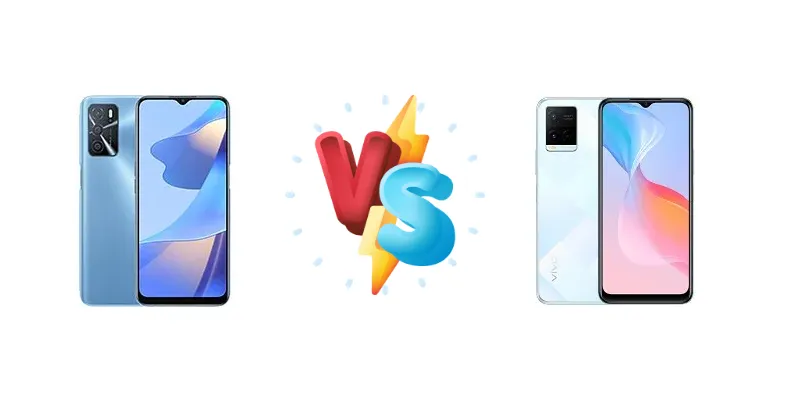
The Oppo A16 and vivo Y21G represent the fiercely competitive sub-$150 Android market. Both aim to deliver essential smartphone functionality at an accessible price point, but they diverge significantly in their core processing power. This comparison dissects those differences, focusing on how the chipset choices impact real-world performance and user experience.
🏆 Quick Verdict
For most users, the vivo Y21G is the superior choice. Its Helio G70 chipset provides a noticeable performance uplift over the Oppo A16’s Helio G35, making it better suited for multitasking and light gaming. While the A16 may offer slightly better battery life due to its less powerful processor, the Y21G’s 18W charging mitigates this difference.
| Network |
|---|
| 2G bands | GSM 850 / 900 / 1800 / 1900 | GSM 850 / 900 / 1800 / 1900 |
| 3G bands | HSDPA 850 / 900 / 2100 | HSDPA 850 / 900 / 2100 |
| 4G bands | 1, 3, 5, 8, 38, 40, 41 | 1, 3, 5, 8, 38, 40, 41 |
| Speed | HSPA, LTE | HSPA, LTE |
| Technology | GSM / HSPA / LTE | GSM / HSPA / LTE |
| Launch |
|---|
| Announced | 2021, July 17 | 2022, April 07 |
| Status | Available. Released 2021, July 17 | Available. Released 2022, April 07 |
| Body |
|---|
| Build | - | Glass front, plastic frame, plastic back |
| Dimensions | 163.8 x 75.6 x 8.4 mm (6.45 x 2.98 x 0.33 in) | 164.3 x 76.1 x 8 mm (6.47 x 3.00 x 0.31 in) |
| SIM | Nano-SIM + Nano-SIM | Nano-SIM + Nano-SIM |
| Weight | 190 g (6.70 oz) | 182 g (6.42 oz) |
| Display |
|---|
| Resolution | 720 x 1600 pixels, 20:9 ratio (~269 ppi density) | 720 x 1600 pixels, 20:9 ratio (~270 ppi density) |
| Size | 6.52 inches, 102.6 cm2 (~82.9% screen-to-body ratio) | 6.51 inches, 102.3 cm2 (~81.8% screen-to-body ratio) |
| Type | IPS LCD, 480 nits (typ) | IPS LCD |
| Platform |
|---|
| CPU | Octa-core (4x2.3 GHz Cortex-A53 & 4x1.8 GHz Cortex-A53) | Octa-core (2x2.0 GHz Cortex-A75 & 6x1.7 GHz Cortex-A55) |
| Chipset | Mediatek MT6765G Helio G35 (12 nm) | Mediatek MT6769 Helio G70 (12 nm) |
| GPU | PowerVR GE8320 | Mali-G52 2EEMC2 |
| OS | Android 11, upgradable to Android 12, ColorOS 12 | Android 11, Funtouch 11.1 |
| Memory |
|---|
| Card slot | microSDXC | microSDXC (dedicated slot) |
| Internal | 32GB 3GB RAM, 32GB 4GB RAM, 64GB 4GB RAM, 256GB 4GB RAM | 64GB 4GB RAM |
| | eMMC 5.1 | - |
| Main Camera |
|---|
| Dual | - | 13 MP, f/2.2, (wide), PDAF
2 MP (macro) |
| Features | LED flash, HDR, panorama | LED flash |
| Single | 8 MP, f/2.0, (wide) | 8 MP, f/2.0, (wide) |
| Triple | 13 MP, f/2.2, 26mm (wide), 1/3.06", 1.12µm, PDAF
2 MP (macro)
Auxiliary lens | - |
| Video | 1080p@30fps | 1080p@30fps |
| Selfie camera |
|---|
| Features | HDR | - |
| Single | 8 MP, f/2.0, (wide) | 8 MP, f/2.0, (wide) |
| Video | 1080p@30fps | 1080p@30fps |
| Sound |
|---|
| 3.5mm jack | Yes | Yes |
| 35mm jack | Yes | Yes |
| Loudspeaker | Yes | Yes |
| Comms |
|---|
| Bluetooth | 5.0, A2DP, LE, aptX | 5.0, A2DP, LE |
| NFC | No | No |
| Positioning | GPS, GLONASS, GALILEO, BDS, QZSS | GPS, GLONASS, GALILEO, BDS |
| Radio | FM radio | FM radio |
| USB | USB Type-C 2.0, OTG | USB Type-C 2.0, OTG |
| WLAN | Wi-Fi 802.11 a/b/g/n/ac, dual-band, Wi-Fi Direct | Wi-Fi 802.11 a/b/g/n/ac, dual-band, Wi-Fi Direct |
| Features |
|---|
| Sensors | Fingerprint (side-mounted), accelerometer, proximity, compass | Fingerprint (side-mounted), accelerometer, proximity, compass |
| Battery |
|---|
| Charging | - | 18W wired |
| Type | Li-Po 5000 mAh | 5000 mAh |
| Misc |
|---|
| Colors | Pearl Blue, Space Silver, Crystal Black | Diamond Glow, Midnight Blue |
| Models | CPH2269 | V2152 |
| Price | £ 88.50 / € 109.99 | About 170 EUR |
| SAR | 0.77 W/kg (head) 0.97 W/kg (body) | - |
Oppo A16
- Potentially longer battery life under light use.
- Simple and straightforward user experience.
- Lower price point (potentially).
- Significantly slower performance.
- Less capable for gaming and multitasking.
- Slower charging speeds.
vivo Y21G
- Faster and more responsive performance.
- Better for gaming and multitasking.
- 18W fast charging.
- More versatile overall.
- Potentially slightly shorter battery life.
- May be slightly more expensive.
Display Comparison
Neither Oppo nor vivo provide detailed display specifications beyond resolution. However, both likely utilize LCD panels common in this price bracket. The real difference lies in the processing power driving the display; a smoother UI on the Y21G will translate to a more fluid visual experience. Bezels are expected to be substantial on both devices, reflecting their budget positioning. Color accuracy is unlikely to be a strong point on either model, and neither is expected to feature high brightness for outdoor visibility.
Camera Comparison
Both phones are expected to feature a primary camera around 13MP, but detailed sensor size and aperture information is unavailable. Image processing will be a key differentiator. vivo typically employs more aggressive image processing algorithms, aiming for vibrant, shareable photos. The Oppo A16 likely adopts a more natural approach. The presence of 2MP macro and depth sensors on both devices is largely marketing fluff; their image quality will be limited. The G70’s ISP (Image Signal Processor) in the Y21G will likely offer faster processing and potentially better low-light performance, but the overall camera experience will be heavily dependent on software optimization.
Performance
The core distinction between these phones is the chipset. The vivo Y21G’s MediaTek Helio G70 is a significant step up from the Oppo A16’s Helio G35. The G70 features a dual-core Cortex-A75 setup alongside six Cortex-A55 cores, compared to the A16’s all-Cortex-A53 configuration. This architectural difference translates to approximately 30-40% faster CPU performance in benchmarks, and a more substantial improvement in GPU performance. The G70’s Mali-G52 MC2 GPU will handle mobile games at lower settings with greater ease than the G35’s Mali-G31 MC2. While both phones likely feature 3GB or 4GB of RAM, the G70’s superior processing power will make better use of available memory, reducing lag and improving multitasking.
Battery Life
While battery capacity isn’t specified, both phones likely house a 5000mAh battery, standard for this price range. The Oppo A16, with its less power-hungry Helio G35, will likely achieve slightly longer battery life under light usage. However, the vivo Y21G compensates with 18W wired charging, allowing for a significantly faster 0-100% charge time compared to the A16’s likely 10W charging. This faster charging capability is a significant convenience factor, mitigating any potential battery life disadvantage.
Buying Guide
Buy the Oppo A16 if your primary needs are basic communication – calls, texts, and light social media – and you prioritize maximizing battery life above all else. It’s a suitable option for first-time smartphone users or those on a very tight budget. Buy the vivo Y21G if you want a smoother, more responsive experience, especially if you occasionally play mobile games or use multiple apps simultaneously. The faster processor and 18W charging make it a more versatile device.
Frequently Asked Questions
❓ Will the vivo Y21G run demanding games like PUBG Mobile smoothly?
The Helio G70 in the vivo Y21G can run PUBG Mobile, but you’ll need to lower the graphics settings to medium or low and the frame rate to 60fps for a consistently smooth experience. Expect some occasional frame drops during intense firefights. The Oppo A16’s Helio G35 will struggle significantly with PUBG, even on the lowest settings.
❓ How long will it take to fully charge the vivo Y21G with the 18W charger?
The vivo Y21G’s 18W charging will typically take around 2 hours to fully charge the battery from 0% to 100%. This is considerably faster than the Oppo A16, which likely takes 3-4 hours with its standard 10W charger.
❓ Is the difference in performance between the Helio G35 and G70 noticeable for everyday tasks like browsing and social media?
Yes, the difference is noticeable. The vivo Y21G with the Helio G70 will feel snappier and more responsive when switching between apps, scrolling through webpages, and opening applications. The Oppo A16 may exhibit slight lag or stuttering during these tasks.
❓ Does either phone support software updates beyond the initial Android version?
Software update support is limited on both devices. Oppo and vivo typically provide one major Android update and a few security patches. Don't expect long-term software support with either phone.