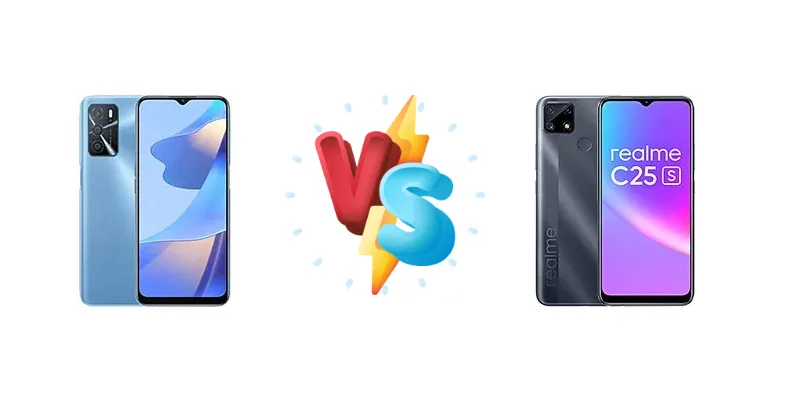
The Oppo A16 and Realme C25s represent the fiercely competitive sub-$150 smartphone market. Both aim to deliver essential features at an accessible price, but they diverge significantly in their core processing power. This comparison dissects the key differences, focusing on how the chipset choices impact real-world performance and user experience.
🏆 Quick Verdict
For most users, the Realme C25s is the superior choice. Its Helio G85 chipset, featuring more powerful Cortex-A75 cores, provides a noticeable performance boost over the Oppo A16’s Helio G35, making it better suited for gaming and multitasking. While the A16 may offer slightly better battery life due to its less powerful processor, the C25s’ 18W charging mitigates this difference.
| Network |
|---|
| 2G bands | GSM 850 / 900 / 1800 / 1900 | GSM 850 / 900 / 1800 / 1900 |
| 3G bands | HSDPA 850 / 900 / 2100 | HSDPA 850 / 900 / 2100 |
| 4G bands | 1, 3, 5, 8, 38, 40, 41 | 1, 3, 5, 7, 8, 20, 28, 38, 40, 41 |
| Speed | HSPA, LTE | HSPA, LTE |
| Technology | GSM / HSPA / LTE | GSM / HSPA / LTE |
| Launch |
|---|
| Announced | 2021, July 17 | 2021, June 08 |
| Status | Available. Released 2021, July 17 | Available. Released 2021, June 09 |
| Body |
|---|
| Build | - | Glass front, plastic back, plastic frame |
| Dimensions | 163.8 x 75.6 x 8.4 mm (6.45 x 2.98 x 0.33 in) | 164.5 x 75.9 x 9.6 mm (6.48 x 2.99 x 0.38 in) |
| SIM | Nano-SIM + Nano-SIM | Nano-SIM + Nano-SIM |
| Weight | 190 g (6.70 oz) | 209 g (7.37 oz) |
| Display |
|---|
| Resolution | 720 x 1600 pixels, 20:9 ratio (~269 ppi density) | 720 x 1600 pixels, 20:9 ratio (~270 ppi density) |
| Size | 6.52 inches, 102.6 cm2 (~82.9% screen-to-body ratio) | 6.5 inches, 102.0 cm2 (~81.7% screen-to-body ratio) |
| Type | IPS LCD, 480 nits (typ) | IPS LCD, 480 nits (typ), 570 nits (peak) |
| Platform |
|---|
| CPU | Octa-core (4x2.3 GHz Cortex-A53 & 4x1.8 GHz Cortex-A53) | Octa-core (2x2.0 GHz Cortex-A75 & 6x1.8 GHz Cortex-A55) |
| Chipset | Mediatek MT6765G Helio G35 (12 nm) | Mediatek MT6769Z Helio G85 (12 nm) |
| GPU | PowerVR GE8320 | Mali-G52 MC2 |
| OS | Android 11, upgradable to Android 12, ColorOS 12 | Android 11, Realme UI 2.0 |
| Memory |
|---|
| Card slot | microSDXC | microSDXC (dedicated slot) |
| Internal | 32GB 3GB RAM, 32GB 4GB RAM, 64GB 4GB RAM, 256GB 4GB RAM | 64GB 4GB RAM, 128GB 4GB RAM |
| | eMMC 5.1 | eMMC 5.1 |
| Main Camera |
|---|
| Features | LED flash, HDR, panorama | LED flash, HDR, panorama |
| Single | 8 MP, f/2.0, (wide) | 8 MP, f/2.0, 26mm (wide), 1/4.0", 1.12µm |
| Triple | 13 MP, f/2.2, 26mm (wide), 1/3.06", 1.12µm, PDAF
2 MP (macro)
Auxiliary lens | 48 MP, f/1.8, 26mm (wide), PDAF (International model)
or
13 MP, f/2.2, 26mm (wide), 1/3.06", 1.12µm, PDAF (India model)
2 MP (macro)
Auxiliary lens |
| Video | 1080p@30fps | 1080p@30/60fps |
| Selfie camera |
|---|
| Features | HDR | HDR, panorama |
| Single | 8 MP, f/2.0, (wide) | 8 MP, f/2.0, 26mm (wide), 1/4.0", 1.12µm |
| Video | 1080p@30fps | 1080p@30fps |
| Sound |
|---|
| 3.5mm jack | Yes | Yes |
| 35mm jack | Yes | Yes |
| Loudspeaker | Yes | Yes |
| Comms |
|---|
| Bluetooth | 5.0, A2DP, LE, aptX | 5.0, A2DP, LE |
| NFC | No | No |
| Positioning | GPS, GLONASS, GALILEO, BDS, QZSS | GPS, GLONASS, BDS |
| Radio | FM radio | Unspecified |
| USB | USB Type-C 2.0, OTG | USB Type-C 2.0, OTG |
| WLAN | Wi-Fi 802.11 a/b/g/n/ac, dual-band, Wi-Fi Direct | Wi-Fi 802.11 a/b/g/n/ac, dual-band, Wi-Fi Direct |
| Features |
|---|
| Sensors | Fingerprint (side-mounted), accelerometer, proximity, compass | Fingerprint (rear-mounted), accelerometer, proximity, compass |
| Battery |
|---|
| Charging | - | 18W wired
5W reverse wired |
| Type | Li-Po 5000 mAh | 6000 mAh |
| Misc |
|---|
| Colors | Pearl Blue, Space Silver, Crystal Black | Water Blue, Water Gray |
| Models | CPH2269 | RMX3195, RMX3197 |
| Price | £ 88.50 / € 109.99 | About 180 EUR |
| SAR | 0.77 W/kg (head) 0.97 W/kg (body) | - |
Oppo A16
- Potentially longer battery life under light use.
- Simple and straightforward user experience.
- Likely more affordable.
- Significantly weaker performance compared to the C25s.
- Slower charging speeds.
- Less responsive user interface.
Realme C25s
- Faster and more responsive performance thanks to the Helio G85.
- 18W fast charging for quicker top-ups.
- 5W reverse wired charging for emergency power sharing.
- Potentially slightly shorter battery life under heavy use.
- May be slightly more expensive than the A16.
- Performance still limited by the budget chipset.
Display Comparison
Neither device boasts a standout display. Both likely utilize LCD panels, typical for this price bracket. Without specific brightness data, it’s reasonable to assume both offer adequate visibility indoors, but may struggle in direct sunlight. The focus here isn’t on display quality, but rather on the underlying performance that drives the UI displayed on them.
Camera Comparison
Without detailed camera specs beyond the chipsets, a direct comparison is limited. Both phones likely feature a primary camera and multiple secondary sensors (often 2MP macro/depth units). The image signal processor (ISP) within the Helio G85 likely offers more advanced image processing capabilities, potentially resulting in better dynamic range and noise reduction in the Realme C25s. However, the quality will heavily depend on the primary sensor used in each device, a detail not provided. The 2MP auxiliary cameras on both devices are unlikely to provide significant photographic value.
Performance
The core difference lies in the chipsets. The Realme C25s’ MediaTek Helio G85 (12nm) is a significant upgrade over the Oppo A16’s Helio G35 (12nm). The G85 features two Cortex-A75 cores clocked at 2.0 GHz, alongside six Cortex-A55 cores at 1.8 GHz. This contrasts with the A16’s eight Cortex-A53 cores, all clocked at either 2.3 GHz or 1.8 GHz. The A75 cores in the G85 offer substantially higher single-core performance, crucial for app launch speeds and responsiveness. While both use the same 12nm process, the architectural improvements in the G85 translate to a smoother experience, especially in demanding tasks. The A16’s reliance on older A53 cores will result in noticeable lag when switching between apps or playing graphically intensive games.
Battery Life
Battery capacity isn’t specified for either device, but given their market segment, both likely house batteries in the 5000mAh range. The Oppo A16, with its less powerful Helio G35, will likely exhibit slightly longer battery life under light usage. However, the Realme C25s compensates with 18W wired charging, a significant advantage over the A16’s likely 10W or 15W charging. This means the C25s can be topped up much faster, minimizing downtime. The 5W reverse wired charging on the C25s is a niche feature, allowing it to act as a power bank for smaller devices.
Buying Guide
Buy the Oppo A16 if your primary needs are basic communication – calls, texts, and light social media – and you prioritize maximizing battery life above all else. It’s a solid option for first-time smartphone users or those on a very tight budget. Buy the Realme C25s if you enjoy mobile gaming, frequently multitask between apps, or simply want a smoother, more responsive user experience. The faster processor and 18W charging make it a more versatile device.
Frequently Asked Questions
❓ Will the Realme C25s handle popular games like PUBG Mobile or Call of Duty Mobile?
The Helio G85 in the Realme C25s is capable of running PUBG Mobile and Call of Duty Mobile, but you’ll likely need to use medium or low graphics settings to maintain a stable frame rate. The Oppo A16’s Helio G35 will struggle with these titles, even on the lowest settings.
❓ Does the Realme C25s’ 18W charging significantly reduce charging time compared to the Oppo A16?
Yes, the 18W charging on the Realme C25s will noticeably reduce charging time. While exact 0-100% times depend on battery capacity, expect the C25s to charge considerably faster than the Oppo A16, which likely supports slower charging speeds (10W or 15W).
❓ Is the difference in processor performance between the Helio G35 and Helio G85 noticeable in everyday tasks like browsing and social media?
Absolutely. The Helio G85’s more powerful Cortex-A75 cores provide a smoother and more responsive experience when browsing the web, scrolling through social media feeds, and opening apps. The Oppo A16’s Helio G35 may exhibit noticeable lag in these scenarios, especially with multiple apps open.