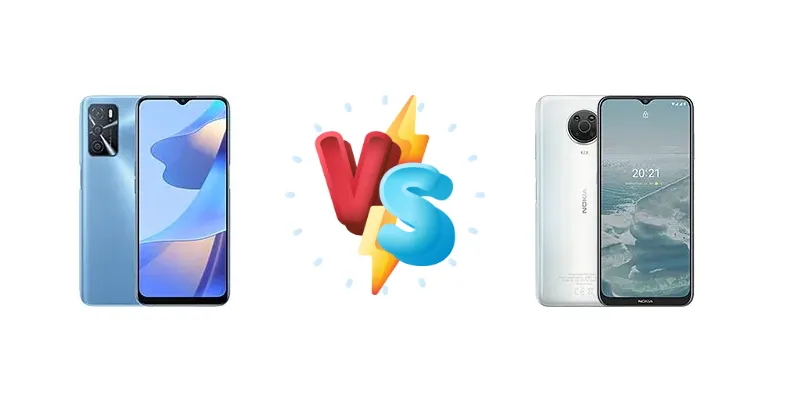
The Oppo A16 and Nokia G20 represent the extreme end of the smartphone price spectrum. Both aim to deliver essential functionality at a minimal cost, but they approach this goal with slightly different philosophies. This comparison dissects their similarities and differences to determine which offers the best value for budget-conscious consumers.
🏆 Quick Verdict
For most users, the Nokia G20 edges out the Oppo A16. While both share the same Mediatek Helio G35 chipset, the Nokia G20’s inclusion of 10W charging, and Nokia’s software support commitment, provide a slightly more complete package for the price.
| Network |
|---|
| 2G bands | GSM 850 / 900 / 1800 / 1900 | GSM 850 / 900 / 1800 / 1900 |
| 3G bands | HSDPA 850 / 900 / 2100 | HSDPA 850 / 900 / 1900 / 2100 - International |
| 4G bands | 1, 3, 5, 8, 38, 40, 41 | 1, 3, 5, 7, 8, 20, 28, 38, 40, 41 - International |
| Speed | HSPA, LTE | HSPA 42.2/5.76 Mbps, LTE Cat4 150/50 Mbps |
| Technology | GSM / HSPA / LTE | GSM / HSPA / LTE |
| | - | 1, 2, 3, 4, 5, 7, 8, 12, 17, 28, 66 - LATAM |
| Launch |
|---|
| Announced | 2021, July 17 | 2021, April 08 |
| Status | Available. Released 2021, July 17 | Available. Released 2021, May 17 |
| Body |
|---|
| Dimensions | 163.8 x 75.6 x 8.4 mm (6.45 x 2.98 x 0.33 in) | 164.9 x 76 x 9.2 mm (6.49 x 2.99 x 0.36 in) |
| SIM | Nano-SIM + Nano-SIM | · Nano-SIM· Nano-SIM + Nano-SIM |
| Weight | 190 g (6.70 oz) | 197 g (6.95 oz) |
| | - | Splash protection |
| Display |
|---|
| Resolution | 720 x 1600 pixels, 20:9 ratio (~269 ppi density) | 720 x 1600 pixels, 20:9 ratio (~269 ppi density) |
| Size | 6.52 inches, 102.6 cm2 (~82.9% screen-to-body ratio) | 6.52 inches, 102.6 cm2 (~81.9% screen-to-body ratio) |
| Type | IPS LCD, 480 nits (typ) | IPS LCD |
| Platform |
|---|
| CPU | Octa-core (4x2.3 GHz Cortex-A53 & 4x1.8 GHz Cortex-A53) | Octa-core (4x2.3 GHz Cortex-A53 & 4x1.8 GHz Cortex-A53) |
| Chipset | Mediatek MT6765G Helio G35 (12 nm) | Mediatek MT6765G Helio G35 (12 nm) |
| GPU | PowerVR GE8320 | PowerVR GE8320 |
| OS | Android 11, upgradable to Android 12, ColorOS 12 | Android 11, upgradable to Android 13 |
| Memory |
|---|
| Card slot | microSDXC | microSDXC (dedicated slot) |
| Internal | 32GB 3GB RAM, 32GB 4GB RAM, 64GB 4GB RAM, 256GB 4GB RAM | 64GB 4GB RAM, 128GB 4GB RAM |
| | eMMC 5.1 | - |
| Main Camera |
|---|
| Features | LED flash, HDR, panorama | LED flash, HDR, panorama |
| Quad | - | 48 MP, f/1.8, (wide), PDAF
5 MP, (ultrawide)
2 MP (macro)
Auxiliary lens |
| Single | 8 MP, f/2.0, (wide) | 8 MP, (wide) |
| Triple | 13 MP, f/2.2, 26mm (wide), 1/3.06", 1.12µm, PDAF
2 MP (macro)
Auxiliary lens | - |
| Video | 1080p@30fps | 1080p@30fps |
| Selfie camera |
|---|
| Features | HDR | - |
| Single | 8 MP, f/2.0, (wide) | 8 MP, (wide) |
| Video | 1080p@30fps | 1080p@30fps |
| Sound |
|---|
| 3.5mm jack | Yes | Yes |
| 35mm jack | Yes | Yes |
| Loudspeaker | Yes | Yes |
| Comms |
|---|
| Bluetooth | 5.0, A2DP, LE, aptX | 5.0, A2DP, LE |
| NFC | No | Yes (market/region dependent) |
| Positioning | GPS, GLONASS, GALILEO, BDS, QZSS | GPS, GLONASS, BDS |
| Radio | FM radio | FM radio |
| USB | USB Type-C 2.0, OTG | USB Type-C 2.0, OTG |
| WLAN | Wi-Fi 802.11 a/b/g/n/ac, dual-band, Wi-Fi Direct | Wi-Fi 802.11 b/g/n |
| Features |
|---|
| Sensors | Fingerprint (side-mounted), accelerometer, proximity, compass | Fingerprint (side-mounted), accelerometer, gyro, proximity |
| Battery |
|---|
| Charging | - | 10W wired |
| Type | Li-Po 5000 mAh | Li-Po 5050 mAh |
| Misc |
|---|
| Colors | Pearl Blue, Space Silver, Crystal Black | Glacier, Night |
| Models | CPH2269 | TA-1336, TA-1343, TA-1347, TA-1372, TA-1365 |
| Price | £ 88.50 / € 109.99 | About 90 EUR |
| SAR | 0.77 W/kg (head) 0.97 W/kg (body) | 1.01 W/kg (head) 1.02 W/kg (body) |
| SAR EU | - | 0.49 W/kg (head) 1.13 W/kg (body) |
Oppo A16
- Potentially lower initial cost
- Compact and lightweight design (likely)
- Simple and straightforward user interface (likely)
- Lack of specified charging method
- Uncertain software update commitment
- Limited performance for demanding tasks
Nokia G20
- 10W wired charging included
- Nokia’s software update promise (albeit limited)
- Potentially better build quality (Nokia reputation)
- Slow charging speed
- Limited performance for demanding tasks
- May be slightly more expensive than Oppo A16
Display Comparison
Both the Oppo A16 and Nokia G20 lack detailed display specifications in the provided data. Given their price point, it’s safe to assume both utilize LCD panels with 720p+ resolutions. The absence of information regarding peak brightness, color gamut coverage, or refresh rates suggests neither phone will excel in visual fidelity. Bezels are likely to be substantial on both devices, maximizing screen real estate within a compact form factor. Color accuracy will likely be standard for this segment.
Camera Comparison
Camera details are sparse for both devices. Without sensor size or aperture information, it’s difficult to assess image quality. The prevalence of 2MP macro and depth sensors in this price bracket suggests these are largely marketing features with limited practical utility. Image processing will likely be heavily reliant on software algorithms to enhance photos, potentially leading to over-sharpening or artificial colors. The Nokia G20 may benefit from Nokia’s image processing algorithms, but without detailed specs, a clear winner cannot be determined.
Performance
The core of both the Oppo A16 and Nokia G20 is the Mediatek Helio G35 chipset, fabricated on a 12nm process. This SoC features an octa-core CPU configuration with four cores clocked at 2.3 GHz and another four at 1.8 GHz, utilizing Cortex-A53 architecture. This configuration is adequate for basic tasks like calling, texting, and light social media browsing. However, demanding applications or multitasking will likely result in noticeable slowdowns. The identical chipset means performance will be virtually indistinguishable between the two devices, limited by the CPU and GPU capabilities of the Helio G35. RAM configurations are not specified, but will be a key factor in multitasking performance.
Battery Life
Battery capacity is not specified for the Oppo A16, but the Nokia G20’s charging specification of 10W wired provides a crucial point of differentiation. While 10W is slow by modern standards, it’s preferable to having no specified charging method. The Nokia G20 will take a considerable amount of time to fully charge, but the inclusion of wired charging offers a reliable power source. Without knowing the Oppo A16’s battery capacity, it’s difficult to assess real-world battery life, but both phones are likely to offer all-day battery life with moderate usage.
Buying Guide
Buy the Oppo A16 if you prioritize a potentially slightly lower upfront cost and are comfortable with a more basic user experience. Buy the Nokia G20 if you value guaranteed software updates, even if they are infrequent, and appreciate the convenience of included, albeit slow, wired charging. Both are suitable for basic communication and light tasks, but the Nokia G20 offers a bit more peace of mind.
Frequently Asked Questions
❓ Will the Nokia G20 receive Android version updates beyond its initial release?
Nokia typically provides a limited number of OS updates and security patches for its budget devices. While the G20 launched with Android 11, expect at least one major Android version update (likely to Android 12) and a couple of years of security updates, but don't expect long-term support like flagship devices.
❓ Is the Mediatek Helio G35 capable of running popular games like PUBG Mobile or Call of Duty Mobile?
The Mediatek Helio G35 is a very entry-level chipset. While it *can* technically run PUBG Mobile or Call of Duty Mobile, you'll need to play at the lowest graphics settings and expect significant frame rate drops, especially during intense action. It's not designed for serious gaming.
❓ How long will it take to fully charge the Nokia G20 with the 10W charger?
With a 10W charger, expect the Nokia G20 to take approximately 3-4 hours to fully charge from 0% to 100%. This is a relatively slow charging speed compared to modern smartphones, but it's a functional charging solution.