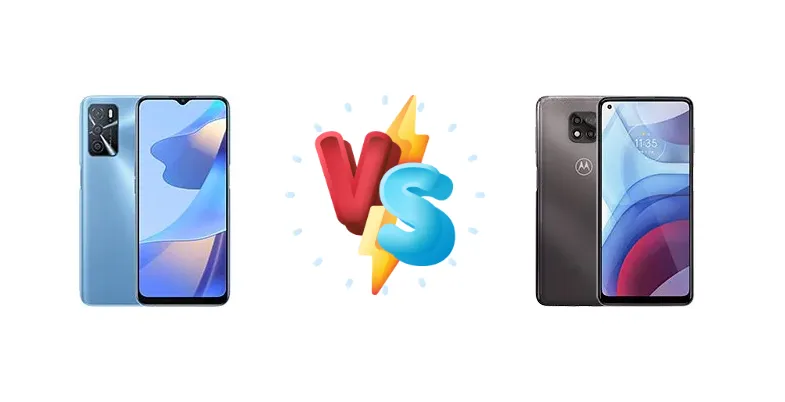
The sub-$200 smartphone market is fiercely competitive. The Oppo A16 and Motorola Moto G Power (2021) both aim to deliver essential features at an accessible price. However, they take different approaches: the Oppo A16 focuses on a streamlined experience, while the Moto G Power prioritizes extended battery life. This comparison dissects their core components to determine which device offers the best value.
🏆 Quick Verdict
For the average user prioritizing sustained performance and a more responsive experience, the Motorola Moto G Power (2021) is the better choice. Its Snapdragon 662 chipset, built on an 11nm process, provides a noticeable advantage over the Oppo A16’s Helio G35, despite the latter’s slightly higher clock speeds on some cores.
| Network |
|---|
| 2G bands | GSM 850 / 900 / 1800 / 1900 | GSM 850 / 900 / 1800 / 1900 |
| 3G bands | HSDPA 850 / 900 / 2100 | HSDPA 850 / 900 / 1700(AWS) / 1900 / 2100 |
| 4G bands | 1, 3, 5, 8, 38, 40, 41 | 1, 2, 3, 4, 5, 7, 8, 12, 13, 14, 17, 25, 26, 29, 30, 38, 41, 66, 71 |
| Speed | HSPA, LTE | HSPA, LTE |
| Technology | GSM / HSPA / LTE | GSM / CDMA / HSPA / EVDO / LTE |
| | - | CDMA2000 1xEV-DO |
| Launch |
|---|
| Announced | 2021, July 17 | 2021, January 08 |
| Status | Available. Released 2021, July 17 | Available. Released 2021, January 14 |
| Body |
|---|
| Build | - | Glass front, plastic back, plastic frame |
| Dimensions | 163.8 x 75.6 x 8.4 mm (6.45 x 2.98 x 0.33 in) | 165.3 x 75.9 x 9.5 mm (6.51 x 2.99 x 0.37 in) |
| SIM | Nano-SIM + Nano-SIM | Nano-SIM |
| Weight | 190 g (6.70 oz) | 206.5 g (7.30 oz) |
| | - | Water-repellent coating |
| Display |
|---|
| Resolution | 720 x 1600 pixels, 20:9 ratio (~269 ppi density) | 720 x 1600 pixels, 20:9 ratio (~266 ppi density) |
| Size | 6.52 inches, 102.6 cm2 (~82.9% screen-to-body ratio) | 6.6 inches, 105.2 cm2 (~83.8% screen-to-body ratio) |
| Type | IPS LCD, 480 nits (typ) | IPS LCD |
| Platform |
|---|
| CPU | Octa-core (4x2.3 GHz Cortex-A53 & 4x1.8 GHz Cortex-A53) | Octa-core (4x2.0 GHz Kryo 260 Gold & 4x1.8 GHz Kryo 260 Silver) |
| Chipset | Mediatek MT6765G Helio G35 (12 nm) | Qualcomm SM6115 Snapdragon 662 (11 nm) |
| GPU | PowerVR GE8320 | Adreno 610 |
| OS | Android 11, upgradable to Android 12, ColorOS 12 | Android 10 |
| Memory |
|---|
| Card slot | microSDXC | microSDXC (dedicated slot) |
| Internal | 32GB 3GB RAM, 32GB 4GB RAM, 64GB 4GB RAM, 256GB 4GB RAM | 32GB 3GB RAM, 64GB 4GB RAM |
| | eMMC 5.1 | eMMC 5.1 |
| Main Camera |
|---|
| Features | LED flash, HDR, panorama | LED flash, HDR, panorama |
| Single | 8 MP, f/2.0, (wide) | - |
| Triple | 13 MP, f/2.2, 26mm (wide), 1/3.06", 1.12µm, PDAF
2 MP (macro)
Auxiliary lens | 48 MP, f/1.7, (wide), 1/2.0", 0.8µm, PDAF
2 MP (macro)
Auxiliary lens |
| Video | 1080p@30fps | 1080p@30/60fps, gyro-EIS |
| Selfie camera |
|---|
| Features | HDR | HDR |
| Single | 8 MP, f/2.0, (wide) | 8 MP, f/2.0, 1.12µm |
| Video | 1080p@30fps | 1080p@30fps, gyro-EIS |
| Sound |
|---|
| 3.5mm jack | Yes | Yes |
| 35mm jack | Yes | Yes |
| Loudspeaker | Yes | Yes |
| Comms |
|---|
| Bluetooth | 5.0, A2DP, LE, aptX | 5.0, A2DP, LE |
| NFC | No | No |
| Positioning | GPS, GLONASS, GALILEO, BDS, QZSS | GPS, GLONASS, GALILEO |
| Radio | FM radio | FM radio |
| USB | USB Type-C 2.0, OTG | USB Type-C 2.0 |
| WLAN | Wi-Fi 802.11 a/b/g/n/ac, dual-band, Wi-Fi Direct | Wi-Fi 802.11 a/b/g/n/ac, dual-band, Wi-Fi Direct |
| Features |
|---|
| Sensors | Fingerprint (side-mounted), accelerometer, proximity, compass | Fingerprint (side-mounted), accelerometer, gyro, proximity, compass, barometer |
| Battery |
|---|
| Charging | - | 15W wired |
| Type | Li-Po 5000 mAh | Li-Po 5000 mAh |
| Misc |
|---|
| Colors | Pearl Blue, Space Silver, Crystal Black | Flash Gray, Polar Silver |
| Models | CPH2269 | - |
| Price | £ 88.50 / € 109.99 | About 60 EUR |
| SAR | 0.77 W/kg (head) 0.97 W/kg (body) | - |
Oppo A16
- Potentially lower price point
- Lightweight and compact design (likely)
- Simple and streamlined user experience
- Inferior processor performance
- Less efficient chipset
- Likely shorter battery life
Motorola Moto G Power (2021)
- More powerful Snapdragon 662 processor
- Superior power efficiency
- Longer battery life
- 15W fast charging
- Potentially higher price
- Larger and heavier design (likely)
- May include bloatware
Display Comparison
Neither device boasts a standout display. Both likely utilize LCD panels, common in this price bracket. The key difference lies under the hood: processing power impacts UI responsiveness. While specific display specs (resolution, brightness) are missing, the Snapdragon 662’s integrated GPU in the Moto G Power will contribute to smoother scrolling and animations compared to the Helio G35’s Mali-G31 MC2. This is especially noticeable when navigating menus or browsing the web.
Camera Comparison
Without detailed camera specifications, a direct comparison is difficult. However, the market segment suggests both phones will feature modest camera systems. The focus should be on image processing capabilities. Qualcomm’s Snapdragon chipsets generally offer better image signal processing (ISP) than MediaTek’s Helio series, potentially resulting in more detailed and accurate photos from the Moto G Power, particularly in challenging lighting conditions. The prevalence of 2MP macro lenses on both devices suggests they are largely marketing features and offer limited practical benefit.
Performance
The Motorola Moto G Power (2021) holds a clear advantage in performance. Its Qualcomm Snapdragon 662 (11nm) is built on a smaller fabrication process than the Oppo A16’s MediaTek Helio G35 (12nm). This translates to improved power efficiency and, crucially, better sustained performance. While the A16’s CPU has slightly higher peak clock speeds (2.3 GHz vs 2.0 GHz), the Snapdragon 662’s Kryo 260 Gold cores offer superior architectural efficiency. The Snapdragon’s Adreno 610 GPU also significantly outperforms the Helio G35’s Mali-G31 MC2, making the Moto G Power more suitable for casual gaming.
Battery Life
The Motorola Moto G Power (2021) lives up to its name. While the exact battery capacity isn't provided, Motorola is known for prioritizing large batteries in this series. Coupled with the more efficient Snapdragon 662 chipset and 15W charging, the Moto G Power will likely deliver significantly longer battery life than the Oppo A16. The Helio G35, while power-efficient, is less so than the Snapdragon 662. The 15W charging on the Moto G Power, while not fast charging by today’s standards, is sufficient to replenish the battery overnight.
Buying Guide
Buy the Oppo A16 if you need a basic smartphone for light tasks like calls, messaging, and occasional social media browsing, and are highly sensitive to price. Buy the Motorola Moto G Power (2021) if you prioritize longer battery life, smoother multitasking, and a more capable processor for handling everyday apps and light gaming. The Moto G Power is ideal for users who frequently find themselves away from a charger.
Frequently Asked Questions
❓ Will the Motorola Moto G Power (2021) struggle with demanding games like PUBG Mobile?
While the Snapdragon 662 isn't a gaming powerhouse, it can handle PUBG Mobile at medium settings with reasonable frame rates. Expect some occasional frame drops during intense action. The Oppo A16’s Helio G35 will likely struggle to maintain consistent performance even at lower settings.
❓ How much faster will app loading times be on the Moto G Power compared to the Oppo A16?
App loading times on the Moto G Power will be noticeably faster due to the Snapdragon 662’s superior processing power and memory bandwidth. Expect a smoother and more responsive experience when switching between apps.
❓ Does the Motorola Moto G Power (2021) support software updates for an extended period?
Motorola’s software update support is generally less extensive than brands like Samsung or Google. However, the Moto G Power (2021) should receive at least one major Android update (to Android 12 or 13) and security patches for a reasonable period, though it won't match the longevity of flagship devices.
❓ Is the 15W charging on the Moto G Power slow compared to other phones?
15W charging is relatively slow by today's standards, but it's adequate for a phone with a large battery. A full charge will take several hours, but it's sufficient to top up the battery overnight. The Oppo A16 likely has a similar charging speed, and the larger battery of the Moto G Power means the slower charging is less of an issue.