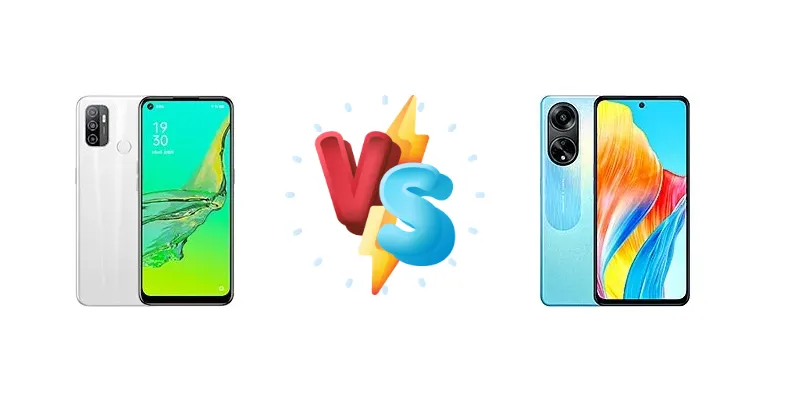
Oppo's A-series consistently delivers value in the budget smartphone space. The A11s and A98 represent different tiers within that range, with the A98 offering a more modern chipset and faster charging. This comparison dissects the key differences to help you determine which device best suits your needs and budget.
🏆 Quick Verdict
For the majority of users, the Oppo A98 is the superior choice. Its Snapdragon 695 5G chipset provides a noticeable performance boost over the A11s' Snapdragon 460, and the inclusion of 67W fast charging dramatically reduces downtime. While the A11s remains a viable option for basic tasks, the A98 offers a more future-proof and enjoyable experience.
| Network |
|---|
| 2G bands | GSM 850 / 900 / 1800 / 1900 | GSM 850 / 900 / 1800 / 1900 |
| 3G bands | HSDPA 850 / 900 / 2100 | HSDPA 800 / 850 / 900 / 1700(AWS) / 1900 / 2100 |
| 4G bands | 1, 3, 5, 8, 38, 39, 40, 41 | 1, 2, 3, 4, 5, 7, 8, 12, 13, 17, 18, 19, 20, 26, 28, 32, 38, 39, 40, 41, 66 |
| 5G bands | - | 1, 3, 5, 7, 8, 20, 28, 38, 40, 41, 66, 77, 78 SA/NSA |
| Speed | HSPA, LTE | HSPA, LTE, 5G |
| Technology | GSM / CDMA / HSPA / CDMA2000 / LTE | GSM / HSPA / LTE / 5G |
| | CDMA2000 1x | - |
| Launch |
|---|
| Announced | 2021, December 27 | 2023, May 09 |
| Status | Available. Released 2021, December 27 | Available. Released 2023, May 19 |
| Body |
|---|
| Dimensions | 163.9 x 75.1 x 8.4 mm (6.45 x 2.96 x 0.33 in) | 165.6 x 76.1 x 8.2 mm (6.52 x 3.00 x 0.32 in) |
| SIM | Nano-SIM + Nano-SIM | Nano-SIM + Nano-SIM |
| Weight | 186 g (6.56 oz) | 192 g (6.77 oz) |
| Display |
|---|
| Resolution | 720 x 1600 pixels, 20:9 ratio (~270 ppi density) | 1080 x 2400 pixels, 20:9 ratio (~392 ppi density) |
| Size | 6.5 inches, 102.0 cm2 (~82.9% screen-to-body ratio) | 6.72 inches, 109.0 cm2 (~86.5% screen-to-body ratio) |
| Type | IPS LCD, 90Hz, 480 nits (typ) | IPS LCD, 120Hz, 550 nits (typ), 680 nits (HBM) |
| Platform |
|---|
| CPU | Octa-core (4x1.8 GHz Kryo 240 & 4x1.6 GHz Kryo 240) | Octa-core (2x2.2 GHz Kryo 660 Gold & 6x1.7 GHz Kryo 660 Silver) |
| Chipset | Qualcomm SM4250 Snapdragon 460 (11 nm) | Qualcomm SM6375 Snapdragon 695 5G (6 nm) |
| GPU | Adreno 610 | Adreno 619 |
| OS | Android 10, ColorOS 7.2 | Android 13, upgradable to Android 14, ColorOS 14 |
| Memory |
|---|
| Card slot | microSDXC (dedicated slot) | microSDXC |
| Internal | 64GB 4GB RAM, 128GB 4GB RAM, 128GB 8GB RAM | 256GB 8GB RAM |
| | eMMC 5.1 | UFS 2.2 |
| Main Camera |
|---|
| Dual | - | 64 MP, f/1.7, 26mm (wide), PDAF
2 MP, f/3.3, 34mm (microscope)
Auxiliary lens |
| Features | LED flash, HDR, panorama | LED flash, HDR, panorama |
| Single | 8 MP, f/2.0, (wide) | - |
| Triple | 13 MP, f/2.2, 25mm (wide), 1/3.06", 1.12µm, PDAF
2 MP (macro)
Auxiliary lens | - |
| Video | 1080p@30fps | 1080p@30fps |
| Selfie camera |
|---|
| Features | HDR | Panorama |
| Single | 8 MP, f/2.0, (wide) | 32 MP, f/2.4, 22mm (wide) |
| Video | 1080p@30fps | 1080p@30fps |
| Sound |
|---|
| 3.5mm jack | Yes | Yes |
| 35mm jack | Yes | Yes |
| Loudspeaker | Yes | Yes, with stereo speakers |
| Comms |
|---|
| Bluetooth | 5.0, A2DP, LE, aptX HD | 5.1, A2DP, LE, aptX HD |
| Infrared port | - | Yes |
| NFC | No | Yes |
| Positioning | GPS, GLONASS, GALILEO, BDS | GPS (L1), GLONASS (G1), BDS (B1I), GALILEO (E1), QZSS (L1) |
| Radio | Unspecified | No |
| USB | USB Type-C 2.0, OTG | USB Type-C 2.0, OTG |
| WLAN | Wi-Fi 802.11 a/b/g/n/ac, dual-band, Wi-Fi Direct | Wi-Fi 802.11 a/b/g/n/ac, dual-band |
| Features |
|---|
| Sensors | Fingerprint (rear-mounted), accelerometer, proximity, compass | Fingerprint (side-mounted), accelerometer, gyro, proximity, compass |
| Battery |
|---|
| Charging | 18W wired | 67W wired, PD, 50% in 18 min |
| Type | Li-Po 5000 mAh | Li-Po 5000 mAh |
| Misc |
|---|
| Colors | Gray, White | Cool Black, Dreamy Blue |
| Models | - | CPH2529 |
| Price | About 140 EUR | About 290 EUR |
Oppo A11s
- More affordable price point
- Functional for basic smartphone tasks
- Potentially longer battery life due to less powerful chipset
- Significantly slower performance
- Slower 18W charging
- Lacks 5G connectivity
Oppo A98
- Faster Snapdragon 695 5G chipset
- 67W SuperVOOC fast charging
- 5G connectivity for faster data speeds
- Higher price compared to the A11s
- Potentially slightly shorter battery life (though mitigated by efficiency)
- May require a separate charger for full 67W speed
Display Comparison
Neither Oppo provides display specifications beyond resolution in their marketing materials. However, given their price points, both likely utilize LCD panels. The A98’s advantage lies in its chipset’s ability to drive a potentially higher refresh rate display, though this isn’t confirmed. The A11s, with its older Snapdragon 460, is likely limited to a standard 60Hz panel. Bezels are expected to be similar on both devices, reflecting their budget positioning. Color accuracy will likely be standard for this segment, prioritizing vibrancy over absolute fidelity.
Camera Comparison
Detailed camera specifications are lacking for both devices. However, given Oppo’s marketing strategy, both likely feature a primary camera supplemented by depth and macro sensors. The A98’s more powerful chipset allows for more sophisticated image processing, potentially resulting in better dynamic range and low-light performance. While the sensor size remains unknown, the A98’s ISP (Image Signal Processor) within the Snapdragon 695 will likely offer superior noise reduction and detail preservation. The inclusion of Optical Image Stabilization (OIS) is unlikely on either device at this price point, but the A98’s processing capabilities could partially compensate for this.
Performance
The core difference between these two phones is the chipset. The Oppo A98’s Snapdragon 695 (6nm) is a substantial upgrade over the A11s’ Snapdragon 460 (11nm). The 6nm process node inherently offers better power efficiency, leading to improved battery life and reduced thermal throttling. The CPU configuration further highlights this: the A98 features a prime core clocked at 2.2 GHz (Kryo 660 Gold) alongside six efficiency cores at 1.7 GHz (Kryo 660 Silver), while the A11s has a uniform octa-core setup at 1.8 GHz and 1.6 GHz (Kryo 240). This translates to a significantly faster and more responsive experience on the A98, particularly when multitasking or running demanding applications. The A98 also benefits from the Snapdragon 695’s integrated 5G modem.
Battery Life
Battery capacity isn’t specified for either device, but both likely fall in the 5000mAh range, typical for this segment. The A98’s standout feature is its 67W wired charging, capable of reaching 50% charge in just 18 minutes. This is a massive advantage over the A11s’ 18W charging, which will take considerably longer to fully replenish the battery. While the A98’s chipset consumes more power, the efficiency gains from the 6nm process and optimized power management likely offset this, resulting in comparable real-world battery life. The faster charging speed, however, significantly reduces downtime and enhances the overall user experience.
Buying Guide
Buy the Oppo A11s if you prioritize extreme affordability and only need a phone for very basic tasks like calls, texts, and light social media. It's a functional device for those on a tight budget. Buy the Oppo A98 if you want a smoother, more responsive experience, 5G connectivity, and significantly faster charging. It's ideal for users who stream videos, play mobile games occasionally, and value convenience.
Frequently Asked Questions
❓ Does the Snapdragon 695 in the Oppo A98 get hot during extended gaming sessions?
The Snapdragon 695 is generally efficient and well-managed. While it will warm up during prolonged gaming, the 6nm process node and Oppo’s thermal management should prevent significant throttling. Expect playable frame rates in most popular titles, but don't expect flagship-level sustained performance.
❓ Is the 67W charging compatible with all USB-C chargers, or do I need Oppo's proprietary charger?
While the A98 supports the USB Power Delivery (PD) standard, you'll achieve the full 67W charging speed with Oppo's proprietary SuperVOOC charger. Using a standard USB-PD charger will still charge the device, but at a slower rate.
❓ Will the Oppo A11s receive future Android updates?
Given its position in Oppo’s lineup, the A11s is likely to receive at least one major Android update (potentially to Android 13 or 14) and several security patches. However, long-term software support is not guaranteed.
❓ How does the 5G performance of the Oppo A98 compare to Wi-Fi 6?
In areas with strong 5G coverage, the A98 will offer significantly faster download and upload speeds compared to Wi-Fi 6. However, 5G performance is heavily dependent on network availability and signal strength. Wi-Fi 6 remains a reliable and efficient option for home or office networks.