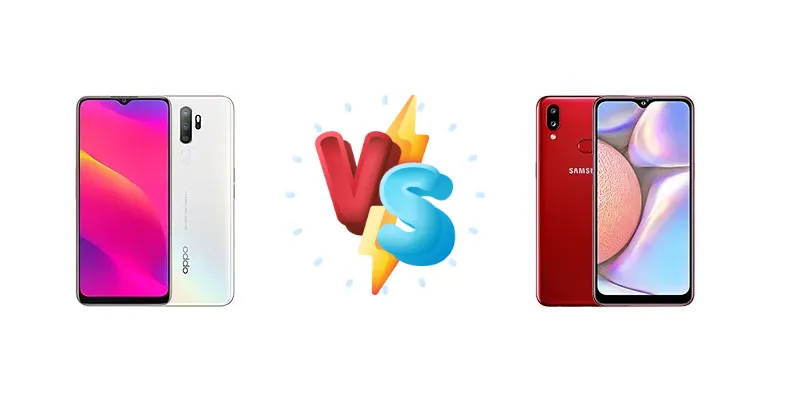
The Oppo A11 and Samsung Galaxy A10s represent the lower end of the smartphone market, targeting first-time buyers or those seeking a reliable secondary device. Both offer essential functionality, but diverge significantly in their core hardware, particularly in their chipsets. This comparison dissects those differences to determine which phone delivers the best value.
🏆 Quick Verdict
For most users, the Oppo A11 emerges as the stronger choice. Its Qualcomm Snapdragon 665 chipset provides a noticeable performance advantage over the Samsung Galaxy A10s’ MediaTek Helio P22, translating to smoother multitasking and a more responsive user experience. While both offer similar battery capabilities, the A11’s superior processing power makes it the better all-around device.
| Network |
|---|
| 2G bands | GSM 850 / 900 / 1800 / 1900 | GSM 850 / 900 / 1800 / 1900 |
| 3G bands | HSDPA 850 / 900 / 2100 | HSDPA 850 / 900 / 1900 / 2100 |
| 4G bands | 1, 3, 4, 5, 8, 34, 38, 39, 40, 41 | 1, 2, 3, 5, 7, 8, 20, 38, 40, 41 |
| Speed | HSPA 42.2/5.76 Mbps, LTE (2CA) Cat6 400/50 Mbps | HSPA 42.2/5.76 Mbps, LTE Cat4 150/50 Mbps |
| Technology | GSM / CDMA / HSPA / LTE | GSM / HSPA / LTE |
| | CDMA 800 & TD-SCDMA | 1, 2, 3, 5, 7, 8, 12, 17, 28 - SM-A107M/DS |
| Launch |
|---|
| Announced | 2019, October. Released 2019, October | 2019, August 12. Released 2019, August 27 |
| Status | Discontinued | Discontinued |
| Body |
|---|
| Build | Glass front, plastic back, plastic frame | Glass front, plastic back, plastic frame |
| Dimensions | 163.6 x 75.6 x 9.1 mm (6.44 x 2.98 x 0.36 in) | 156.9 x 75.8 x 7.8 mm (6.18 x 2.98 x 0.31 in) |
| SIM | Nano-SIM + Nano-SIM | · Nano-SIM· Nano-SIM + Nano-SIM |
| Weight | 195 g (6.88 oz) | 168 g (5.93 oz) |
| Display |
|---|
| Resolution | 720 x 1600 pixels, 20:9 ratio (~270 ppi density) | 720 x 1520 pixels, 19:9 ratio (~271 ppi density) |
| Size | 6.5 inches, 102.0 cm2 (~82.5% screen-to-body ratio) | 6.2 inches, 95.9 cm2 (~80.7% screen-to-body ratio) |
| Type | IPS LCD | PLS LCD |
| Platform |
|---|
| CPU | Octa-core (4x2.0 GHz Kryo 260 Gold & 4x1.8 GHz Kryo 260 Silver) | Octa-core 2.0 GHz Cortex-A53 |
| Chipset | Qualcomm SDM665 Snapdragon 665 (11 nm) | Mediatek MT6762 Helio P22 (12 nm) |
| GPU | Adreno 610 | PowerVR GE8320 |
| OS | Android 9.0 (Pie), ColorOS 6.0 | Android 9.0 (Pie), upgradable to Android 11, One UI 3.1 |
| Memory |
|---|
| Card slot | microSDXC (dedicated slot) | microSDXC (dedicated slot) |
| Internal | 64GB 4GB RAM, 128GB 4GB RAM, 128GB 6GB RAM, 256GB 6GB RAM | 32GB 2GB RAM, 32GB 3GB RAM |
| | UFS 2.1 | eMMC 5.1 |
| Main Camera |
|---|
| Dual | - | 13 MP, f/1.8, 28mm (wide), AF
Auxiliary lens |
| Features | LED flash, HDR, panorama | LED flash, panorama, HDR |
| Quad | 12 MP, f/1.8, (wide), PDAF
8 MP, f/2.3, 13mm (ultrawide), 1/4.0", 1.12µm, AF
2 MP, f/2.4, 1/5.0", 1.75µm
Auxiliary lens | - |
| Video | 4K@30fps, 1080p@30fps, gyro-EIS | 1080p@30fps |
| Selfie camera |
|---|
| Features | HDR | - |
| Single | 8 MP, f/2.0 | 8 MP, f/2.0 |
| Video | 1080p@30fps | 1080p@30fps |
| Sound |
|---|
| 3.5mm jack | Yes | Yes |
| 35mm jack | Yes | Yes |
| Loudspeaker | Yes, with stereo speakers | Yes |
| | 24-bit/192kHz audio | - |
| Comms |
|---|
| Bluetooth | 5.0, A2DP, LE | 4.2, A2DP, LE |
| NFC | No | No |
| Positioning | GPS, GLONASS, GALILEO, QZSS, BDS | GPS, GLONASS, GALILEO |
| Radio | FM radio | FM radio |
| USB | USB Type-C 2.0 | microUSB 2.0, OTG |
| WLAN | Wi-Fi 802.11 a/b/g/n/ac, dual-band, Wi-Fi Direct | Wi-Fi 802.11 b/g/n, Wi-Fi Direct |
| Features |
|---|
| Sensors | Fingerprint (rear-mounted), accelerometer, gyro, proximity, compass | Fingerprint (rear-mounted), accelerometer, proximity |
| Battery |
|---|
| Charging | 10W wired
Reverse wired | - |
| Type | Li-Po 5000 mAh, non-removable | Li-Po 4000 mAh, non-removable |
| Misc |
|---|
| Colors | Purple, Lake Green, Cloud White | Blue, Green, Red, Black |
| Models | PCHM10, PCHT10 | SM-A107F, SM-A107M |
| Price | About 200 EUR | About 180 EUR |
| SAR | - | 0.25 W/kg (head) 1.06 W/kg (body) |
Oppo A11
- More powerful Snapdragon 665 chipset
- Potentially better thermal management
- Reverse wired charging capability
- Battery capacity not publicly specified
- Display specifications are unknown
Samsung Galaxy A10s
- Larger 4000mAh battery
- Established Samsung brand reputation
- Simple and user-friendly interface
- Less powerful MediaTek Helio P22 chipset
- Slower app loading and multitasking
- Potentially more throttling under load
Display Comparison
Neither Oppo nor Samsung provide detailed display specifications for these models. Given their price point, both likely utilize LCD panels with 720p+ resolutions. The A10s’ display is 6.2 inches, while the A11 is 6.5 inches. The larger screen of the A11 may be preferable for media consumption, but without knowing peak brightness or color accuracy, it’s difficult to definitively declare a winner. Expect both to struggle in direct sunlight.
Camera Comparison
Both phones feature basic camera setups. Details are sparse, but the A10s has a 13MP main sensor, while the A11’s main sensor resolution is not specified. Both include depth sensors and likely 2MP macro lenses (which offer limited utility). Image quality will likely be similar in good lighting conditions, but the Snapdragon 665’s image signal processor (ISP) in the A11 may provide slightly better noise reduction and dynamic range. The A11’s superior processing power could also lead to faster image processing times.
Performance
The core difference lies in the chipsets. The Oppo A11’s Qualcomm Snapdragon 665 (11nm) is architecturally superior to the Samsung Galaxy A10s’ MediaTek Helio P22 (12nm). The Snapdragon 665 utilizes a Kryo CPU with a mix of performance (Kryo 260 Gold) and efficiency (Kryo 260 Silver) cores, offering a more balanced approach. The Helio P22 relies solely on Cortex-A53 cores, which are less efficient and offer lower peak performance. This translates to faster app loading times and smoother multitasking on the A11. The 11nm process node of the Snapdragon 665 also suggests better thermal efficiency, potentially reducing throttling during sustained workloads.
Battery Life
The Samsung Galaxy A10s packs a 4000mAh battery, while the Oppo A11’s battery capacity is not publicly available. However, both phones feature 10W wired charging. Given the less power-hungry Helio P22 chipset, the A10s might offer slightly longer battery life in some scenarios. However, the Snapdragon 665’s efficiency gains could offset this difference, especially with moderate usage. Expect both phones to last a full day with typical use, but neither offers fast charging capabilities.
Buying Guide
Buy the Oppo A11 if you prioritize performance for everyday tasks like social media, browsing, and light gaming. The Snapdragon 665 offers a more fluid experience. Buy the Samsung Galaxy A10s if you are looking for a minimal, no-frills device and brand recognition is a key factor, and your usage is extremely light, focusing primarily on calls and basic messaging.
Frequently Asked Questions
❓ Will the Oppo A11 handle popular games like PUBG Mobile?
While the Snapdragon 665 isn't a gaming powerhouse, it can run PUBG Mobile at lower settings. Expect frame rate drops during intense action. The Helio P22 in the A10s will struggle more, requiring even lower settings and potentially resulting in an unplayable experience.
❓ Does the Samsung Galaxy A10s overheat during prolonged use?
The MediaTek Helio P22 is known to generate more heat than the Snapdragon 665. While the A10s likely won't become dangerously hot, you may experience noticeable throttling and performance slowdowns during extended gaming sessions or video recording.
❓ Is the reverse wired charging on the Oppo A11 useful?
The 10W reverse wired charging is a niche feature. It allows you to use the A11 as a power bank for other devices, like wireless earbuds or a smartwatch, but the charging speed is slow and it will drain the A11's battery significantly.
❓ How does the software experience differ between the two phones?
The Oppo A11 runs ColorOS, while the Samsung Galaxy A10s runs One UI. Both are Android-based, but ColorOS is often criticized for its aggressive battery management and pre-installed bloatware. One UI is generally considered cleaner and more user-friendly, though it also includes Samsung's own apps.