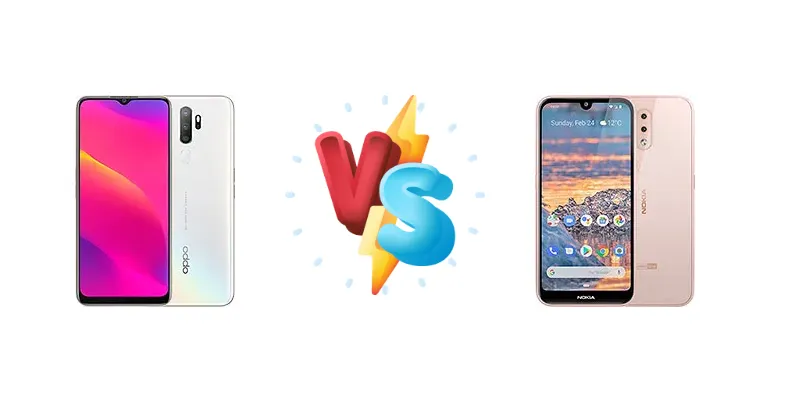
The Oppo A11 and Nokia 4.2 represent two distinct approaches to the budget smartphone market. The A11 leverages a newer, more powerful Qualcomm Snapdragon 665 chipset, while the Nokia 4.2 aims for a balance of affordability and the clean Android One experience. This comparison dissects their core components to determine which device delivers the best value for users prioritizing performance and everyday usability.
🏆 Quick Verdict
For the average user, the Oppo A11 emerges as the stronger choice. Its Snapdragon 665 chipset, built on an 11nm process, provides a noticeable performance advantage over the Nokia 4.2’s Snapdragon 439, translating to smoother multitasking and a more responsive user experience. While both phones target the budget segment, the A11 offers a better return on investment.
| Network |
|---|
| 2G bands | GSM 850 / 900 / 1800 / 1900 | GSM 850 / 900 / 1800 / 1900 |
| 3G bands | HSDPA 850 / 900 / 2100 | HSDPA 850 / 900 / 2100 - Global |
| 4G bands | 1, 3, 4, 5, 8, 34, 38, 39, 40, 41 | 1, 3, 5, 7, 8, 20, 28, 38, 40, 41 - EMEA, APAC, MENA |
| Speed | HSPA 42.2/5.76 Mbps, LTE (2CA) Cat6 400/50 Mbps | HSPA 42.2/5.76 Mbps, LTE Cat4 150/50 Mbps |
| Technology | GSM / CDMA / HSPA / LTE | GSM / HSPA / LTE |
| | CDMA 800 & TD-SCDMA | 1, 3, 5, 8, 40, 41 - India |
| Launch |
|---|
| Announced | 2019, October. Released 2019, October | 2019, February 24. Released 2019, May 07 |
| Status | Discontinued | Discontinued |
| Body |
|---|
| Build | Glass front, plastic back, plastic frame | Glass front, glass back, plastic frame |
| Dimensions | 163.6 x 75.6 x 9.1 mm (6.44 x 2.98 x 0.36 in) | 149 x 71.3 x 8.4 mm (5.87 x 2.81 x 0.33 in) |
| SIM | Nano-SIM + Nano-SIM | Nano-SIM + Nano-SIM |
| Weight | 195 g (6.88 oz) | 161 g (5.68 oz) |
| Display |
|---|
| Resolution | 720 x 1600 pixels, 20:9 ratio (~270 ppi density) | 720 x 1520 pixels, 19:9 ratio (~295 ppi density) |
| Size | 6.5 inches, 102.0 cm2 (~82.5% screen-to-body ratio) | 5.71 inches, 81.4 cm2 (~76.6% screen-to-body ratio) |
| Type | IPS LCD | IPS LCD |
| Platform |
|---|
| CPU | Octa-core (4x2.0 GHz Kryo 260 Gold & 4x1.8 GHz Kryo 260 Silver) | Octa-core (4x1.95 GHz Cortex-A53 & 4x1.45 GHz Cortex A53) |
| Chipset | Qualcomm SDM665 Snapdragon 665 (11 nm) | Qualcomm SDM439 Snapdragon 439 (12 nm) |
| GPU | Adreno 610 | Adreno 505 |
| OS | Android 9.0 (Pie), ColorOS 6.0 | Android 9.0 (Pie), upgradable to Android 11, Android One |
| Memory |
|---|
| Card slot | microSDXC (dedicated slot) | microSDXC (dedicated slot) |
| Internal | 64GB 4GB RAM, 128GB 4GB RAM, 128GB 6GB RAM, 256GB 6GB RAM | 16GB 2GB RAM, 32GB 3GB RAM |
| | UFS 2.1 | eMMC 5.1 |
| Main Camera |
|---|
| Dual | - | 13 MP, f/2.2, 1/3.1", 1.12µm, PDAF
Auxiliary lens |
| Features | LED flash, HDR, panorama | LED flash |
| Quad | 12 MP, f/1.8, (wide), PDAF
8 MP, f/2.3, 13mm (ultrawide), 1/4.0", 1.12µm, AF
2 MP, f/2.4, 1/5.0", 1.75µm
Auxiliary lens | - |
| Video | 4K@30fps, 1080p@30fps, gyro-EIS | 1080p@30fps |
| Selfie camera |
|---|
| Features | HDR | - |
| Single | 8 MP, f/2.0 | 8 MP, f/2.0, 1/4.0", 1.12µm |
| Video | 1080p@30fps | 1080p@30fps |
| Sound |
|---|
| 3.5mm jack | Yes | Yes |
| 35mm jack | Yes | Yes |
| Loudspeaker | Yes, with stereo speakers | Yes |
| | 24-bit/192kHz audio | - |
| Comms |
|---|
| Bluetooth | 5.0, A2DP, LE | 4.2, A2DP, LE, aptX |
| NFC | No | Yes (market dependent) |
| Positioning | GPS, GLONASS, GALILEO, QZSS, BDS | GPS, GLONASS, BDS |
| Radio | FM radio | FM radio |
| USB | USB Type-C 2.0 | microUSB 2.0, OTG |
| WLAN | Wi-Fi 802.11 a/b/g/n/ac, dual-band, Wi-Fi Direct | Wi-Fi 802.11 b/g/n |
| Features |
|---|
| Sensors | Fingerprint (rear-mounted), accelerometer, gyro, proximity, compass | Fingerprint (rear-mounted), accelerometer, proximity |
| Battery |
|---|
| Charging | 10W wired
Reverse wired | - |
| Type | Li-Po 5000 mAh, non-removable | Li-Ion 3000 mAh, non-removable |
| Misc |
|---|
| Colors | Purple, Lake Green, Cloud White | Black, Pink Sand |
| Models | PCHM10, PCHT10 | TA-1184, TA-1133, TA-1149, TA-1150, TA-1157, TA-1152 |
| Price | About 200 EUR | About 130 EUR |
| SAR | - | 0.43 W/kg (head) 1.08 W/kg (body) |
| SAR EU | - | 0.45 W/kg (head) 1.53 W/kg (body) |
Oppo A11
- More powerful Snapdragon 665 chipset
- Better power efficiency for longer battery life
- Reverse wired charging capability
- Potential for more bloatware (typical of Oppo)
- Software update support may be less consistent than Nokia
Nokia 4.2
- Clean Android One experience with guaranteed updates
- Affordable price point
- Simple and user-friendly interface
- Less powerful Snapdragon 439 chipset
- Slower performance for demanding tasks
- No reverse charging
Display Comparison
Neither Oppo nor Nokia provide display specifications beyond the basic screen size. However, the chipset differences indirectly impact the display experience. The Snapdragon 665 in the A11 has a more capable ISP, potentially leading to better image processing for photos viewed on the screen. Without knowing panel type or resolution, it's difficult to assess color accuracy or brightness, but the A11’s superior processing power suggests a more fluid UI and potentially better video playback.
Camera Comparison
Without detailed camera specifications, a direct comparison is limited. However, the Snapdragon 665’s superior Image Signal Processor (ISP) in the Oppo A11 provides a significant advantage in image processing. This means better dynamic range, noise reduction, and overall image quality, even with similar sensor sizes. The Nokia 4.2’s SD439 ISP is less capable, potentially resulting in softer images and less detail in challenging lighting conditions. The presence of a 2MP macro lens on either device is unlikely to significantly impact the overall camera experience.
Performance
The core difference lies in the chipsets. The Oppo A11’s Qualcomm Snapdragon 665 (11nm) features an octa-core CPU with a split configuration of 4x2.0 GHz Kryo 260 Gold and 4x1.8 GHz Kryo 260 Silver cores. This contrasts with the Nokia 4.2’s Snapdragon 439 (12nm) which utilizes an octa-core setup of 4x1.95 GHz Cortex-A53 and 4x1.45 GHz Cortex A53 cores. The 11nm process of the SD665, despite being slightly older technology, generally offers better power efficiency and sustained performance compared to the 12nm SD439. The Kryo cores in the A11 also represent a more modern CPU architecture, resulting in improved single-core and multi-core performance. This translates to faster app launch times and smoother multitasking on the Oppo A11.
Battery Life
Both devices feature 10W wired charging. The Oppo A11 also offers reverse wired charging, a feature absent on the Nokia 4.2. While battery capacity isn’t specified, the Snapdragon 665’s improved power efficiency in the A11 likely translates to longer battery life despite potentially having a similar capacity to the Nokia 4.2. The 10W charging speed on both devices is relatively slow, meaning a full charge will take a considerable amount of time, but the A11’s reverse charging capability adds a degree of versatility.
Buying Guide
Buy the Oppo A11 if you need a phone capable of handling moderate gaming, smoother app switching, and generally faster performance for everyday tasks. It’s ideal for users who prioritize responsiveness and aren’t heavily invested in the Nokia/Android One ecosystem. Buy the Nokia 4.2 if you prefer a clean, bloatware-free Android experience with guaranteed updates and are willing to trade some performance for software simplicity and potentially longer software support.
Frequently Asked Questions
❓ Will the Oppo A11 struggle with popular apps like Facebook or WhatsApp?
The Snapdragon 665 in the Oppo A11 is more than capable of handling everyday apps like Facebook and WhatsApp smoothly. While it won't offer the same performance as flagship devices, you shouldn't experience significant lag or slowdowns during normal usage.
❓ Is the Nokia 4.2 a good choice for mobile gaming?
The Nokia 4.2’s Snapdragon 439 is not ideal for demanding mobile games. While it can run less graphically intensive titles, you’ll likely need to lower graphics settings and may still experience frame rate drops. The Oppo A11, with its Snapdragon 665, offers a noticeably better gaming experience.
❓ How long will software updates be supported on the Nokia 4.2?
The Nokia 4.2, being part of the Android One program, is guaranteed to receive at least two years of Android version updates and three years of security patches from its launch date. This is a significant advantage over the Oppo A11, which typically receives less consistent software support.
❓ Does the Oppo A11's reverse charging work with any device?
The Oppo A11's reverse wired charging is compatible with most devices that charge via USB-C. However, the 10W output is relatively slow, so it's best suited for topping up smaller devices like wireless earbuds or smartwatches, rather than fully charging another phone.