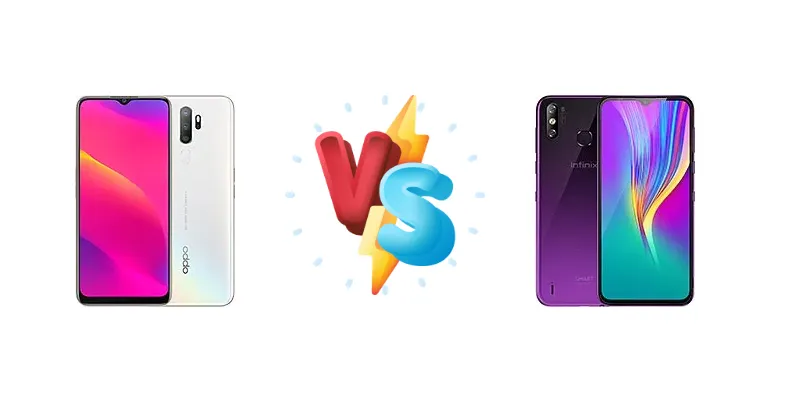
The Oppo A11 and Infinix Smart 4c represent the extreme end of the smartphone price spectrum. Both aim to deliver essential smartphone functionality at a minimal cost, but they take different approaches to achieving this. The A11 leverages Qualcomm’s Snapdragon 665, while the Smart 4c opts for MediaTek’s Helio A22. This comparison dissects these choices, revealing which phone offers the best value for users prioritizing performance, battery life, and overall usability.
🏆 Quick Verdict
For the average user needing a phone for everyday tasks and occasional light gaming, the Oppo A11 is the superior choice. Its Snapdragon 665 chipset provides a significantly more responsive experience than the Helio A22 in the Infinix Smart 4c, justifying a potential price premium.
| Network |
|---|
| 2G bands | GSM 850 / 900 / 1800 / 1900 | GSM 850 / 900 / 1800 / 1900 |
| 3G bands | HSDPA 850 / 900 / 2100 | HSDPA 850 / 900 / 2100 |
| 4G bands | 1, 3, 4, 5, 8, 34, 38, 39, 40, 41 | 1, 3, 5, 8, 38, 40, 41 |
| Speed | HSPA 42.2/5.76 Mbps, LTE (2CA) Cat6 400/50 Mbps | HSPA 21.1/5.76 Mbps, LTE Cat4 150/50 Mbps |
| Technology | GSM / CDMA / HSPA / LTE | GSM / HSPA / LTE |
| | CDMA 800 & TD-SCDMA | - |
| Launch |
|---|
| Announced | 2019, October. Released 2019, October | 2019, November. Released 2019, December |
| Status | Discontinued | Discontinued |
| Body |
|---|
| Build | Glass front, plastic back, plastic frame | - |
| Dimensions | 163.6 x 75.6 x 9.1 mm (6.44 x 2.98 x 0.36 in) | 167 x 76 x 8.3 mm (6.57 x 2.99 x 0.33 in) |
| SIM | Nano-SIM + Nano-SIM | Nano-SIM + Nano-SIM |
| Weight | 195 g (6.88 oz) | 183 g (6.46 oz) |
| Display |
|---|
| Resolution | 720 x 1600 pixels, 20:9 ratio (~270 ppi density) | 720 x 1600 pixels, 20:9 ratio (~266 ppi density) |
| Size | 6.5 inches, 102.0 cm2 (~82.5% screen-to-body ratio) | 6.6 inches, 105.2 cm2 (~82.9% screen-to-body ratio) |
| Type | IPS LCD | IPS LCD |
| Platform |
|---|
| CPU | Octa-core (4x2.0 GHz Kryo 260 Gold & 4x1.8 GHz Kryo 260 Silver) | Quad-core 2.0 GHz Cortex-A53 |
| Chipset | Qualcomm SDM665 Snapdragon 665 (11 nm) | Mediatek MT6761 Helio A22 (12 nm) |
| GPU | Adreno 610 | PowerVR GE8320 |
| OS | Android 9.0 (Pie), ColorOS 6.0 | Android 9.0 (Pie) |
| Memory |
|---|
| Card slot | microSDXC (dedicated slot) | microSDXC (dedicated slot) |
| Internal | 64GB 4GB RAM, 128GB 4GB RAM, 128GB 6GB RAM, 256GB 6GB RAM | 32GB 2GB RAM |
| | UFS 2.1 | eMMC 5.1 |
| Main Camera |
|---|
| Dual | - | 8 MP
Auxiliary lens |
| Features | LED flash, HDR, panorama | Dual-LED flash |
| Quad | 12 MP, f/1.8, (wide), PDAF
8 MP, f/2.3, 13mm (ultrawide), 1/4.0", 1.12µm, AF
2 MP, f/2.4, 1/5.0", 1.75µm
Auxiliary lens | - |
| Video | 4K@30fps, 1080p@30fps, gyro-EIS | 1080p@30fps |
| Selfie camera |
|---|
| Features | HDR | - |
| Single | 8 MP, f/2.0 | 5 MP |
| Video | 1080p@30fps | - |
| Sound |
|---|
| 3.5mm jack | Yes | Yes |
| 35mm jack | Yes | Yes |
| Loudspeaker | Yes, with stereo speakers | Yes |
| | 24-bit/192kHz audio | - |
| Comms |
|---|
| Bluetooth | 5.0, A2DP, LE | 5.0, A2DP, LE |
| NFC | No | No |
| Positioning | GPS, GLONASS, GALILEO, QZSS, BDS | GPS |
| Radio | FM radio | FM radio |
| USB | USB Type-C 2.0 | microUSB 2.0 |
| WLAN | Wi-Fi 802.11 a/b/g/n/ac, dual-band, Wi-Fi Direct | Wi-Fi 802.11 a/b/g/n |
| Features |
|---|
| Sensors | Fingerprint (rear-mounted), accelerometer, gyro, proximity, compass | Fingerprint (rear-mounted), accelerometer, proximity, compass |
| Battery |
|---|
| Charging | 10W wired
Reverse wired | - |
| Type | Li-Po 5000 mAh, non-removable | 4000 mAh, non-removable |
| Misc |
|---|
| Colors | Purple, Lake Green, Cloud White | Midnight Black, Quetzal Cyan, Cosmic Purple |
| Models | PCHM10, PCHT10 | X653C |
| Price | About 200 EUR | - |
Oppo A11
- Significantly faster processor (Snapdragon 665)
- Better multitasking capabilities
- Reverse wired charging
- Potentially better camera image processing
- 10W charging is relatively slow
- Display specifications are basic
Infinix Smart 4c
- More affordable price point
- Potentially better battery efficiency due to 12nm process
- Simple and easy-to-use interface
- Lightweight design
- Slow and sluggish performance
- Limited multitasking capabilities
- Poor gaming performance
- Basic camera quality
Display Comparison
Neither Oppo nor Infinix provide detailed display specifications for these models. However, given their price points, both likely utilize LCD panels with 720p+ resolutions. The key difference lies in the processing power driving them. The Snapdragon 665 in the A11 will provide a smoother scrolling experience and faster app loading times, indirectly improving the perceived quality of the display. Bezels are expected to be substantial on both devices, reflecting their budget nature. Color accuracy is unlikely to be a strong point on either.
Camera Comparison
Camera performance on both devices is expected to be basic. Detailed sensor information is scarce, but both likely feature a primary camera paired with auxiliary sensors of limited utility. The Oppo A11 likely benefits from Qualcomm’s image signal processor (ISP) within the Snapdragon 665, offering potentially better image processing and noise reduction compared to the Helio A22’s ISP. While megapixel counts may be similar, the A11’s ISP will likely deliver more usable images, particularly in challenging lighting conditions. Focusing on the primary sensor is key, as any additional 2MP macro or depth sensors will offer minimal benefit.
Performance
The performance gap between the Oppo A11 and Infinix Smart 4c is substantial. The A11’s Qualcomm Snapdragon 665, built on an 11nm process, features an octa-core CPU (4x2.0 GHz Kryo 260 Gold & 4x1.8 GHz Kryo 260 Silver). This contrasts sharply with the Smart 4c’s MediaTek Helio A22, a quad-core 2.0 GHz Cortex-A53 processor fabricated on a more efficient 12nm node. While the A22’s 12nm process is more efficient, the sheer core count and architectural advantages of the Snapdragon 665 translate to significantly faster processing speeds and improved multitasking capabilities. The A11 will handle app switching and more demanding applications with greater ease. Gaming performance will also be noticeably better on the A11, though neither phone is suited for graphically intensive titles.
Battery Life
Battery capacity is not specified in the provided data. However, both phones likely feature batteries in the 4000-5000 mAh range, typical for this price segment. The Oppo A11’s 10W wired charging is standard for budget devices, while the Infinix Smart 4c’s charging capabilities are unknown. The more efficient Snapdragon 665 in the A11 may contribute to slightly better battery life under moderate usage, but real-world battery performance will heavily depend on usage patterns and display brightness. The A11 also offers reverse wired charging, a feature absent on the Smart 4c, allowing it to act as a power bank for other devices.
Buying Guide
Buy the Oppo A11 if you need a phone capable of handling multitasking, streaming video, and playing less demanding games without significant lag. It’s ideal for users who value a smoother, more responsive user experience. Buy the Infinix Smart 4c if your primary needs are basic communication – calls, texts, and light social media – and you prioritize absolute affordability above all else. It’s a suitable option for first-time smartphone users or as a reliable backup device.
Frequently Asked Questions
❓ Will the Helio A22 in the Infinix Smart 4c struggle with popular apps like WhatsApp and Facebook?
While the Helio A22 can run these apps, you may experience noticeable lag and slowdowns, especially when multitasking or using the apps for extended periods. The Oppo A11’s Snapdragon 665 provides a much smoother experience for these common applications.
❓ Is the Oppo A11 a good choice for playing mobile games like PUBG Mobile or Call of Duty?
The Oppo A11 can handle less demanding games, but it's not ideal for graphically intensive titles like PUBG Mobile or Call of Duty. You'll likely need to play at the lowest settings and may still experience frame rate drops. The Helio A22 in the Smart 4c is even less capable of handling these games.
❓ Does the reverse charging feature on the Oppo A11 significantly extend the battery life of other devices?
The 10W reverse charging on the Oppo A11 is a convenient feature, but it's not a fast charging solution. It will provide a slow trickle charge to other devices, offering a small boost in battery life rather than a full recharge.