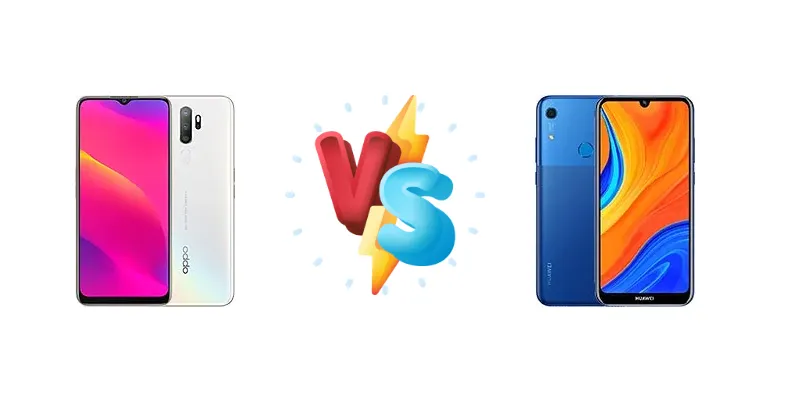
The Oppo A11 and Huawei Y6s (2019) represent two contenders in the fiercely competitive sub-$150 smartphone market. While both aim to deliver essential smartphone functionality at an accessible price, they diverge significantly in their core hardware. This comparison dissects those differences, focusing on the impact of their respective chipsets and how they translate to real-world user experience.
🏆 Quick Verdict
For the average user prioritizing consistent performance and future-proofing, the Oppo A11 emerges as the better choice. Its Qualcomm Snapdragon 665, built on an 11nm process, offers a noticeable performance advantage over the Huawei Y6s’ MediaTek Helio P35, despite the latter’s slightly higher clock speed on some cores.
| Network |
|---|
| 2G bands | GSM 850 / 900 / 1800 / 1900 | GSM 850 / 900 / 1800 / 1900 |
| 3G bands | HSDPA 850 / 900 / 2100 | HSDPA 850 / 900 / 1900 / 2100 - JAT-L29, JAT-LX1, JAT-LX1 NFC |
| 4G bands | 1, 3, 4, 5, 8, 34, 38, 39, 40, 41 | 1, 3, 5, 7, 8, 20, 38, 40, 41 - JAT-L29 |
| Speed | HSPA 42.2/5.76 Mbps, LTE (2CA) Cat6 400/50 Mbps | HSPA, LTE |
| Technology | GSM / CDMA / HSPA / LTE | GSM / HSPA / LTE |
| | CDMA 800 & TD-SCDMA | 1, 2, 3, 4, 5, 7, 8, 28, 38, 41 - JAT-LX3 |
| Launch |
|---|
| Announced | 2019, October. Released 2019, October | 2020, January 30. Released 2020, May |
| Status | Discontinued | Discontinued |
| Body |
|---|
| Build | Glass front, plastic back, plastic frame | Glass front, plastic back, plastic frame |
| Dimensions | 163.6 x 75.6 x 9.1 mm (6.44 x 2.98 x 0.36 in) | 156.3 x 73.5 x 8 mm (6.15 x 2.89 x 0.31 in) |
| SIM | Nano-SIM + Nano-SIM | Nano-SIM + Nano-SIM |
| Weight | 195 g (6.88 oz) | 150 g (5.29 oz) |
| Display |
|---|
| Resolution | 720 x 1600 pixels, 20:9 ratio (~270 ppi density) | 720 x 1560 pixels, 19.5:9 ratio (~282 ppi density) |
| Size | 6.5 inches, 102.0 cm2 (~82.5% screen-to-body ratio) | 6.09 inches, 91.0 cm2 (~79.2% screen-to-body ratio) |
| Type | IPS LCD | IPS LCD |
| Platform |
|---|
| CPU | Octa-core (4x2.0 GHz Kryo 260 Gold & 4x1.8 GHz Kryo 260 Silver) | Octa-core (4x2.3 GHz Cortex-A53 & 4x1.8 GHz Cortex-A53) |
| Chipset | Qualcomm SDM665 Snapdragon 665 (11 nm) | Mediatek MT6765 Helio P35 (12 nm) |
| GPU | Adreno 610 | PowerVR GE8320 |
| OS | Android 9.0 (Pie), ColorOS 6.0 | Android 9.0 (Pie), EMUI 9.1 |
| Memory |
|---|
| Card slot | microSDXC (dedicated slot) | microSDXC (dedicated slot) |
| Internal | 64GB 4GB RAM, 128GB 4GB RAM, 128GB 6GB RAM, 256GB 6GB RAM | 32GB 3GB RAM, 64GB 3GB RAM |
| | UFS 2.1 | eMMC 5.1 |
| Main Camera |
|---|
| Features | LED flash, HDR, panorama | LED flash, HDR, panorama |
| Quad | 12 MP, f/1.8, (wide), PDAF
8 MP, f/2.3, 13mm (ultrawide), 1/4.0", 1.12µm, AF
2 MP, f/2.4, 1/5.0", 1.75µm
Auxiliary lens | - |
| Single | - | 13 MP, f/1.8, PDAF |
| Video | 4K@30fps, 1080p@30fps, gyro-EIS | 1080p@30fps |
| Selfie camera |
|---|
| Features | HDR | - |
| Single | 8 MP, f/2.0 | 8 MP, f/2.0 |
| Video | 1080p@30fps | 1080p@30fps |
| Sound |
|---|
| 3.5mm jack | Yes | Yes |
| 35mm jack | Yes | Yes |
| Loudspeaker | Yes, with stereo speakers | Yes |
| | 24-bit/192kHz audio | - |
| Comms |
|---|
| Bluetooth | 5.0, A2DP, LE | 4.2, A2DP, LE |
| NFC | No | Yes (JAT-LX1 NFC only) |
| Positioning | GPS, GLONASS, GALILEO, QZSS, BDS | GPS, GLONASS, BDS |
| Radio | FM radio | FM Radio, built-in antenna |
| USB | USB Type-C 2.0 | microUSB 2.0 |
| WLAN | Wi-Fi 802.11 a/b/g/n/ac, dual-band, Wi-Fi Direct | Wi-Fi 802.11 b/g/n, Wi-Fi Direct |
| Features |
|---|
| Sensors | Fingerprint (rear-mounted), accelerometer, gyro, proximity, compass | Fingerprint (rear-mounted), accelerometer, proximity |
| Battery |
|---|
| Charging | 10W wired
Reverse wired | - |
| Type | Li-Po 5000 mAh, non-removable | Li-Po 3020 mAh |
| Misc |
|---|
| Colors | Purple, Lake Green, Cloud White | Orchid Blue, Starry Black |
| Models | PCHM10, PCHT10 | JAT-LX3, JAT-L29, JAT-LX1, JAT-L41 |
| Price | About 200 EUR | About 160 EUR |
Oppo A11
- More powerful Snapdragon 665 chipset
- Better power efficiency for longer battery life
- Reverse wired charging capability
- 10W charging is relatively slow
- Limited detailed specifications available
Huawei Y6s (2019)
- Potentially lower initial cost
- Slightly higher CPU clock speed (on some cores)
- Simple and straightforward user experience
- Less powerful Helio P35 chipset
- Lower graphics performance
- Less efficient power consumption
Display Comparison
Neither Oppo nor Huawei provide detailed display specifications for these models. However, given their price points, it’s safe to assume both utilize LCD panels. The key difference lies under the hood. The lack of detailed specs makes a direct comparison difficult, but the focus should be on real-world viewing experience, which will likely be similar given the target market. Expect standard 720p+ resolutions and adequate, but not exceptional, color accuracy.
Camera Comparison
Without detailed sensor information, a precise camera comparison is challenging. Both phones likely feature a primary camera paired with depth or macro sensors. However, the image signal processor (ISP) within the Snapdragon 665 is generally more advanced, offering better image processing capabilities – improved dynamic range, noise reduction, and color accuracy. The A11 is likely to produce more consistently pleasing photos, especially in challenging lighting conditions. The Y6s’ camera performance will likely be adequate for basic snapshots but will struggle in low light.
Performance
The Oppo A11’s Qualcomm Snapdragon 665 (11nm) and the Huawei Y6s’ MediaTek Helio P35 (12nm) represent a crucial divergence. While the Helio P35 boasts a higher peak clock speed (2.3 GHz vs 2.0 GHz on the Snapdragon’s performance cores), the Snapdragon 665 benefits from a more modern architecture (Kryo 260 cores) and a smaller manufacturing process. The 11nm process generally translates to better power efficiency and thermal management, meaning the A11 is less likely to throttle under sustained load. The Snapdragon 665’s Adreno 610 GPU also provides a significant advantage in graphics performance, making it the better choice for casual gaming. The Y6s relies on a PowerVR GE8320, which is less capable.
Battery Life
Both devices likely feature batteries in the 4000-5000 mAh range, typical for this price segment. However, the Snapdragon 665’s superior power efficiency gives the Oppo A11 an edge in battery life. While both support 10W charging, the A11 also offers reverse wired charging, a useful feature for topping up accessories. The Helio P35, while built on a 12nm process, is less efficient overall, meaning the Y6s may require more frequent charging despite a potentially similar battery capacity.
Buying Guide
Buy the Oppo A11 if you need a phone capable of handling everyday tasks smoothly, with a bit of headroom for light gaming and multitasking. The Snapdragon 665 provides a more responsive experience. Buy the Huawei Y6s (2019) if your primary needs are basic communication – calls, texts, and light social media – and you prioritize a potentially lower initial cost, accepting compromises in performance and long-term usability.
Frequently Asked Questions
❓ Will the Oppo A11 handle popular games like PUBG Mobile or Call of Duty Mobile?
The Snapdragon 665 in the Oppo A11 can run PUBG Mobile and Call of Duty Mobile, but you’ll likely need to lower the graphics settings to medium or low to achieve a smooth frame rate. The Helio P35 in the Y6s will struggle with these titles, even on the lowest settings.
❓ Is the difference in chipset performance noticeable for everyday tasks like browsing and social media?
Yes, the Snapdragon 665 provides a noticeably smoother and more responsive experience for everyday tasks. Apps will launch faster, multitasking will be more fluid, and scrolling will be less laggy compared to the Huawei Y6s.
❓ Does the Huawei Y6s (2019) support Google Mobile Services (GMS)?
The Huawei Y6s (2019) predates the full restrictions on Huawei’s access to GMS. It *should* include the Play Store and other core Google apps. However, software updates may be limited.
❓ How long will it take to fully charge each phone from 0%?
With 10W charging, both phones will take approximately 2.5 to 3.5 hours to fully charge from 0%. The Oppo A11’s more efficient chipset will reach 100% slightly faster, but the difference won’t be dramatic.