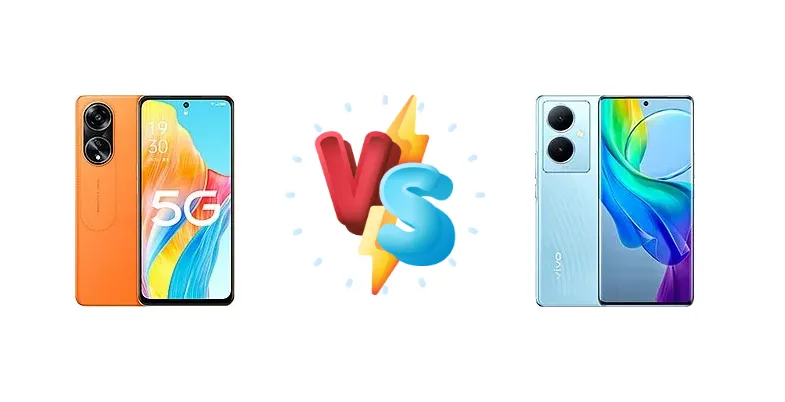
The budget smartphone market is fiercely competitive, and the Oppo A1 and vivo Y78+ are two strong contenders. Both offer 5G connectivity and a Snapdragon 695 chipset, but key differences in charging speed and potentially other features could sway your decision. Let's dive into a detailed comparison to help you choose the right phone for your needs.
🏆 Quick Verdict
The Oppo A1 takes a clear lead thanks to its significantly faster 67W charging. While both phones share the same capable Snapdragon 695 chipset, the Oppo A1's charging advantage makes it the better choice for those prioritizing quick top-ups. The vivo Y78+ might offer other advantages like design or software, but charging is key.
| Network |
|---|
| 2G bands | GSM 850 / 900 / 1800 / 1900 | GSM 850 / 900 / 1800 / 1900 |
| 3G bands | HSDPA 850 / 900 / 1700(AWS) / 1900 / 2100 | HSDPA 850 / 900 / 2100 |
| 4G bands | 1, 3, 4, 5, 8, 28, 34, 38, 39, 40, 41 | 1, 3, 5, 8, 28, 34, 38, 39, 40, 41 |
| 5G bands | 1, 5, 8, 28, 41, 77, 78 SA/NSA | 1, 5, 8, 28, 41, 77, 78 SA/NSA |
| Speed | HSPA, LTE, 5G | HSPA, LTE, 5G |
| Technology | GSM / CDMA / HSPA / CDMA2000 / LTE / 5G | GSM / CDMA / HSPA / CDMA2000 / LTE / 5G |
| | CDMA 800 & TD-SCDMA | CDMA2000 1x |
| Launch |
|---|
| Announced | 2023, April 04 | 2023, April 24 |
| Status | Available. Released 2023, April 14 | Available. Released 2023, April 26 |
| Body |
|---|
| Build | - | Glass front, plastic frame, plastic back |
| Dimensions | 165.6 x 76.1 x 8.2 mm (6.52 x 3.00 x 0.32 in) | 164.3 x 74.8 x 7.9 mm (6.47 x 2.94 x 0.31 in) |
| SIM | Nano-SIM + Nano-SIM | Nano-SIM + Nano-SIM |
| Weight | 191 g or 193 g (6.74 oz) | 177 g (6.24 oz) |
| Display |
|---|
| Protection | Corning Gorilla Glass 3 | - |
| Resolution | 1080 x 2400 pixels, 20:9 ratio (~392 ppi density) | 1080 x 2400 pixels, 20:9 ratio (~388 ppi density) |
| Size | 6.72 inches, 109.0 cm2 (~86.5% screen-to-body ratio) | 6.78 inches, 111.0 cm2 (~90.3% screen-to-body ratio) |
| Type | IPS LCD, 120Hz, 550 nits (typ), 680 nits (HBM) | AMOLED, 120Hz, 1300 nits (peak) |
| Platform |
|---|
| CPU | Octa-core (2x2.2 GHz Kryo 660 Gold & 6x1.7 GHz Kryo 660 Silver) | Octa-core (2x2.2 GHz Kryo 660 Gold & 6x1.7 GHz Kryo 660 Silver) |
| Chipset | Qualcomm SM6375 Snapdragon 695 5G (6 nm) | Qualcomm SM6375 Snapdragon 695 5G (6 nm) |
| GPU | Adreno 619 | Adreno 619 |
| OS | Android 13, ColorOS 13.1 | Android 13, OriginOS 3 |
| Memory |
|---|
| Card slot | microSDXC | No |
| Internal | 256GB 8GB RAM, 256GB 12GB RAM | 128GB 8GB RAM, 256GB 8GB RAM, 256GB 12GB RAM |
| | eMMC 5.1 | UFS 2.2 |
| Main Camera |
|---|
| Dual | 50 MP, f/1.8, (wide), AF
Auxiliary lens | 50 MP, f/1.8, (wide), PDAF, OIS
Auxiliary lens |
| Features | LED flash, HDR, panorama | LED flash, HDR, panorama |
| Single | 13 MP, f/2.2, 1/3.1", 1.12µm, PDAF | - |
| Video | 1080p@30fps | 1080p@30fps |
| Selfie camera |
|---|
| Features | Panorama | - |
| Single | 8 MP, f/2.0, (wide) | 8 MP, f/2.0, (wide) |
| Video | 1080p@30fps | 1080p@30fps |
| Sound |
|---|
| 3.5mm jack | Yes | Yes |
| 35mm jack | Yes | No |
| Loudspeaker | Yes, with stereo speakers | Yes |
| Comms |
|---|
| Bluetooth | 5.1, A2DP, LE, aptX HD | 5.1, A2DP, LE, aptX HD, aptX Adaptive |
| Infrared port | Yes | - |
| NFC | No | No |
| Positioning | GPS, GALILEO, GLONASS, BDS, QZSS | GPS (L1), GLONASS (G1), BDS (B1I+B1c), GALILEO (E1), QZSS (L1) |
| Radio | No | No |
| USB | USB Type-C 2.0, OTG | USB Type-C 2.0, OTG |
| WLAN | Wi-Fi 802.11 a/b/g/n/ac, dual-band | Wi-Fi 802.11 a/b/g/n/ac, dual-band, Wi-Fi Direct |
| Features |
|---|
| Sensors | Fingerprint (side-mounted), accelerometer, proximity, compass | Fingerprint (under display, optical), accelerometer, gyro, proximity, compass |
| Battery |
|---|
| Charging | 67W wired, PD, 76% in 30 min | 44W wired |
| Type | Li-Po 5000 mAh | 5000 mAh |
| Misc |
|---|
| Colors | Black, Blue, Orange | Black, Blue, Gold |
| Models | PHS110 | V2271A |
| Price | About 270 EUR | About 210 EUR |
Oppo A1
- 67W Fast Charging
- Snapdragon 695 5G Chipset
- Likely good value for money
- Potentially less refined design compared to vivo
- Camera details unknown
vivo Y78+
- Potentially better design and build quality
- Likely good software experience (vivo's Funtouch OS)
- Decent camera capabilities (speculative)
- Slower 44W Charging
- Snapdragon 695 5G Chipset (shared with Oppo A1)
Display Comparison
While specific display details are not provided, both phones likely feature similar LCD panels in the 6.4-6.7 inch range. Expect FHD+ resolution and a standard 60Hz refresh rate. Differences in color accuracy and brightness would need to be assessed through hands-on testing.
Camera Comparison
Camera specifications are not fully detailed. Both likely feature a primary 50MP sensor, but differences in secondary lenses (ultrawide, macro, depth) and image processing algorithms will impact photo quality. The vivo Y78+ might have a slight edge in camera features based on vivo's typical offerings.
Performance
Both devices are powered by the same Qualcomm Snapdragon 695 5G chipset, ensuring comparable performance in everyday tasks and moderate gaming. Expect smooth multitasking and responsive app loading. However, thermal management could differ slightly between the two phones.
Battery Life
The Oppo A1 boasts a significant advantage with its 67W wired charging, allowing for much faster charging times compared to the vivo Y78+'s 44W charging. Battery capacity is likely similar, around 5000mAh, meaning both phones should offer all-day battery life with moderate usage.
Buying Guide
The Oppo A1 is ideal for users who value fast charging above all else and want a reliable 5G experience. The vivo Y78+ is a good option for those prioritizing design, software features, or potentially a slightly better camera experience (though this is speculative without detailed camera testing) and are less concerned about charging speed.
Frequently Asked Questions
❓ Which phone has faster charging?
The Oppo A1 has significantly faster charging with 67W compared to the vivo Y78+'s 44W.
❓ Do both phones support 5G?
Yes, both the Oppo A1 and vivo Y78+ support 5G connectivity.