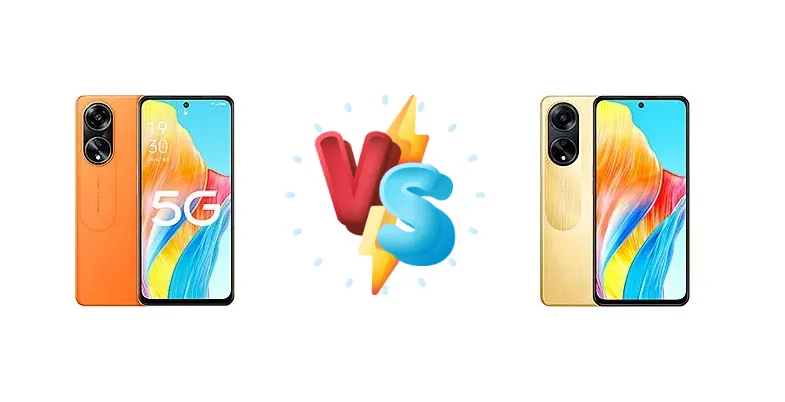
Oppo's A-series and F-series both cater to the budget-conscious smartphone user. The Oppo A1 and F23 share a common chipset, but subtle differences in features and design might make one a better choice for you. Let's dive into a comprehensive comparison to help you decide.
🏆 Quick Verdict
The Oppo F23 edges out the A1 primarily due to its potentially faster charging (advertised) and likely design/feature refinements. Both offer solid 5G performance thanks to the Snapdragon 695, but the F23's slightly improved charging and potentially better camera software make it the preferred pick for most.
| Network |
|---|
| 2G bands | GSM 850 / 900 / 1800 / 1900 | GSM 850 / 900 / 1800 / 1900 |
| 3G bands | HSDPA 850 / 900 / 1700(AWS) / 1900 / 2100 | HSDPA 900 / 2100 |
| 4G bands | 1, 3, 4, 5, 8, 28, 34, 38, 39, 40, 41 | 1, 3, 5, 8, 40, 41 |
| 5G bands | 1, 5, 8, 28, 41, 77, 78 SA/NSA | 1, 3, 5, 8, 28, 40, 41, 77, 78 SA/NSA |
| Speed | HSPA, LTE, 5G | HSPA, LTE, 5G |
| Technology | GSM / CDMA / HSPA / CDMA2000 / LTE / 5G | GSM / HSPA / LTE / 5G |
| | CDMA 800 & TD-SCDMA | - |
| Launch |
|---|
| Announced | 2023, April 04 | 2023, May 15 |
| Status | Available. Released 2023, April 14 | Available. Released 2023, May 18 |
| Body |
|---|
| Dimensions | 165.6 x 76.1 x 8.2 mm (6.52 x 3.00 x 0.32 in) | 165.6 x 76.1 x 8.2 mm (6.52 x 3.00 x 0.32 in) |
| SIM | Nano-SIM + Nano-SIM | Nano-SIM + Nano-SIM |
| Weight | 191 g or 193 g (6.74 oz) | 192 g (6.77 oz) |
| Display |
|---|
| Protection | Corning Gorilla Glass 3 | - |
| Resolution | 1080 x 2400 pixels, 20:9 ratio (~392 ppi density) | 1080 x 2400 pixels, 20:9 ratio (~392 ppi density) |
| Size | 6.72 inches, 109.0 cm2 (~86.5% screen-to-body ratio) | 6.72 inches, 109.0 cm2 (~86.5% screen-to-body ratio) |
| Type | IPS LCD, 120Hz, 550 nits (typ), 680 nits (HBM) | IPS LCD, 120Hz, 550 nits (typ), 680 nits (HBM) |
| Platform |
|---|
| CPU | Octa-core (2x2.2 GHz Kryo 660 Gold & 6x1.7 GHz Kryo 660 Silver) | Octa-core (2x2.2 GHz Kryo 660 Gold & 6x1.7 GHz Kryo 660 Silver) |
| Chipset | Qualcomm SM6375 Snapdragon 695 5G (6 nm) | Qualcomm SM6375 Snapdragon 695 5G (6 nm) |
| GPU | Adreno 619 | Adreno 619 |
| OS | Android 13, ColorOS 13.1 | Android 13, upgradable to Android 14, ColorOS 14 |
| Memory |
|---|
| Card slot | microSDXC | microSDXC |
| Internal | 256GB 8GB RAM, 256GB 12GB RAM | 128GB 8GB RAM, 256GB 8GB RAM |
| | eMMC 5.1 | UFS 2.2 |
| Main Camera |
|---|
| Dual | 50 MP, f/1.8, (wide), AF
Auxiliary lens | 64 MP, f/1.8, 26mm (wide), PDAF
2 MP, f/3.3, 34mm (microscope)
Auxiliary lens |
| Features | LED flash, HDR, panorama | LED flash, HDR, panorama |
| Single | 13 MP, f/2.2, 1/3.1", 1.12µm, PDAF | - |
| Video | 1080p@30fps | 1080p@30fps |
| Selfie camera |
|---|
| Features | Panorama | Panorama |
| Single | 8 MP, f/2.0, (wide) | 32 MP, f/2.4, 22mm (wide) |
| Video | 1080p@30fps | 1080p@30fps |
| Sound |
|---|
| 3.5mm jack | Yes | Yes |
| 35mm jack | Yes | Yes |
| Loudspeaker | Yes, with stereo speakers | Yes, with stereo speakers |
| Comms |
|---|
| Bluetooth | 5.1, A2DP, LE, aptX HD | 5.1, A2DP, LE, aptX HD |
| Infrared port | Yes | Yes |
| NFC | No | No |
| Positioning | GPS, GALILEO, GLONASS, BDS, QZSS | GPS (L1), GLONASS (G1), BDS (B1I), GALILEO (E1), QZSS (L1) |
| Radio | No | No |
| USB | USB Type-C 2.0, OTG | USB Type-C 2.0, OTG |
| WLAN | Wi-Fi 802.11 a/b/g/n/ac, dual-band | Wi-Fi 802.11 a/b/g/n/ac, dual-band |
| Features |
|---|
| Sensors | Fingerprint (side-mounted), accelerometer, proximity, compass | Fingerprint (side-mounted), accelerometer, gyro, proximity, compass |
| Battery |
|---|
| Charging | 67W wired, PD, 76% in 30 min | 67W wired, PD, 50% in 18 min (advertised) |
| Type | Li-Po 5000 mAh | Li-Po 5000 mAh |
| Misc |
|---|
| Colors | Black, Blue, Orange | Cool Black, Bold Gold |
| Models | PHS110 | CPH2527 |
| Price | About 270 EUR | About 270 EUR |
| SAR | - | 1.19 W/kg (head) 0.96 W/kg (body) |
Oppo A1
- Potentially lower price
- Solid 5G performance
- Decent battery life
- Likely simpler camera system
- Potentially less refined design
- Slower advertised charging
Oppo F23
- Faster advertised charging
- Likely improved camera system
- Potentially more refined design
- Solid 5G performance
- Potentially higher price
- Battery life may be similar to A1
Display Comparison
While both likely feature similar 6.7-inch FHD+ displays, the F23 might offer a slightly improved panel with better color accuracy or brightness. The A1 may prioritize affordability, potentially using a more basic display. Actual display quality will depend on the specific panel used in each device.
Camera Comparison
The F23 is expected to have a more advanced camera system, potentially with improved image processing and additional features like optical image stabilization (OIS). The A1 likely has a simpler camera setup, focusing on affordability. Expect the F23 to deliver better image quality, especially in low light.
Performance
Both phones are powered by the Snapdragon 695 5G, ensuring smooth everyday performance and decent gaming capabilities. Differences in RAM and software optimization could slightly impact real-world speed, but the core processing power is identical. Expect similar performance in most tasks.
Battery Life
Both phones likely have a 5000mAh battery. The F23's advertised 50% charge in 18 minutes (with 67W charging) is a significant advantage over the A1's 76% in 30 minutes (also 67W). Real-world charging times may vary.
Buying Guide
The Oppo A1 is ideal for users prioritizing raw performance and a potentially lower price point. The Oppo F23 is a better choice for those who value faster charging, a more refined design (likely with a better camera setup and software), and are willing to spend a bit more.
Frequently Asked Questions
❓ Is the Snapdragon 695 5G chipset good for gaming?
Yes, the Snapdragon 695 5G is capable of handling most mobile games at medium settings. Don't expect flagship-level performance, but it's sufficient for casual and moderate gaming.
❓ What is the difference between the Oppo A-series and F-series?
Generally, the F-series focuses on design and camera features, while the A-series prioritizes affordability and essential features. However, the lines are blurring, and both series offer competitive devices.