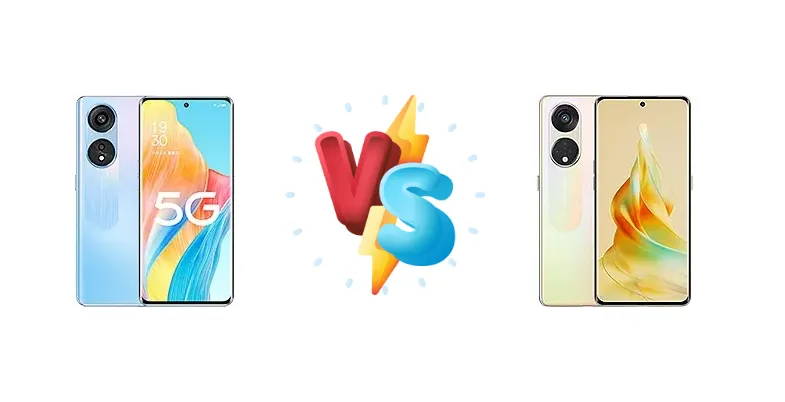
Oppo's A-series and Reno-series offer compelling mid-range smartphones, often blurring the lines between budget and premium. The Oppo A1 Pro and Reno8 T 5G both share the same Snapdragon 695 5G chipset, but subtle differences in design, features, and price could sway your decision. Let's dive into a detailed comparison to help you choose the right one.
🏆 Quick Verdict
Both phones offer excellent value with the Snapdragon 695 5G. The Reno8 T 5G edges out the A1 Pro with a slightly more refined design and potentially better camera software optimization, justifying its slightly higher price. However, the A1 Pro is a strong contender if budget is a primary concern.
| Network |
|---|
| 2G bands | GSM 850 / 900 / 1800 / 1900 | GSM 850 / 900 / 1800 / 1900 |
| 3G bands | HSDPA 850 / 900 / 1900 / 2100 | HSDPA 800 / 850 / 900 / 1700(AWS) / 1900 / 2100 |
| 4G bands | 1, 3, 4, 5, 8, 28, 34, 38, 39, 40, 41 | 1, 2, 3, 4, 5, 7, 8, 12, 17, 18, 19, 20, 26, 28, 38, 39, 40, 41, 66 |
| 5G bands | 1, 5, 8, 28, 41, 77, 78 SA/NSA | 1, 3, 5, 7, 8, 20, 28, 38, 40, 41, 66, 77, 78 SA/NSA |
| Speed | HSPA, LTE, 5G | HSPA, LTE, 5G |
| Technology | GSM / CDMA / HSPA / CDMA2000 / LTE / 5G | GSM / HSPA / LTE / 5G |
| | CDMA2000 1x | - |
| Launch |
|---|
| Announced | 2022, November 16 | 2023, February 01 |
| Status | Available. Released 2022, November 25 | Available. Released 2023, February 10 |
| Body |
|---|
| Dimensions | 162.3 x 74.3 x 7.7 mm (6.39 x 2.93 x 0.30 in) | 162.3 x 74.3 x 7.7 mm (6.39 x 2.93 x 0.30 in) |
| SIM | Nano-SIM + Nano-SIM | Nano-SIM + Nano-SIM |
| Weight | 171 g (6.03 oz) | 171 g (6.03 oz) |
| Display |
|---|
| Protection | AGC DT-Star2 | Asahi Glass AGC DT-Star2 |
| Resolution | 1080 x 2412 pixels, 20:9 ratio (~394 ppi density) | 1080 x 2412 pixels, 20:9 ratio (~394 ppi density) |
| Size | 6.7 inches, 108.0 cm2 (~89.6% screen-to-body ratio) | 6.7 inches, 108.0 cm2 (~89.6% screen-to-body ratio) |
| Type | OLED, 1B colors, 120Hz, 500 nits (typ), 800 nits (HBM), 950 nits (peak) | AMOLED, 1B colors, 120Hz, 500 nits (typ), 800 nits (HBM), 950 nits (peak) |
| Platform |
|---|
| CPU | Octa-core (2x2.2 GHz Kryo 660 Gold & 6x1.7 GHz Kryo 660 Silver) | Octa-core (2x2.2 GHz Kryo 660 Gold & 6x1.7 GHz Kryo 660 Silver) |
| Chipset | Qualcomm SM6375 Snapdragon 695 5G (6 nm) | Qualcomm SM6375 Snapdragon 695 5G (6 nm) |
| GPU | Adreno 619 | Adreno 619 |
| OS | Android 13, ColorOS 13 | Android 13, upgradable to Android 14, ColorOS 14 |
| Memory |
|---|
| Card slot | microSDXC | microSDXC (uses shared SIM slot) |
| Internal | 128GB 8GB RAM, 256GB 8GB RAM, 256GB 12GB RAM | 128GB 8GB RAM, 256GB 8GB RAM |
| | UFS 2.2 | UFS 2.2 |
| Main Camera |
|---|
| Dual | 108 MP, f/1.7, 24mm (wide), 1/1.67", 0.64µm, AF
Auxiliary lens | 108 MP, f/1.7, 24mm (wide), 1/1.67", 0.64µm, AF
2 MP, f/3.3, 34mm (microscope)
2 MP, f/2.4, (depth) |
| Features | LED flash, HDR, panorama | LED flash, HDR, panorama |
| Single | 16 MP, f/2.4, 25mm (wide) | 32 MP, f/2.4, 22mm (wide) |
| Triple | - | 108 MP, f/1.7, 24mm (wide), 1/1.67", 0.64µm, AF
2 MP, f/3.3, 34mm (microscope)
Auxiliary lens |
| Video | 1080p@30fps | 1080p@30fps |
| Selfie camera |
|---|
| Features | - | HDR, panorama |
| Single | 16 MP, f/2.4, 25mm (wide) | 32 MP, f/2.4, 22mm (wide) |
| Video | 1080p@30fps | 1080p@30fps |
| Sound |
|---|
| 3.5mm jack | No | No |
| 35mm jack | No | No |
| Loudspeaker | Yes, with stereo speakers | Yes, with stereo speakers |
| Comms |
|---|
| Bluetooth | 5.1, A2DP, LE, aptX HD | 5.1, A2DP, LE, aptX HD |
| NFC | Yes | Yes |
| Positioning | GPS, GALILEO, GLONASS, BDS, QZSS | GPS, GALILEO, GLONASS, BDS, QZSS |
| Radio | No | No |
| USB | USB Type-C 2.0, OTG | USB Type-C 2.0, OTG |
| WLAN | Wi-Fi 802.11 a/b/g/n/ac, dual-band | Wi-Fi 802.11 a/b/g/n/ac, dual-band |
| Features |
|---|
| Sensors | Fingerprint (under display, optical), accelerometer, gyro, proximity, compass | Fingerprint (under display, optical), accelerometer, gyro, proximity, compass |
| Battery |
|---|
| Charging | 67W wired, PD, 80% in 30 min
Reverse wired | 67W wired, PD, 100% in 44 min
Reverse wired |
| Type | Li-Po 4800 mAh | Li-Po 4800 mAh |
| Misc |
|---|
| Colors | Black, Blue, Gold | Black Starlight (Midnight Black), Dawn Gold (Sunrise Gold) |
| Models | PHQ110 | CPH2505 |
| Price | About 260 EUR | About 340 EUR |
Oppo A1 Pro
- Fast 67W Charging
- Clean Software Experience
- Competitive Price
- Reverse Wired Charging
- Potentially less refined design
- Camera may lack advanced features
- 60Hz display
Oppo Reno8 T 5G
- Slightly more premium design
- Potentially better camera software
- Faster charging (to 100%)
- Good Value
- Slightly higher price
- 60Hz display
Display Comparison
Both phones likely feature similar 6.4-inch FHD+ AMOLED displays with a 60Hz refresh rate. The Reno8 T 5G might have slightly better color accuracy and brightness due to its generally higher positioning in Oppo's lineup. Expect vibrant colors and good viewing angles on both.
Camera Comparison
While both phones likely have a triple-camera setup with a 50MP main sensor, the Reno8 T 5G may benefit from improved image processing algorithms and potentially a slightly better ultrawide lens. Expect decent image quality in good lighting conditions on both, but low-light performance could be a differentiator.
Performance
Performance is virtually identical thanks to the shared Snapdragon 695 5G chipset. Both phones will handle everyday tasks, social media, and light gaming with ease. Demanding games might require lower graphics settings. Software optimization could be a differentiating factor, with Oppo potentially offering slightly smoother performance on the Reno8 T 5G.
Battery Life
Both offer 67W fast charging, but the Reno8 T 5G charges slightly faster (44 minutes vs 30 minutes for the A1 Pro to 80%). Battery capacity is likely similar (around 5000mAh), suggesting comparable battery life under typical usage.
Buying Guide
The Oppo A1 Pro is ideal for budget-conscious users who prioritize fast charging and a clean software experience. The Oppo Reno8 T 5G is a better choice for those seeking a more premium design, potentially improved camera performance, and a slightly more polished overall experience, willing to spend a bit more.
Frequently Asked Questions
❓ Is the Snapdragon 695 5G chipset good for gaming?
The Snapdragon 695 5G is capable of handling most games, but you may need to lower graphics settings for demanding titles to maintain smooth performance.
❓ What is reverse wired charging?
Reverse wired charging allows you to use your phone to charge other devices, like earbuds or smartwatches, using a USB cable.