
Oppo A1 Pro vs Google Pixel 7a: Which Mid-Range Champion Reigns Supreme?
| Phones Images | |||||
|---|---|---|---|---|---|
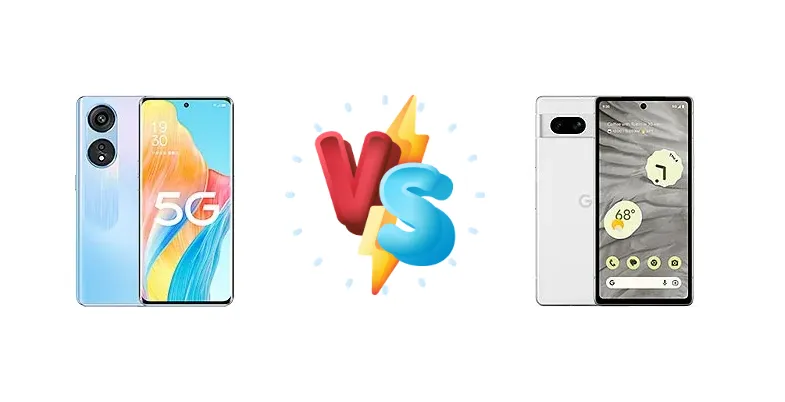
|
🏆 Quick Verdict
For the average user prioritizing camera quality and software experience, the Google Pixel 7a is the stronger choice. Its Tensor G2 chip delivers significantly better performance, and its camera consistently produces excellent results. However, the Oppo A1 Pro’s 67W charging is a game-changer for those who value speed and convenience.
| PHONES | ||
|---|---|---|
| Phone Names | Oppo A1 Pro | Google Pixel 7a |
| Network | ||
|---|---|---|
| 2G bands | GSM 850 / 900 / 1800 / 1900 | GSM 850 / 900 / 1800 / 1900 |
| 3G bands | HSDPA 850 / 900 / 1900 / 2100 | HSDPA 800 / 850 / 900 / 1700(AWS) / 1900 / 2100 |
| 4G bands | 1, 3, 4, 5, 8, 28, 34, 38, 39, 40, 41 | 1, 2, 3, 4, 5, 7, 8, 12, 13, 14, 17, 20, 25, 26, 28, 29, 30, 38, 40, 41, 48, 66, 71 - GWKK3, G0DZQ |
| 5G bands | 1, 5, 8, 28, 41, 77, 78 SA/NSA | 1, 2, 3, 5, 7, 8, 12, 14, 20, 25, 28, 30, 38, 41, 48, 66, 71, 77, 78 SA/NSA/Sub6 - GWKK3 |
| Speed | HSPA, LTE, 5G | HSPA, LTE, 5G |
| Technology | GSM / CDMA / HSPA / CDMA2000 / LTE / 5G | GSM / HSPA / LTE / 5G |
| CDMA2000 1x | 1, 2, 3, 5, 7, 8, 12, 20, 25, 28, 38, 40, 41, 66, 75, 76, 77, 78, 79 SA/NSA/Sub6 - GHL1X, G82U8 | |
| Launch | ||
|---|---|---|
| Announced | 2022, November 16 | 2023, May 10 |
| Status | Available. Released 2022, November 25 | Available. Released 2023, May 10 |
| Body | ||
|---|---|---|
| Build | - | Glass front (Gorilla Glass 3), aluminum frame, plastic back |
| Dimensions | 162.3 x 74.3 x 7.7 mm (6.39 x 2.93 x 0.30 in) | 152 x 72.9 x 9 mm (5.98 x 2.87 x 0.35 in) |
| SIM | Nano-SIM + Nano-SIM | Nano-SIM + eSIM |
| Weight | 171 g (6.03 oz) | 193.5 g (6.84 oz) |
| - | IP67 dust/water resistant (up to 1m for 30 min) | |
| Display | ||
|---|---|---|
| Protection | AGC DT-Star2 | Corning Gorilla Glass 3 |
| Resolution | 1080 x 2412 pixels, 20:9 ratio (~394 ppi density) | 1080 x 2400 pixels, 20:9 ratio (~429 ppi density) |
| Size | 6.7 inches, 108.0 cm2 (~89.6% screen-to-body ratio) | 6.1 inches, 90.7 cm2 (~81.8% screen-to-body ratio) |
| Type | OLED, 1B colors, 120Hz, 500 nits (typ), 800 nits (HBM), 950 nits (peak) | OLED, HDR, 90Hz |
| - | Always-on display | |
| Platform | ||
|---|---|---|
| CPU | Octa-core (2x2.2 GHz Kryo 660 Gold & 6x1.7 GHz Kryo 660 Silver) | Octa-core (2x2.85 GHz Cortex-X1 & 2x2.35 GHz Cortex-A78 & 4x1.80 GHz Cortex-A55) |
| Chipset | Qualcomm SM6375 Snapdragon 695 5G (6 nm) | Google Tensor G2 (5 nm) |
| GPU | Adreno 619 | Mali-G710 MP7 |
| OS | Android 13, ColorOS 13 | Android 13, upgradable to Android 15, up to 5 major Android upgrades |
| Memory | ||
|---|---|---|
| Card slot | microSDXC | No |
| Internal | 128GB 8GB RAM, 256GB 8GB RAM, 256GB 12GB RAM | 128GB 8GB RAM |
| UFS 2.2 | UFS 3.1 | |
| Main Camera | ||
|---|---|---|
| Dual | 108 MP, f/1.7, 24mm (wide), 1/1.67", 0.64µm, AF Auxiliary lens | 64 MP, f/1.9, 26mm (wide), 1/1.73", 0.8µm, dual pixel PDAF, OIS 13 MP, f/2.2, 120˚ (ultrawide), 1.12µm |
| Features | LED flash, HDR, panorama | Dual-LED flash, Pixel Shift, Auto-HDR, panorama |
| Single | 16 MP, f/2.4, 25mm (wide) | - |
| Video | 1080p@30fps | 4K@30/60fps, 1080p@30/60/120/240fps, OIS |
| Selfie camera | ||
|---|---|---|
| Features | - | HDR, panorama |
| Single | 16 MP, f/2.4, 25mm (wide) | 13 MP, f/2.2, 20mm (ultrawide), 1.12µm |
| Video | 1080p@30fps | 4K@30fps, 1080p@30fps |
| Sound | ||
|---|---|---|
| 3.5mm jack | No | No |
| 35mm jack | No | No |
| Loudspeaker | Yes, with stereo speakers | Yes, with stereo speakers |
| Comms | ||
|---|---|---|
| Bluetooth | 5.1, A2DP, LE, aptX HD | 5.3, A2DP, LE |
| NFC | Yes | Yes |
| Positioning | GPS, GALILEO, GLONASS, BDS, QZSS | GPS, GLONASS, GALILEO, BDS, QZSS, NavIC |
| Radio | No | No |
| USB | USB Type-C 2.0, OTG | USB Type-C 3.2 |
| WLAN | Wi-Fi 802.11 a/b/g/n/ac, dual-band | Wi-Fi 802.11 a/b/g/n/ac/6e, tri-band |
| Features | ||
|---|---|---|
| Sensors | Fingerprint (under display, optical), accelerometer, gyro, proximity, compass | Fingerprint (under display, optical), accelerometer, gyro, proximity, compass, barometer |
| Battery | ||
|---|---|---|
| Charging | 67W wired, PD, 80% in 30 min Reverse wired | 18W wired, PD3.0 7.5W wireless |
| Type | Li-Po 4800 mAh | Li-Po 4385 mAh |
| Misc | ||
|---|---|---|
| Colors | Black, Blue, Gold | Charcoal, Snow, Sea, Coral |
| Models | PHQ110 | GWKK3, GHL1X, G0DZQ, G82U8 |
| Price | About 260 EUR | € 179.90 / $ 150.00 / £ 170.00 / ₹ 25,980 |
Oppo A1 Pro
- Incredibly fast 67W charging
- Reverse wired charging capability
- Potentially more affordable price point
- Significantly less powerful processor
- Camera likely inferior to Pixel 7a
- Limited software update commitment (likely)
Google Pixel 7a
- Powerful Google Tensor G2 chip
- Excellent camera system with computational photography
- Guaranteed software updates and features
- Slow 18W charging
- Lower charging speed compared to Oppo A1 Pro
- Potentially higher price
Display Comparison
The Pixel 7a boasts a measured peak brightness of 1070 nits, offering excellent visibility in direct sunlight, a metric the A1 Pro’s display specifications lack. While the A1 Pro’s panel details are unavailable, the Pixel 7a’s OLED panel delivers vibrant colors and deep blacks. The Pixel 7a’s 90Hz refresh rate (assumed based on Pixel 7 series) provides a smoother scrolling experience than the likely 60Hz panel on the A1 Pro, enhancing overall usability. Bezels appear comparable based on available imagery, but the Pixel 7a’s color accuracy is likely superior due to Google’s display calibration.
Camera Comparison
The Pixel 7a’s camera system is a major strength, leveraging Google’s renowned computational photography. While specific sensor sizes aren’t provided, the Pixel 7a excels in dynamic range, detail, and low-light performance. The A1 Pro’s camera specifications are not detailed enough to make a direct comparison, but it’s unlikely to match the Pixel 7a’s image processing prowess. The Pixel 7a’s video capabilities are also superior, offering excellent stabilization and dynamic range. Ignoring the likely low-resolution macro lens on both devices, the Pixel 7a’s overall camera experience is significantly more refined.
Performance
The core difference lies in the chipsets. The Google Pixel 7a’s Tensor G2, fabricated on a 5nm process, features a tri-cluster configuration with 2x2.85 GHz Cortex-X1 cores for peak performance, 2x2.35 GHz Cortex-A78 cores for sustained tasks, and 4x1.80 GHz Cortex-A55 cores for efficiency. This contrasts sharply with the Oppo A1 Pro’s Snapdragon 695 5G (6nm), which utilizes a more modest octa-core setup with 2x2.2 GHz Kryo 660 Gold and 6x1.7 GHz Kryo 660 Silver cores. The Tensor G2’s architectural advantages and smaller node size translate to significantly faster processing speeds and improved AI capabilities, making the Pixel 7a the clear winner for demanding tasks like video editing and gaming. The A1 Pro is sufficient for everyday use, but will struggle with resource-intensive applications.
Battery Life
The Pixel 7a boasts an endurance rating of 76 hours, suggesting a respectable battery life. However, the Oppo A1 Pro’s 67W wired charging is a standout feature, capable of charging to 80% in just 30 minutes. The Pixel 7a’s 18W charging is considerably slower. While the Pixel 7a’s battery endurance is good, the A1 Pro’s charging speed mitigates concerns about battery life, allowing for quick top-ups throughout the day. The A1 Pro also offers reverse wired charging, a feature absent on the Pixel 7a.
Buying Guide
Buy the Oppo A1 Pro if you need blazing-fast charging and prioritize a smooth, responsive experience for everyday tasks. It’s ideal for users who frequently find themselves needing to top up their battery quickly. Buy the Google Pixel 7a if you prefer a superior camera system, a more powerful processor for demanding applications, and Google’s clean, feature-rich Android experience with guaranteed updates.