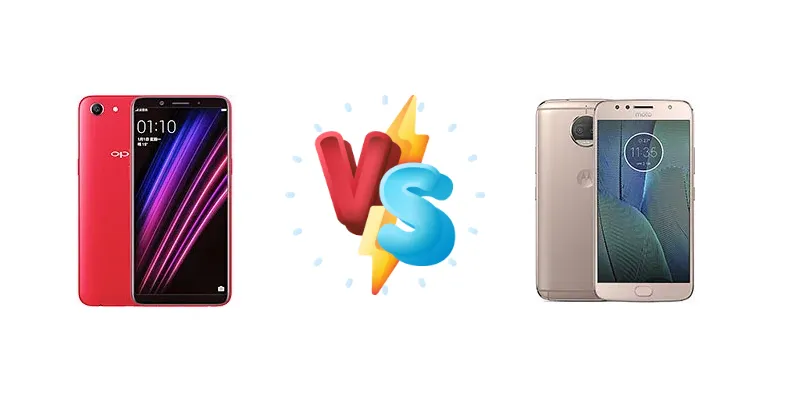
Released in 2018, the Oppo A1 and Motorola Moto G5S Plus represent a pivotal moment in the budget smartphone market. Both devices aimed to deliver a compelling experience without breaking the bank, but they took different approaches. The Oppo A1 leveraged MediaTek's Helio P23, while the Moto G5S Plus opted for Qualcomm's Snapdragon 625. This comparison dissects their strengths and weaknesses to determine which phone holds up better today.
🏆 Quick Verdict
For the average user prioritizing long-term performance and battery efficiency, the Motorola Moto G5S Plus is the better choice. While the Oppo A1's Helio P23 offers a slightly higher clock speed, the Snapdragon 625's 14nm process and optimized architecture deliver superior sustained performance and battery life, evidenced by its 81-hour endurance rating.
| Network |
|---|
| 2G bands | GSM 850 / 900 / 1800 / 1900 | GSM 850 / 900 / 1800 / 1900 - SIM 1 & SIM 2 (dual-SIM model only) |
| 3G bands | HSDPA 850 / 900 / 1900 / 2100 | HSDPA 850 / 900 / 1900 / 2100 |
| 4G bands | 1, 3, 5, 7, 8, 34, 38, 39, 40, 41 | 1, 2, 3, 5, 7, 8, 18, 19, 20, 26, 28, 38, 40, 41 |
| EDGE | - | No |
| GPRS | - | Class 10 |
| Speed | HSPA, LTE | HSPA 42.2/5.76 Mbps, LTE (2CA) Cat7 300/150 Mbps |
| Technology | GSM / CDMA / HSPA / LTE | GSM / HSPA / LTE |
| Launch |
|---|
| Announced | 2018, March. Released 2018, April | 2017, August. Released 2017, August |
| Status | Discontinued | Discontinued |
| Body |
|---|
| Build | - | Glass front (Gorilla Glass 3), aluminum back, aluminum frame |
| Dimensions | 150.5 x 73.1 x 7.7 mm (5.93 x 2.88 x 0.30 in) | 153.5 x 76.2 x 8 mm (6.04 x 3.00 x 0.31 in) |
| Keyboard | - | QWERTY |
| SIM | Nano-SIM + Nano-SIM | · Nano-SIM· Nano-SIM + Nano-SIM |
| Weight | 143 g (5.04 oz) | 168 g (5.93 oz) |
| | - | Splash resistant |
| Display |
|---|
| Protection | Corning Gorilla Glass 3 | Corning Gorilla Glass 3 |
| Resolution | 720 x 1440 pixels, 18:9 ratio (~282 ppi density) | 1080 x 1920 pixels, 16:9 ratio (~401 ppi density) |
| Size | 5.7 inches, 83.8 cm2 (~76.2% screen-to-body ratio) | 5.5 inches, 83.4 cm2 (~71.3% screen-to-body ratio) |
| Type | S-IPS LCD | IPS LCD |
| Platform |
|---|
| CPU | Octa-core 2.5 GHz Cortex-A53 | Octa-core 2.0 GHz Cortex-A53 |
| Chipset | Mediatek MT6763T Helio P23 (16 nm) | Qualcomm MSM8953 Snapdragon 625 (14 nm) |
| GPU | Mali-G71 MP1 | Adreno 506 |
| OS | Android 7.1.1 (Nougat), ColorOS 3.2 | Android 7.1 (Nougat), upgradable to Android 8.1 (Oreo) |
| Memory |
|---|
| Call records | - | 20 dialed, 20 received, 20 missed calls |
| Card slot | microSDXC (dedicated slot) | microSDXC (uses shared SIM slot) |
| Internal | 32GB 3GB RAM, 64GB 4GB RAM | 32GB 3GB RAM, 64GB 4GB RAM |
| Phonebook | - | 2000 entries |
| | - | eMMC 5.1 |
| Main Camera |
|---|
| Features | LED flash, panorama | Dual-LED dual-tone flash, panorama |
| Single | 13 MP, f/2.2, 1/3.1", 1.12µm, PDAF | 13 MP, f/2.0, AF
13 MP, (depth) |
| Video | 1080p@30fps | 4K@30fps, 1080p@60fps, 1080p@30fps (gyro-EIS) |
| Selfie camera |
|---|
| Features | - | LED flash |
| Single | 8 MP, f/2.2 | 8 MP, f/2.0 |
| Video | - | 1080p@30fps, 480p@120fps |
| Sound |
|---|
| 3.5mm jack | - | Yes |
| 35mm jack | Yes | Yes |
| Loudspeaker | Yes | Yes |
| Comms |
|---|
| Bluetooth | 4.2, A2DP, LE | 4.2, A2DP, LE, EDR, aptX |
| NFC | No | Yes (market dependent) |
| Positioning | GPS | GPS, GLONASS |
| Radio | FM radio | FM radio |
| USB | microUSB 2.0, OTG | microUSB 2.0 |
| WLAN | Wi-Fi 802.11 a/b/g/n, Wi-Fi Direct | Wi-Fi 802.11 a/b/g/n, dual-band, Wi-Fi Direct |
| Features |
|---|
| Browser | - | WAP 2.0/xHTML |
| Games | - | Yes |
| Java | - | No |
| Messaging | - | SMS, MMS, IM |
| Sensors | Accelerometer, proximity, compass | Fingerprint (front-mounted), accelerometer, gyro, proximity |
| Battery |
|---|
| Charging | - | 15W wired |
| Stand-by | - | Up to 300 h |
| Talk time | - | Up to 4 h |
| Type | Li-Ion 3180 mAh, non-removable | Li-Ion 3000 mAh, non-removable |
| Misc |
|---|
| Colors | Deep sea blue, Cherry red, Pearl white | Lunar Gray, Fine Gold |
| Models | - | XT1803, XT1805, XT1806, XT1804, Moto G5S Plus (XT1804) |
| Price | About 150 EUR | About 160 EUR |
| SAR | - | 0.10 W/kg (head) 1.08 W/kg (body) |
| SAR EU | - | 0.38 W/kg (head) 1.27 W/kg (body) |
| Tests |
|---|
| Audio quality | - |
Noise -34.8dB / Crosstalk -93.4dB |
| Battery life | - |
Endurance rating 81h
|
| Camera | - |
Photo / Video |
| Display | - |
Contrast ratio: 1354:1 (nominal), 2.736 (sunlight) |
| Loudspeaker | - |
Voice 91dB / Noise 74dB / Ring 86dB
|
| Performance | - |
GeekBench: 4331 (v4.4)
GFXBench: 3.8fps (ES 3.1 onscreen) |
Oppo A1 (2018)
- Potentially higher peak CPU clock speed (2.5 GHz)
- May be available at a lower price point (depending on current market)
- Octa-core processor for multitasking
- Less efficient 16nm process leads to higher power consumption
- Likely to experience more thermal throttling under load
- Limited information available on camera and display quality
Motorola Moto G5S Plus
- Superior power efficiency thanks to the 14nm Snapdragon 625
- Excellent battery life (81-hour endurance rating)
- Qualcomm’s optimized ISP for better image processing
- Lower CPU clock speed (2.0 GHz) compared to the Oppo A1
- Display technology is not cutting-edge
- May be slightly more expensive than the Oppo A1
Display Comparison
Both the Oppo A1 (2018) and Motorola Moto G5S Plus share the same nominal contrast ratio of 1354:1 and a sunlight contrast ratio of 2.736. This suggests a similar viewing experience in direct sunlight. However, detailed panel specifications like resolution and color gamut are missing for the Oppo A1. The Moto G5S Plus, while not boasting cutting-edge display technology, provides a reliably viewable experience, and the shared contrast ratios indicate comparable outdoor visibility.
Camera Comparison
Both phones offer 'Photo / Video' capabilities, but specific details regarding sensor size, aperture, or image processing are absent. Without this information, a direct comparison is difficult. However, Qualcomm’s Snapdragon chipsets generally offer superior image signal processing (ISP) capabilities compared to MediaTek’s offerings at this price point. This suggests the Moto G5S Plus likely delivers better image quality, particularly in low-light conditions, even with similar hardware. The lack of detail on the Oppo A1’s camera makes it difficult to assess its capabilities accurately.
Performance
The core difference lies in the chipsets. The Oppo A1 utilizes the MediaTek MT6763T Helio P23, an octa-core processor clocked at 2.5 GHz, built on a 16nm process. The Motorola Moto G5S Plus features the Qualcomm MSM8953 Snapdragon 625, also an octa-core processor, but clocked at 2.0 GHz and fabricated on a more efficient 14nm process. While the Helio P23 has a higher clock speed, the Snapdragon 625’s smaller manufacturing node translates to significantly better power efficiency and sustained performance. This means the Moto G5S Plus is less likely to throttle under load, providing a smoother experience during prolonged gaming or multitasking. The Snapdragon 625’s architecture is also more mature and optimized for Android.
Battery Life
The Motorola Moto G5S Plus shines in battery life, boasting an endurance rating of 81 hours. This is a testament to the Snapdragon 625’s power efficiency. The Oppo A1’s battery capacity and charging speed are not specified, making a direct comparison challenging. However, given the Helio P23’s less efficient 16nm process, it’s highly probable that the Oppo A1 will require more frequent charging. The Moto G5S Plus also supports 15W wired charging, providing a reasonable recharge time.
Buying Guide
Buy the Oppo A1 (2018) if you prioritize a potentially higher peak CPU clock speed for very light multitasking and aren't concerned about long-term performance or battery degradation. Buy the Motorola Moto G5S Plus if you value consistent performance, exceptional battery life, and a more efficient chipset, making it ideal for daily use and moderate gaming.
Frequently Asked Questions
❓ Will the Oppo A1's Helio P23 struggle with modern app updates and Android versions?
The Helio P23, while capable in 2018, is likely to show its age with newer Android versions and increasingly demanding app updates. The Snapdragon 625 in the Moto G5S Plus, due to Qualcomm’s ongoing software support and optimization, will likely handle these updates more gracefully.
❓ How much does the Snapdragon 625's efficiency impact real-world usage on the Moto G5S Plus?
The Snapdragon 625’s 14nm process translates to significantly less heat generation and power consumption. This means you can expect longer battery life, less throttling during gaming, and a cooler device overall, even with extended use. The Moto G5S Plus can comfortably last a full day on a single charge with moderate usage.
❓ Is the camera on the Moto G5S Plus good enough for casual photography?
While not a flagship-level camera, the Moto G5S Plus’s camera, powered by Qualcomm’s ISP, is capable of producing good-quality photos in well-lit conditions. It excels in consistent performance and image processing, making it suitable for everyday snapshots and social media sharing.