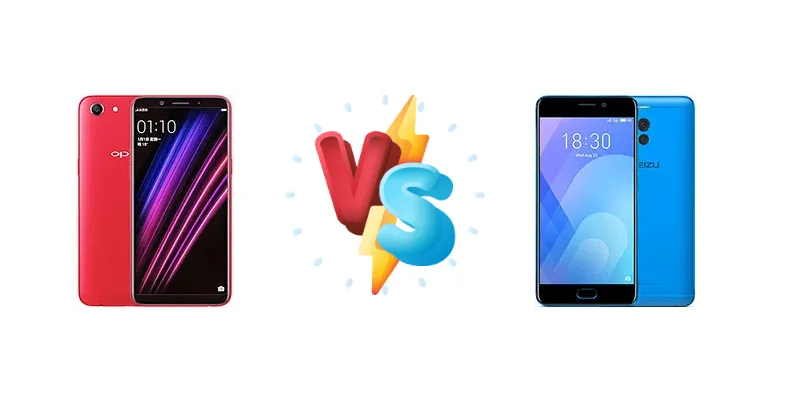
Released in 2018, the Oppo A1 and Meizu M6 Note represent competing approaches to the budget smartphone market. While both aimed for affordability, they differed significantly in their core hardware choices, particularly in their chipsets. This comparison dissects those differences, focusing on real-world implications for performance, battery life, and charging speed.
🏆 Quick Verdict
For the average user prioritizing efficiency and faster charging, the Meizu M6 Note is the better choice. Its Snapdragon 625, built on a smaller 14nm process, offers superior power efficiency and supports 24W charging, a significant advantage over the Oppo A1's Helio P23.
| Network |
|---|
| 2G bands | GSM 850 / 900 / 1800 / 1900 | GSM 850 / 900 / 1800 / 1900 - SIM 1 & SIM 2 |
| 3G bands | HSDPA 850 / 900 / 1900 / 2100 | HSDPA 850 / 900 / 1900 / 2100 |
| 4G bands | 1, 3, 5, 7, 8, 34, 38, 39, 40, 41 | 1, 3, 5, 7, 8, 20, 38, 40 |
| Speed | HSPA, LTE | HSPA, LTE |
| Technology | GSM / CDMA / HSPA / LTE | GSM / CDMA / HSPA / LTE |
| | - | CDMA 800 |
| Launch |
|---|
| Announced | 2018, March. Released 2018, April | 2017, August. Released 2017, September |
| Status | Discontinued | Discontinued |
| Body |
|---|
| Build | - | Glass front, aluminum back, aluminum frame |
| Dimensions | 150.5 x 73.1 x 7.7 mm (5.93 x 2.88 x 0.30 in) | 154.6 x 75.2 x 8.4 mm (6.09 x 2.96 x 0.33 in) |
| SIM | Nano-SIM + Nano-SIM | Nano-SIM + Nano-SIM |
| Weight | 143 g (5.04 oz) | 173 g (6.10 oz) |
| Display |
|---|
| Protection | Corning Gorilla Glass 3 | - |
| Resolution | 720 x 1440 pixels, 18:9 ratio (~282 ppi density) | 1080 x 1920 pixels, 16:9 ratio (~403 ppi density) |
| Size | 5.7 inches, 83.8 cm2 (~76.2% screen-to-body ratio) | 5.5 inches, 82.6 cm2 (~71.0% screen-to-body ratio) |
| Type | S-IPS LCD | IPS LCD |
| Platform |
|---|
| CPU | Octa-core 2.5 GHz Cortex-A53 | Octa-core 2.0 GHz Cortex-A53 |
| Chipset | Mediatek MT6763T Helio P23 (16 nm) | Qualcomm MSM8953 Snapdragon 625 (14 nm) |
| GPU | Mali-G71 MP1 | Adreno 506 |
| OS | Android 7.1.1 (Nougat), ColorOS 3.2 | Android 7.1.2 (Nougat), Flyme 7.3 |
| Memory |
|---|
| Card slot | microSDXC (dedicated slot) | microSDXC |
| Internal | 32GB 3GB RAM, 64GB 4GB RAM | 16GB 4GB RAM, 32GB 3GB RAM, 64GB 4GB RAM |
| | - | eMMC 5.1 |
| Main Camera |
|---|
| Dual | - | 12 MP, f/1.9, 1/2.55", 1.4µm, dual pixel PDAF
5 MP, f/2.0, AF |
| Features | LED flash, panorama | quad-LED dual-tone flash, HDR, panorama |
| Single | 13 MP, f/2.2, 1/3.1", 1.12µm, PDAF | - |
| Video | 1080p@30fps | 1080p@30fps |
| Selfie camera |
|---|
| Single | 8 MP, f/2.2 | 16 MP, f/2.0, 26mm (wide), 1/3.06", 1.0µm |
| Video | - | 1080p@30fps |
| Sound |
|---|
| 3.5mm jack | - | Yes |
| 35mm jack | Yes | Yes |
| Loudspeaker | Yes | Yes |
| Comms |
|---|
| Bluetooth | 4.2, A2DP, LE | 4.2, A2DP, LE |
| NFC | No | No |
| Positioning | GPS | GPS, GLONASS |
| Radio | FM radio | No |
| USB | microUSB 2.0, OTG | microUSB 2.0 |
| WLAN | Wi-Fi 802.11 a/b/g/n, Wi-Fi Direct | Wi-Fi 802.11 a/b/g/n, dual-band |
| Features |
|---|
| Sensors | Accelerometer, proximity, compass | Fingerprint (front-mounted), accelerometer, gyro, proximity, compass |
| Battery |
|---|
| Charging | - | 24W wired |
| Type | Li-Ion 3180 mAh, non-removable | Li-Ion 4000 mAh, non-removable |
| Misc |
|---|
| Colors | Deep sea blue, Cherry red, Pearl white | Black, Blue, Gold |
| Models | - | M6 Note, MZ-M6 Note |
| Price | About 150 EUR | About 170 EUR |
Oppo A1 (2018)
- Higher CPU clock speed (2.5 GHz)
- Potentially lower initial cost (depending on market)
- MediaTek's software optimizations
- Less power-efficient chipset (16nm)
- Slower charging speeds
- Potential for more thermal throttling
Meizu M6 Note
- More power-efficient chipset (14nm)
- Faster 24W charging
- Qualcomm's superior ISP for better image processing
- Lower CPU clock speed (2.0 GHz)
- Potentially higher initial cost (depending on market)
- Qualcomm's software optimizations
Display Comparison
Neither device boasts a standout display. Given the 2018 release timeframe, both likely feature IPS LCD panels with 720p+ resolutions. Without specific nit brightness data, it's difficult to declare a clear winner. However, the focus here is on internal components, and display differences are likely minimal for typical usage.
Camera Comparison
Without detailed camera specs beyond the presence of cameras, a direct comparison is challenging. Both phones likely featured a primary camera and a depth sensor. However, Qualcomm’s image signal processor (ISP) within the Snapdragon 625 generally offers superior image processing capabilities, resulting in better dynamic range and noise reduction compared to the MediaTek Helio P23’s ISP. This benefits users who frequently capture photos in challenging lighting conditions.
Performance
The core difference lies in the chipsets. The Meizu M6 Note’s Qualcomm Snapdragon 625 (MSM8953), fabricated on a 14nm process, is demonstrably more efficient than the Oppo A1’s MediaTek Helio P23 (MT6763T) built on a 16nm node. While the Helio P23 boasts a higher clock speed (2.5 GHz vs 2.0 GHz), the Snapdragon 625’s architectural advantages – specifically its Cortex-A53 cores optimized for efficiency – translate to better sustained performance and less thermal throttling. This benefits users engaging in prolonged gaming or multitasking. The Snapdragon 625’s Adreno 506 GPU also provides a more capable graphics experience.
Battery Life
While battery capacity isn't specified, the Snapdragon 625’s superior power efficiency gives the Meizu M6 Note a significant advantage in battery life. Furthermore, the M6 Note supports 24W wired charging, allowing for significantly faster charging times compared to the Oppo A1, which likely supports a standard 10W or 15W charging rate. This is a crucial benefit for users who prioritize minimizing downtime.
Buying Guide
Buy the Oppo A1 (2018) if you prioritize raw CPU clock speed and are comfortable with potentially shorter battery life. Its 2.5 GHz Helio P23 might offer a slight edge in single-threaded tasks. Buy the Meizu M6 Note if you value battery efficiency, faster charging, and a more refined overall experience, thanks to Qualcomm's Snapdragon 625 chipset.
Frequently Asked Questions
❓ Will the Meizu M6 Note's Snapdragon 625 handle modern apps and multitasking smoothly?
Yes, the Snapdragon 625 is a surprisingly capable chipset even by today's standards. Its efficient architecture and 4GB of RAM (typical for this model) allow for smooth multitasking and running most popular apps without significant lag. While it won't handle demanding games at maximum settings, it's more than adequate for everyday use.
❓ How much faster is the 24W charging on the Meizu M6 Note compared to the Oppo A1?
The difference is substantial. The Oppo A1 likely supports 10W or 15W charging, meaning a full charge could take over 3 hours. The Meizu M6 Note's 24W charging can significantly reduce this time, potentially achieving a full charge in around 1.5 to 2 hours, depending on battery size and usage.
❓ Is the Helio P23 in the Oppo A1 suitable for playing games like PUBG Mobile?
PUBG Mobile is playable on the Oppo A1, but you'll likely need to lower the graphics settings to medium or low to maintain a stable frame rate. The Helio P23's GPU isn't as powerful as the Adreno 506 in the Snapdragon 625, and it's more prone to thermal throttling during extended gaming sessions.