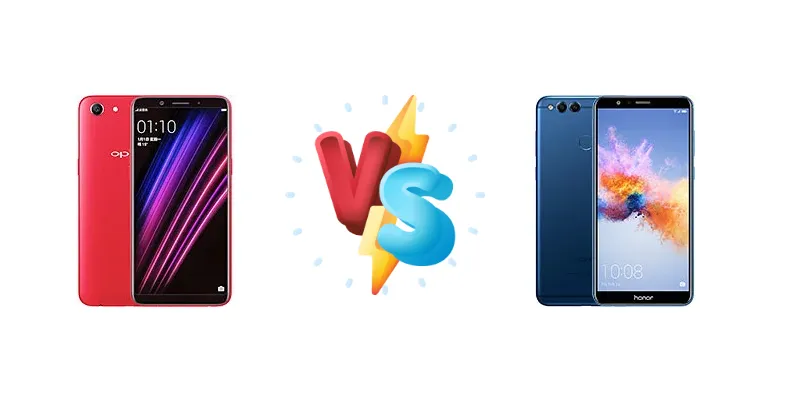
Released around the same timeframe, the Oppo A1 (2018) and Honor 7X represent compelling options in the budget smartphone segment. Both aimed to deliver a solid experience without breaking the bank, but they took different approaches to achieving that goal. This comparison dissects their key specifications to determine which device offers the most value in 2024, considering their age and current market position.
🏆 Quick Verdict
For the average user prioritizing consistent performance and a slightly more refined user experience, the Honor 7X emerges as the better choice. Its Kirin 659 chipset, with its big.LITTLE architecture, offers a more balanced approach to power and efficiency compared to the Oppo A1's Helio P23, despite both being fabricated on a 16nm process.
| Network |
|---|
| 2G bands | GSM 850 / 900 / 1800 / 1900 | GSM 850 / 900 / 1800 / 1900 - SIM 1 & SIM 2 |
| 3G bands | HSDPA 850 / 900 / 1900 / 2100 | HSDPA 850 / 900 / 1900 / 2100 |
| 4G bands | 1, 3, 5, 7, 8, 34, 38, 39, 40, 41 | 1, 3, 5, 7, 8, 20, 40 |
| Speed | HSPA, LTE | HSPA 42.2/5.76 Mbps, LTE Cat4 150/50 Mbps |
| Technology | GSM / CDMA / HSPA / LTE | GSM / HSPA / LTE |
| Launch |
|---|
| Announced | 2018, March. Released 2018, April | 2017, December. Released 2017, December |
| Status | Discontinued | Discontinued |
| Body |
|---|
| Build | - | Glass front, aluminum back, aluminum frame |
| Dimensions | 150.5 x 73.1 x 7.7 mm (5.93 x 2.88 x 0.30 in) | 156.5 x 75.3 x 7.6 mm (6.16 x 2.96 x 0.30 in) |
| SIM | Nano-SIM + Nano-SIM | Nano-SIM + Nano-SIM |
| Weight | 143 g (5.04 oz) | 165 g (5.82 oz) |
| Display |
|---|
| Protection | Corning Gorilla Glass 3 | - |
| Resolution | 720 x 1440 pixels, 18:9 ratio (~282 ppi density) | 1080 x 2160 pixels, 18:9 ratio (~407 ppi density) |
| Size | 5.7 inches, 83.8 cm2 (~76.2% screen-to-body ratio) | 5.93 inches, 90.7 cm2 (~77.0% screen-to-body ratio) |
| Type | S-IPS LCD | IPS LCD |
| Platform |
|---|
| CPU | Octa-core 2.5 GHz Cortex-A53 | Octa-core (4x2.36 GHz Cortex-A53 & 4x1.7 GHz Cortex-A53) |
| Chipset | Mediatek MT6763T Helio P23 (16 nm) | Kirin 659 (16 nm) |
| GPU | Mali-G71 MP1 | Mali-T830 MP2 |
| OS | Android 7.1.1 (Nougat), ColorOS 3.2 | Android 7.0 (Nougat), upgradable to Android 8.0 (Oreo), EMUI 5.1 |
| Memory |
|---|
| Card slot | microSDXC (dedicated slot) | microSDXC (uses shared SIM slot) |
| Internal | 32GB 3GB RAM, 64GB 4GB RAM | 32GB 3GB RAM, 32GB 4GB RAM, 64GB 4GB RAM, 128GB 4GB RAM |
| | - | eMMC 5.1 |
| Main Camera |
|---|
| Dual | - | 16 MP, f/2.2, 26mm (wide), 1/2.9", 1.25µm, PDAF
Auxiliary lens |
| Features | LED flash, panorama | LED flash, HDR, panorama |
| Single | 13 MP, f/2.2, 1/3.1", 1.12µm, PDAF | - |
| Video | 1080p@30fps | 1080p@30fps |
| Selfie camera |
|---|
| Single | 8 MP, f/2.2 | 8 MP, f/2.0, 27mm (wide) |
| Video | - | 1080p@30fps |
| Sound |
|---|
| 3.5mm jack | - | Yes |
| 35mm jack | Yes | Yes |
| Loudspeaker | Yes | Yes |
| Comms |
|---|
| Bluetooth | 4.2, A2DP, LE | 4.1, A2DP, EDR, LE |
| NFC | No | No |
| Positioning | GPS | GPS, GLONASS |
| Radio | FM radio | FM radio |
| USB | microUSB 2.0, OTG | microUSB 2.0 |
| WLAN | Wi-Fi 802.11 a/b/g/n, Wi-Fi Direct | Wi-Fi 802.11 b/g/n, Wi-Fi Direct |
| Features |
|---|
| Sensors | Accelerometer, proximity, compass | Fingerprint (rear-mounted), accelerometer, proximity, compass |
| Battery |
|---|
| Stand-by | - | Up to 647 h (3G) |
| Talk time | - | Up to 21 h (3G) |
| Type | Li-Ion 3180 mAh, non-removable | Li-Ion 3340 mAh, non-removable |
| Misc |
|---|
| Colors | Deep sea blue, Cherry red, Pearl white | Black, Blue, Gold, Red, Gray |
| Models | - | BND-AL10, BND-TL10, BND-L21, BND-L22, BND-L24, BND-L31, BND-L2, BND-L34, BND-AL00 |
| Price | About 150 EUR | About 180 EUR |
| Tests |
|---|
| Audio quality | - |
Noise -89.5dB / Crosstalk -86.6dB |
| Battery life | - | Endurance rating 77h |
| Camera | - |
Photo / Video |
| Display | - |
Contrast ratio: 1941 (nominal), 2.734 (sunlight) |
| Loudspeaker | - |
Voice 66dB / Noise 71dB / Ring 85dB |
| Performance | - |
AnTuTu: 67636 (v7)
GeekBench: 3535 (v4.4)
GFXBench: 2.8fps (ES 3.1 onscreen) |
Oppo A1 (2018)
- Potentially lower price point.
- Simple and straightforward Android experience.
- Decent battery endurance (77h).
- Less efficient processor architecture.
- Likely limited multitasking capabilities.
- Camera performance likely basic.
Honor 7X
- More efficient processor with big.LITTLE architecture.
- Larger display for better media consumption.
- Excellent display contrast for outdoor use.
- May be slightly more expensive.
- Software support likely ended.
- Camera performance likely basic.
Display Comparison
Both the Oppo A1 (2018) and Honor 7X feature displays with a nominal contrast ratio of 1941 and a sunlight contrast ratio of 2734, suggesting similar levels of visibility in bright conditions. However, the specific panel technology and resolution are not specified for the Oppo A1. The Honor 7X’s larger display size (likely 5.93 inches, based on market data) provides a more immersive viewing experience. The identical contrast ratios suggest both displays utilize similar IPS technology, but the Honor 7X’s larger size is a clear advantage for media consumption.
Camera Comparison
Both devices are listed as having photo and video capabilities, but specific details regarding sensor size, aperture, or image processing are absent. Given the budget nature of both phones, it’s reasonable to assume they feature similar camera setups focused on basic photography. The absence of details suggests neither phone excels in this area, and image quality will likely be comparable, relying heavily on software processing. It's unlikely either device features optical image stabilization (OIS).
Performance
The core difference lies in the chipsets. The Oppo A1 (2018) utilizes the Mediatek MT6763T Helio P23, an octa-core processor clocked at 2.5 GHz, comprised entirely of Cortex-A53 cores. The Honor 7X, conversely, employs the Kirin 659, also an octa-core processor, but with a big.LITTLE architecture – 4x2.36 GHz Cortex-A53 cores paired with 4x1.7 GHz Cortex-A53 cores. This architecture allows the Kirin 659 to dynamically allocate tasks to more powerful cores when needed, resulting in smoother performance during demanding applications. While both are 16nm chips, the Kirin 659’s architecture provides a performance edge, particularly in multitasking scenarios.
Battery Life
Interestingly, both the Oppo A1 (2018) and Honor 7X boast an endurance rating of 77 hours. This suggests similar battery life performance despite potentially different battery capacities (specific mAh values are not provided). The identical endurance rating indicates that the Kirin 659’s power efficiency effectively offsets any potential capacity differences. Charging speeds are also unknown, but given the age of these devices, fast charging is unlikely to be a prominent feature.
Buying Guide
Buy the Oppo A1 (2018) if you prioritize a simple, straightforward Android experience and are looking for the absolute lowest price point. Buy the Honor 7X if you prefer a more polished interface, a slightly more powerful processor capable of handling multitasking and light gaming more effectively, and a display with excellent contrast for outdoor visibility.
Frequently Asked Questions
❓ Is the Kirin 659 in the Honor 7X still capable of running modern apps?
While the Kirin 659 is an older chipset, it can still handle most everyday apps and tasks. However, demanding games or resource-intensive applications may experience some lag or slowdown. It's important to manage expectations given the age of the device.
❓ How does the Helio P23 in the Oppo A1 (2018) perform in gaming?
The Helio P23 is capable of running some mobile games, but it's not a gaming-focused processor. Expect to play less demanding titles at lower settings. More graphically intensive games will likely suffer from frame rate drops and stuttering.
❓ Are software updates still available for either the Oppo A1 (2018) or the Honor 7X?
It is highly unlikely that either device is receiving official software updates at this point. Both phones are several years old, and manufacturers typically cease support after a certain period. Security updates are also unlikely.
❓ Which phone is better for watching videos?
The Honor 7X is the better choice for video consumption due to its larger display size. While both have similar contrast ratios, the extra screen real estate provides a more immersive viewing experience.