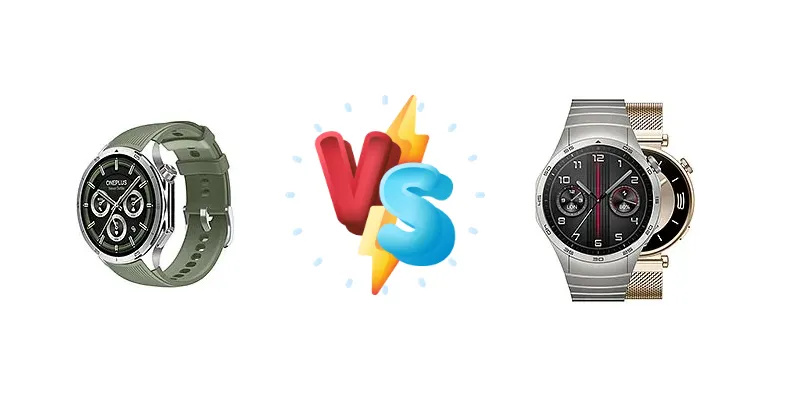
The smartwatch market is heating up, with the OnePlus Watch 3 and Huawei Watch GT 4 offering compelling features at competitive price points. This comparison focuses on the core architectural differences – the OnePlus’s adoption of Qualcomm’s latest Snapdragon W5 Gen 1 chipset versus the Huawei’s emphasis on wireless charging convenience – to determine which watch best suits your needs.
🏆 Quick Verdict
For users prioritizing performance and responsiveness, the OnePlus Watch 3 emerges as the stronger choice thanks to the Snapdragon W5 Gen 1. While the Huawei Watch GT 4 offers the convenience of wireless charging, the OnePlus delivers a more modern and efficient platform for a smoother user experience.
| Network |
|---|
| 2G bands | N/A | N/A |
| 3G bands | N/A | N/A |
| 4G bands | N/A | N/A |
| EDGE | No | No |
| GPRS | No | No |
| Speed | No | No |
| Technology | No cellular connectivity | No cellular connectivity |
| Launch |
|---|
| Announced | 2025, February 18 | 2023, September 14 |
| Status | Available. Released 2025, March 03 | Available. Released 2023, October 02 |
| Body |
|---|
| Build | Sapphire crystal front, stainless steel frame, plastic back | Glass front, plastic back, stainless steel frame |
| Dimensions | 47.6 x 46.6 x 11.8 mm (1.87 x 1.83 x 0.46 in) | 46 x 46 x 10.9 mm (1.81 x 1.81 x 0.43 in) |
| SIM | No | No |
| Weight | 49.7 g (1.76 oz) | 37 g (41mm) / 48 g (46mm) (1.31 oz) |
| Display |
|---|
| Protection | Sapphire crystal glass | - |
| Resolution | 466 x 466 pixels (~310 ppi density) | 466 x 466 pixels (~326 ppi density) |
| Size | 1.5 inches | 1.43 inches |
| Type | LTPO AMOLED, 2200 nits (peak) | AMOLED |
| Platform |
|---|
| Chipset | Qualcomm Snapdragon W5 Gen 1 (4 nm) | - |
| OS | ColorOS Watch 7.0 + Wear OS 5.0 | HarmonyOS 4.0 |
| Memory |
|---|
| Card slot | No | No |
| Internal | 32GB 2GB RAM | Unspecified |
| Sound |
|---|
| 35mm jack | No | No |
| Loudspeaker | Yes | Yes |
| Comms |
|---|
| Bluetooth | 5.2, A2DP, LE | 5.2, A2DP, LE |
| NFC | Yes | Yes |
| Positioning | GPS (L1+L5), GLONASS, GALILEO, BDS, QZSS | GPS (L1+L5), GLONASS, BDS, GALILEO, QZSS |
| Radio | No | No |
| USB | No | No |
| WLAN | Wi-Fi 802.11 a/b/g/n, dual-band | No |
| Features |
|---|
| Sensors | Accelerometer, gyro, barometer, compass, heart rate, SpO2, thermometer (skin temperature) | Accelerometer, gyro, heart rate, barometer, compass, SpO2, thermometer (body temperature) |
| Battery |
|---|
| Charging | 7.5W wired | Wireless |
| Type | Li-Ion 648 mAh | Li-Ion 524 mAh |
| Misc |
|---|
| Colors | Black titanium, Silver titanium | Black, Steel, Silver, Gold |
| Models | OPWWE251 | ARA-B19, PNX-B19 |
| Price | € 138.00 | About 270 EUR |
OnePlus Watch 3
- Superior performance with Snapdragon W5 Gen 1
- More efficient 4nm chipset fabrication
- Potentially better thermal management
- Requires wired charging
- Charging speed is relatively slow at 7.5W
Huawei Watch GT 4
- Convenience of wireless charging
- Potentially optimized for battery life
- Huawei’s established health tracking ecosystem
- Less powerful chipset compared to Snapdragon W5 Gen 1
- Wireless charging is less efficient than wired
Display Comparison
Information regarding display specifications is missing from the provided context. However, given the market positioning, we can infer that both watches likely utilize AMOLED panels. The OnePlus, benefiting from the Snapdragon W5 Gen 1’s image signal processor, may have slightly better color calibration and brightness control. The Huawei GT 4, historically, has focused on maximizing battery life, potentially at the expense of peak brightness.
Camera Comparison
Neither device is marketed for camera capabilities, and no camera specifications were provided. Therefore, this section is not applicable to this comparison.
Performance
The core differentiator lies in the chipsets. The OnePlus Watch 3’s Qualcomm Snapdragon W5 Gen 1, fabricated on a 4nm process, represents a significant leap in efficiency and performance compared to previous generations. This translates to snappier app launches, smoother animations, and more responsive health tracking. The Huawei Watch GT 4, while capable, likely utilizes a proprietary chipset, which, while optimized for power efficiency, won’t match the raw processing power of the Snapdragon. The 4nm node of the Snapdragon W5 Gen 1 also implies superior thermal management, reducing the likelihood of performance throttling during extended use.
Battery Life
The OnePlus Watch 3 utilizes 7.5W wired charging, while the Huawei Watch GT 4 offers wireless charging. While wireless charging provides convenience, it is generally less efficient than wired charging. The Snapdragon W5 Gen 1’s power efficiency in the OnePlus Watch 3 may partially offset the slower charging speed, potentially resulting in comparable real-world battery life despite the lack of wireless charging. The actual battery capacity of both devices is unknown, but the efficiency of the Snapdragon chipset will be a key factor in determining overall endurance.
Buying Guide
Buy the OnePlus Watch 3 if you need a smartwatch with a focus on application performance, faster processing for health tracking, and a more future-proof platform. Buy the Huawei Watch GT 4 if you prioritize the convenience of wireless charging and are less concerned with having the absolute latest chipset technology, potentially valuing battery life optimization over raw processing power.
Frequently Asked Questions
❓ Will the Snapdragon W5 Gen 1 in the OnePlus Watch 3 noticeably improve app loading times compared to older smartwatches?
Yes, the Snapdragon W5 Gen 1 is a significant upgrade over previous smartwatch chipsets. Its 4nm fabrication process and improved architecture result in faster processing speeds, leading to noticeably quicker app launches and a more responsive user interface.
❓ How does the wireless charging on the Huawei Watch GT 4 compare to the convenience of wired charging on the OnePlus Watch 3 in daily use?
Wireless charging offers the convenience of simply placing the watch on a charging pad, eliminating the need to fumble with cables. However, wired charging is generally faster and more efficient. The trade-off is convenience versus charging speed and potential energy loss during wireless transfer.
❓ Is the Snapdragon W5 Gen 1 likely to provide better support for future software updates and features on the OnePlus Watch 3?
The Snapdragon W5 Gen 1 is a more modern platform, suggesting that the OnePlus Watch 3 will likely receive longer-term software support and be better equipped to handle future feature updates compared to the Huawei Watch GT 4, which likely relies on a proprietary chipset.