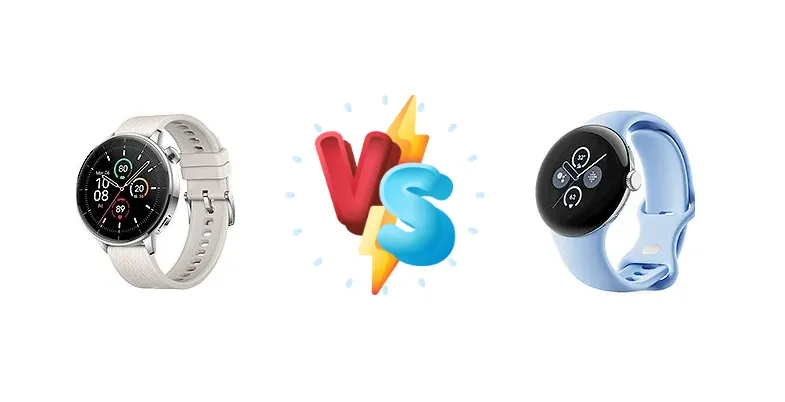
The smartwatch market is heating up, with both OnePlus and Google offering compelling Wear OS options. The OnePlus Watch 3, powered by the latest Qualcomm Snapdragon W5 Gen 1, aims to deliver a significant performance boost. Meanwhile, the Google Pixel Watch 2, utilizing the Qualcomm 5100, focuses on a refined user experience and Google’s ecosystem integration. This comparison dissects the key differences to determine which smartwatch best suits your needs.
🏆 Quick Verdict
For the average user prioritizing raw performance and potentially longer battery life, the OnePlus Watch 3 emerges as the winner. Its Snapdragon W5 Gen 1 chipset offers a more modern architecture than the Pixel Watch 2’s 5100, promising smoother operation and improved efficiency. However, Pixel Watch 2’s tight Google integration remains a strong draw for those deeply invested in the ecosystem.
| Network |
|---|
| 2G bands | N/A | GSM 850 / 900 / 1800 / 1900 |
| 3G bands | N/A | HSDPA 850 / 900 / 1700(AWS) / 1900 / 2100 |
| 4G bands | N/A | LTE |
| EDGE | No | - |
| GPRS | No | - |
| Speed | - | HSPA, LTE |
| Technology | No cellular connectivity | GSM / HSPA / LTE |
| Launch |
|---|
| Announced | 2025, July 08 | 2023, October 04 |
| Status | Available. Released 2025, July 08 | Available. Released 2023, October 12 |
| Body |
|---|
| Build | Glass front, stainless steel frame, plastic back | Glass front (Gorilla Glass 5), aluminum frame |
| Dimensions | 43.2 x 43.2 x 11 mm (1.70 x 1.70 x 0.43 in) | 41 x 41 x 12.3 mm (1.61 x 1.61 x 0.48 in) |
| SIM | No | eSIM |
| Weight | 37.8 g (1.34 oz) | 31 g (1.09 oz) |
| Display |
|---|
| Protection | - | Corning Gorilla Glass 5 |
| Resolution | 466 x 466 pixels (~352 ppi density) | 450 x 450 pixels (~320 ppi density) |
| Size | 1.32 inches | 1.2 inches |
| Type | AMOLED, 1000 nits (peak) | AMOLED, 1000 nits (peak) |
| Platform |
|---|
| Chipset | Qualcomm Snapdragon W5 Gen 1 (4 nm) | Qualcomm 5100 |
| OS | Wear OS | Android Wear OS 4 |
| Memory |
|---|
| Card slot | No | No |
| Internal | 32GB 2GB RAM | 32GB 2GB RAM |
| Sound |
|---|
| 35mm jack | No | No |
| Loudspeaker | Yes | Yes |
| Comms |
|---|
| Bluetooth | 5.2, A2DP, LE | 5.0, A2DP, LE |
| NFC | Yes | Yes |
| Positioning | GPS, GLONASS, GALILEO, BDS, QZSS | GPS, GLONASS, GALILEO, BDS, QZSS |
| Radio | No | No |
| USB | No | No |
| WLAN | Wi-Fi 802.11 a/b/g/n, dual-band | Wi-Fi 802.11 b/g/n |
| Features |
|---|
| Sensors | Accelerometer, gyro, barometer, compass, heart rate, SpO2 | Accelerometer, gyro, heart rate, altimeter, compass, SpO2, thermometer (skin temperature), skin conductance |
| Battery |
|---|
| Charging | - | Wired, 80% in 45 min |
| Type | Li-Ion 354 mAh | Li-Ion 306 mAh |
| Misc |
|---|
| Colors | Black Steel, Silver Steel | Polished Silver, Matte Black, Champagne Gold |
| Models | - | G4TSL, GC3G8, GD2WG |
| Price | € 211.90 | About 160 EUR |
OnePlus Watch 3 43mm
- More powerful Snapdragon W5 Gen 1 chipset
- Potentially longer battery life due to 4nm process
- Likely smoother app performance
- Google ecosystem integration is less seamless
- Specific display specs are unknown
Google Pixel Watch 2
- Seamless Google ecosystem integration
- Faster charging (80% in 45 minutes)
- Fitbit integration for advanced health tracking
- Older Qualcomm 5100 chipset
- Potentially shorter battery life compared to OnePlus Watch 3
Display Comparison
While both watches likely feature AMOLED displays (based on market standards), specific details like peak brightness and resolution are missing. However, the underlying chipset impacts display responsiveness. The Snapdragon W5 Gen 1’s improved GPU could translate to smoother animations and faster app loading times on the OnePlus Watch 3’s display. The Pixel Watch 2’s display quality will rely heavily on Google’s software optimizations.
Camera Comparison
Neither device is marketed for its camera capabilities, and detailed camera specs are unavailable. Smartwatches generally feature limited camera functionality, primarily for quick scans or video calls. Any differences in image quality will likely be minimal and less impactful than other features.
Performance
The core difference lies in the chipsets. The OnePlus Watch 3’s Qualcomm Snapdragon W5 Gen 1, built on a 4nm process, represents a significant leap in efficiency and performance compared to the Google Pixel Watch 2’s Qualcomm 5100. The 4nm node allows for higher transistor density and lower power consumption, potentially leading to less thermal throttling during demanding tasks. While the 5100 is a capable chip, it’s an older generation and will likely exhibit lower peak performance and higher power draw. The impact will be most noticeable when running complex apps or utilizing advanced features.
Battery Life
Battery capacity details are missing for both devices. However, the Snapdragon W5 Gen 1’s 4nm architecture in the OnePlus Watch 3 suggests superior power efficiency. The Pixel Watch 2 compensates with faster charging – 80% in 45 minutes – which mitigates the impact of potentially lower battery life. Users prioritizing all-day battery life without frequent charging may lean towards the OnePlus Watch 3, while those who don’t mind topping up more often can benefit from the Pixel Watch 2’s quicker charging speeds.
Buying Guide
Buy the OnePlus Watch 3 43mm if you need a smartwatch with demonstrably faster processing power for apps and a potentially more efficient chipset for extended battery life. This is ideal for fitness enthusiasts tracking detailed metrics or users who frequently interact with complex watch apps. Buy the Google Pixel Watch 2 if you prioritize seamless integration with Google services like Google Assistant, Fitbit’s advanced health tracking, and a polished, refined software experience, even if it means sacrificing some raw processing speed.
Frequently Asked Questions
❓ Does the Qualcomm 5100 in the Pixel Watch 2 struggle with demanding apps?
While the Qualcomm 5100 is a capable processor, it's an older generation chipset. Users may experience occasional lag or slowdowns when running multiple apps simultaneously or utilizing resource-intensive features like GPS tracking and music playback. The Snapdragon W5 Gen 1 in the OnePlus Watch 3 is designed to handle these tasks more efficiently.
❓ How much does the 45-minute charging time of the Pixel Watch 2 impact daily use?
The Pixel Watch 2’s 80% charge in 45 minutes is a significant convenience. It allows users to quickly top up the battery during short breaks, minimizing downtime. However, if you frequently forget to charge your watch, the OnePlus Watch 3’s potentially longer battery life might be a more practical solution.
❓ Is the Snapdragon W5 Gen 1 in the OnePlus Watch 3 significantly more power efficient than the 5100?
Yes, the 4nm manufacturing process of the Snapdragon W5 Gen 1 is a key advantage. Smaller transistors consume less power and generate less heat, leading to improved battery life and reduced thermal throttling compared to the Qualcomm 5100, which uses a larger process node.