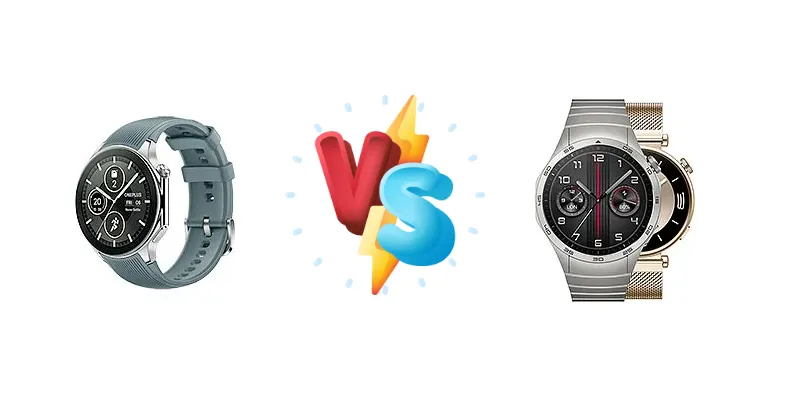
The smartwatch market is heating up, with the OnePlus Watch 2 and Huawei Watch GT 4 offering compelling features at competitive price points. This comparison focuses on the core architectural differences – the OnePlus’s adoption of Qualcomm’s latest wearable chipset versus Huawei’s emphasis on wireless convenience – to determine which watch best suits your needs.
🏆 Quick Verdict
For users prioritizing performance and responsiveness, the OnePlus Watch 2 emerges as the stronger choice thanks to the Snapdragon W5 Gen 1. While the Huawei Watch GT 4 offers the convenience of wireless charging, the OnePlus delivers a more fluid user experience and potential for future software optimizations.
| Network |
|---|
| 2G bands | N/A | N/A |
| 3G bands | N/A | N/A |
| 4G bands | N/A | N/A |
| EDGE | No | No |
| GPRS | No | No |
| Speed | No | No |
| Technology | No cellular connectivity | No cellular connectivity |
| Launch |
|---|
| Announced | 2024, February 26 | 2023, September 14 |
| Status | Available. Released 2024, March 05 | Available. Released 2023, October 02 |
| Body |
|---|
| Build | Sapphire crystal front, stainless steel frame, plastic back | Glass front, plastic back, stainless steel frame |
| Dimensions | 47 x 46.6 x 12.1 mm (1.85 x 1.83 x 0.48 in) | 46 x 46 x 10.9 mm (1.81 x 1.81 x 0.43 in) |
| SIM | No | No |
| Weight | 49 g (1.73 oz) | 37 g (41mm) / 48 g (46mm) (1.31 oz) |
| Display |
|---|
| Protection | Sapphire crystal glass | - |
| Resolution | 466 x 466 pixels (~326 ppi density) | 466 x 466 pixels (~326 ppi density) |
| Size | 1.43 inches | 1.43 inches |
| Type | AMOLED, 1000 nits (HBM) | AMOLED |
| Platform |
|---|
| Chipset | Qualcomm Snapdragon W5 Gen 1 (4 nm) | - |
| OS | Android Wear OS 4 + RTOS | HarmonyOS 4.0 |
| Memory |
|---|
| Card slot | No | No |
| Internal | 32GB 2GB RAM | Unspecified |
| Sound |
|---|
| 35mm jack | No | No |
| Loudspeaker | Yes | Yes |
| Comms |
|---|
| Bluetooth | 5.0, A2DP, LE | 5.2, A2DP, LE |
| NFC | Yes | Yes |
| Positioning | GPS (L1+L5), GLONASS, GALILEO, BDS, QZSS | GPS (L1+L5), GLONASS, BDS, GALILEO, QZSS |
| Radio | No | No |
| USB | No | No |
| WLAN | Wi-Fi 802.11 a/b/g/n, dual-band | No |
| Features |
|---|
| Sensors | Accelerometer, gyro, barometer, compass, heart rate, SpO2 | Accelerometer, gyro, heart rate, barometer, compass, SpO2, thermometer (body temperature) |
| Battery |
|---|
| Charging | 7.5W wired | Wireless |
| Type | 500 mAh | Li-Ion 524 mAh |
| Misc |
|---|
| Colors | Black Steel, Radiant Steel | Black, Steel, Silver, Gold |
| Models | - | ARA-B19, PNX-B19 |
| Price | € 177.90 | About 270 EUR |
OnePlus Watch 2
- Superior performance with Snapdragon W5 Gen 1
- Potentially longer battery life due to chipset efficiency
- Future-proofed with a modern chipset architecture
- Lacks wireless charging convenience
- Wired charging is slower than some competitors
Huawei Watch GT 4
- Convenience of wireless charging
- Potentially optimized power management for extended battery life
- Huawei’s established health and fitness tracking ecosystem
- Likely lower processing power compared to Snapdragon W5 Gen 1
- Potential limitations in app responsiveness and future software support
Display Comparison
Detailed display specifications are currently unavailable for both devices. However, given the market positioning, we anticipate both watches will utilize AMOLED panels. The key differentiator will likely be peak brightness and outdoor visibility. Huawei historically focuses on vibrant color profiles, while OnePlus tends towards more natural calibration. The absence of LTPO information suggests potential differences in always-on display efficiency.
Camera Comparison
Neither device is marketed as having camera capabilities, so this section is not applicable. Smartwatches generally prioritize battery life and size over including a camera.
Performance
The OnePlus Watch 2’s Qualcomm Snapdragon W5 Gen 1 (4nm) represents a significant leap in wearable performance. This 4nm process node inherently offers superior power efficiency compared to older generation chipsets, translating to longer battery life *at the same performance level* or higher performance *at the same battery life*. The Huawei Watch GT 4, while likely utilizing a capable proprietary chipset, will likely lag behind in raw processing power and app responsiveness. The Snapdragon W5 Gen 1’s integrated GPU will also provide a smoother experience for any onboard games or complex watch faces.
Battery Life
The OnePlus Watch 2’s 7.5W wired charging is a potential drawback compared to the Huawei Watch GT 4’s wireless charging. However, the Snapdragon W5 Gen 1’s efficiency could offset this. Wireless charging offers convenience, but is typically slower than wired. The actual 0-100% charge time will depend on battery capacity (currently unspecified for both devices), but the OnePlus Watch 2’s chipset could allow for more efficient charging cycles, minimizing heat generation and maximizing battery health.
Buying Guide
Buy the OnePlus Watch 2 if you need a smartwatch with a modern, efficient chipset for smooth operation and future software updates. This is ideal for users who actively use apps and rely on quick responsiveness. Buy the Huawei Watch GT 4 if you prioritize the convenience of wireless charging and a potentially longer-lasting battery through optimized power management, even if it means sacrificing some raw processing power.
Frequently Asked Questions
❓ Will the Snapdragon W5 Gen 1 in the OnePlus Watch 2 receive long-term software support and updates?
Qualcomm typically provides robust support for its chipsets. However, the longevity of software updates also depends on OnePlus’s commitment to maintaining the Watch 2. The W5 Gen 1’s architecture suggests it’s well-positioned for future Wear OS updates, offering a longer usable lifespan than devices with older chipsets.
❓ How does the wireless charging on the Huawei Watch GT 4 compare to fast wired charging in terms of battery health?
Wireless charging generally generates more heat than wired charging, which *can* contribute to slightly faster battery degradation over the long term. However, the difference is often minimal with modern wireless charging standards. Huawei’s power management algorithms likely mitigate this effect, but the OnePlus Watch 2’s efficient chipset could still offer better overall battery health due to reduced heat generation during charging.
❓ Is the lack of a speaker and microphone on either watch a significant limitation?
The absence of a speaker and microphone limits functionality to notifications and health tracking. Users who frequently take calls or use voice assistants directly from their wrist will find this a significant drawback. Both watches are geared towards fitness and health tracking rather than full smartwatch communication capabilities.