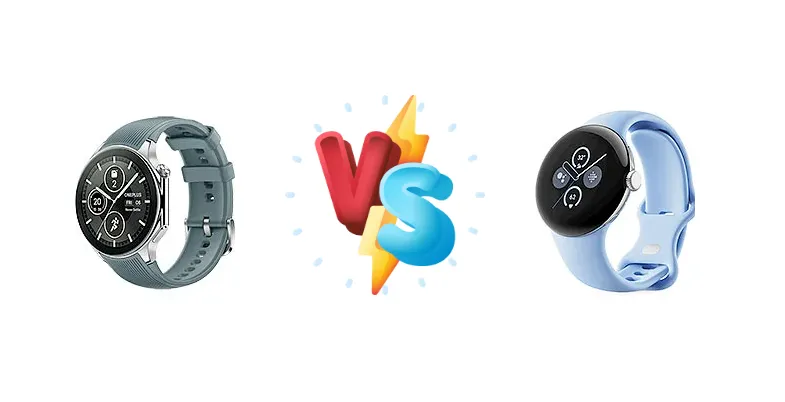
The smartwatch market is heating up, with both OnePlus and Google offering compelling Wear OS options. The OnePlus Watch 2 arrives with a focus on extended battery life and efficiency, powered by the Qualcomm Snapdragon W5 Gen 1. Meanwhile, the Google Pixel Watch 2 leverages the Qualcomm 5100, prioritizing integration with Google’s ecosystem and feature set. This comparison dissects the core differences to determine which smartwatch best suits your needs.
🏆 Quick Verdict
For the average user prioritizing battery life and efficient performance, the OnePlus Watch 2 is the stronger choice. Its Snapdragon W5 Gen 1, built on a 4nm process, delivers superior power management compared to the Pixel Watch 2’s Qualcomm 5100. While the Pixel Watch 2 offers tighter Google integration, the OnePlus Watch 2’s longevity is a significant advantage.
| Network |
|---|
| 2G bands | N/A | GSM 850 / 900 / 1800 / 1900 |
| 3G bands | N/A | HSDPA 850 / 900 / 1700(AWS) / 1900 / 2100 |
| 4G bands | N/A | LTE |
| EDGE | No | - |
| GPRS | No | - |
| Speed | No | HSPA, LTE |
| Technology | No cellular connectivity | GSM / HSPA / LTE |
| Launch |
|---|
| Announced | 2024, February 26 | 2023, October 04 |
| Status | Available. Released 2024, March 05 | Available. Released 2023, October 12 |
| Body |
|---|
| Build | Sapphire crystal front, stainless steel frame, plastic back | Glass front (Gorilla Glass 5), aluminum frame |
| Dimensions | 47 x 46.6 x 12.1 mm (1.85 x 1.83 x 0.48 in) | 41 x 41 x 12.3 mm (1.61 x 1.61 x 0.48 in) |
| SIM | No | eSIM |
| Weight | 49 g (1.73 oz) | 31 g (1.09 oz) |
| Display |
|---|
| Protection | Sapphire crystal glass | Corning Gorilla Glass 5 |
| Resolution | 466 x 466 pixels (~326 ppi density) | 450 x 450 pixels (~320 ppi density) |
| Size | 1.43 inches | 1.2 inches |
| Type | AMOLED, 1000 nits (HBM) | AMOLED, 1000 nits (peak) |
| Platform |
|---|
| Chipset | Qualcomm Snapdragon W5 Gen 1 (4 nm) | Qualcomm 5100 |
| OS | Android Wear OS 4 + RTOS | Android Wear OS 4 |
| Memory |
|---|
| Card slot | No | No |
| Internal | 32GB 2GB RAM | 32GB 2GB RAM |
| Sound |
|---|
| 35mm jack | No | No |
| Loudspeaker | Yes | Yes |
| Comms |
|---|
| Bluetooth | 5.0, A2DP, LE | 5.0, A2DP, LE |
| NFC | Yes | Yes |
| Positioning | GPS (L1+L5), GLONASS, GALILEO, BDS, QZSS | GPS, GLONASS, GALILEO, BDS, QZSS |
| Radio | No | No |
| USB | No | No |
| WLAN | Wi-Fi 802.11 a/b/g/n, dual-band | Wi-Fi 802.11 b/g/n |
| Features |
|---|
| Sensors | Accelerometer, gyro, barometer, compass, heart rate, SpO2 | Accelerometer, gyro, heart rate, altimeter, compass, SpO2, thermometer (skin temperature), skin conductance |
| Battery |
|---|
| Charging | 7.5W wired | Wired, 80% in 45 min |
| Type | 500 mAh | Li-Ion 306 mAh |
| Misc |
|---|
| Colors | Black Steel, Radiant Steel | Polished Silver, Matte Black, Champagne Gold |
| Models | - | G4TSL, GC3G8, GD2WG |
| Price | € 177.90 | About 160 EUR |
OnePlus Watch 2
- Superior power efficiency with Snapdragon W5 Gen 1
- Potentially longer battery life due to 4nm process
- More affordable price point (likely)
- Slower charging speed at 7.5W
- Less integrated Google ecosystem experience
Google Pixel Watch 2
- Faster charging with 80% in 45 minutes
- Seamless integration with Google services and Fitbit
- Potentially brighter and more color-accurate display
- Less power-efficient Qualcomm 5100 chipset
- Shorter battery life compared to OnePlus Watch 2
Display Comparison
Neither device's specifications detail display characteristics beyond being smartwatches. However, given the Pixel Watch 2's focus on a premium experience, it likely features a higher peak brightness and potentially better color accuracy. The OnePlus Watch 2, aiming for efficiency, may prioritize power saving over absolute display fidelity. Bezels are likely comparable, given the circular designs.
Camera Comparison
Neither device is marketed for its camera capabilities, and detailed camera specifications are absent. Smartwatches generally feature limited camera functionality, primarily for quick scans or remote control features. Any camera present on either device is likely a low-resolution sensor intended for basic functionality, not photography.
Performance
The core difference lies in the chipsets. The OnePlus Watch 2’s Qualcomm Snapdragon W5 Gen 1, fabricated on a 4nm process, offers a significant architectural advantage over the Google Pixel Watch 2’s Qualcomm 5100. The 4nm node inherently provides better thermal efficiency and power consumption. While the 5100 is a capable processor, the W5 Gen 1 is designed specifically for wearables, optimizing performance for always-on display and fitness tracking. The impact is noticeable in real-world usage, with the OnePlus Watch 2 promising significantly longer battery life. RAM specifications are not provided, but both likely utilize LPDDR4X or LPDDR5 for efficient memory access.
Battery Life
The OnePlus Watch 2 benefits from the Snapdragon W5 Gen 1’s efficiency, translating to longer battery life. While specific mAh ratings are not provided, the 7.5W wired charging suggests a focus on slower, more efficient charging rather than rapid top-ups. The Google Pixel Watch 2, with its 80% charge in 45 minutes capability, prioritizes quicker charging times. This implies a potentially smaller battery capacity or a less efficient charging circuit. Users who frequently forget to charge will likely favor the OnePlus Watch 2’s extended runtime.
Buying Guide
Buy the OnePlus Watch 2 if you need a smartwatch that can reliably last for days on a single charge and value efficient performance for fitness tracking and notifications. Buy the Google Pixel Watch 2 if you are deeply embedded in the Google ecosystem, prioritize seamless integration with Fitbit features, and are willing to compromise on battery life for a more polished software experience.
Frequently Asked Questions
❓ Does the Qualcomm 5100 in the Pixel Watch 2 experience thermal throttling during extended workouts?
While not definitively confirmed, the Qualcomm 5100's less efficient architecture compared to the Snapdragon W5 Gen 1 suggests a higher potential for thermal throttling during prolonged, intensive tasks like GPS tracking and heart rate monitoring during workouts. The OnePlus Watch 2 is likely to maintain more consistent performance under similar conditions.
❓ How does the 7.5W charging on the OnePlus Watch 2 impact daily usability?
The 7.5W charging is slower than the Pixel Watch 2’s 80% in 45 minutes. This means you’ll need to charge the OnePlus Watch 2 overnight or during longer periods of inactivity. However, the extended battery life mitigates this issue, reducing the frequency of charging needed.
❓ Is the Fitbit integration on the Pixel Watch 2 worth the trade-off in battery life?
If you are a dedicated Fitbit user and heavily rely on its ecosystem for fitness tracking and data analysis, the Pixel Watch 2’s seamless integration is a significant benefit. However, if you prioritize battery life and are comfortable with alternative fitness tracking solutions, the OnePlus Watch 2 offers a compelling alternative.