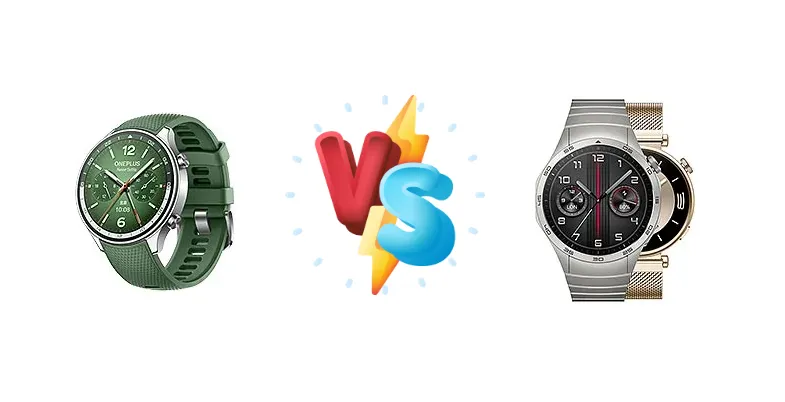
The smartwatch market is increasingly competitive, with both OnePlus and Huawei offering compelling options. The OnePlus Watch 2 distinguishes itself with eSIM support, enabling standalone connectivity, while the Huawei Watch GT 4 focuses on refined design and wireless charging convenience. This comparison dissects these key differences and more, helping you determine which smartwatch best fits your lifestyle.
🏆 Quick Verdict
For users prioritizing cellular connectivity and a modern chipset, the OnePlus Watch 2 (eSIM) is the superior choice. Its Qualcomm Snapdragon W5 Gen 1 offers a more future-proof platform. However, those valuing wireless charging simplicity and potentially longer battery life (based on Huawei’s historical performance) may prefer the GT 4.
| Network |
|---|
| 2G bands | GSM 850 / 900 / 1800 / 1900 | N/A |
| 3G bands | HSDPA 850 / 900 / 1900 / 2100 | N/A |
| 4G bands | LTE | N/A |
| EDGE | - | No |
| GPRS | - | No |
| Speed | HSPA, LTE | No |
| Technology | GSM / HSPA / LTE | No cellular connectivity |
| Launch |
|---|
| Announced | 2024, June 27 | 2023, September 14 |
| Status | Available. Released 2024, July 03 | Available. Released 2023, October 02 |
| Body |
|---|
| Build | - | Glass front, plastic back, stainless steel frame |
| Dimensions | 47.6 x 46.6 x 12.1 mm (1.87 x 1.83 x 0.48 in) | 46 x 46 x 10.9 mm (1.81 x 1.81 x 0.43 in) |
| SIM | eSIM | No |
| Weight | 37 g (1.31 oz) | 37 g (41mm) / 48 g (46mm) (1.31 oz) |
| Display |
|---|
| Resolution | 466 x 466 pixels (~326 ppi density) | 466 x 466 pixels (~326 ppi density) |
| Size | 1.43 inches | 1.43 inches |
| Type | AMOLED, 1000 nits (HBM) | AMOLED |
| Platform |
|---|
| Chipset | Qualcomm Snapdragon W5 Gen 1 (4 nm) | - |
| OS | ColorOS Watch 6.0 | HarmonyOS 4.0 |
| Memory |
|---|
| Card slot | No | No |
| Internal | 32GB 2GB RAM | Unspecified |
| Sound |
|---|
| 35mm jack | No | No |
| Loudspeaker | Yes | Yes |
| Comms |
|---|
| Bluetooth | 5.0, A2DP, LE | 5.2, A2DP, LE |
| NFC | Yes | Yes |
| Positioning | GPS (L1+L5), GLONASS, GALILEO, BDS, QZSS | GPS (L1+L5), GLONASS, BDS, GALILEO, QZSS |
| Radio | No | No |
| USB | No | No |
| WLAN | Wi-Fi 802.11 a/b/g/n, dual-band | No |
| Features |
|---|
| Sensors | Accelerometer, gyro, barometer, compass, heart rate, SpO2 | Accelerometer, gyro, heart rate, barometer, compass, SpO2, thermometer (body temperature) |
| Battery |
|---|
| Charging | 7.5W wired | Wireless |
| Type | 500 mAh | Li-Ion 524 mAh |
| Misc |
|---|
| Colors | Black, Silver | Black, Steel, Silver, Gold |
| Models | - | ARA-B19, PNX-B19 |
| Price | About 230 EUR | About 270 EUR |
OnePlus Watch 2 (eSIM)
- eSIM connectivity for standalone operation
- Modern Qualcomm Snapdragon W5 Gen 1 chipset
- Potential for faster software updates and app compatibility
- Slower 7.5W wired charging
- Battery capacity currently unknown
- Potentially higher price point
Huawei Watch GT 4
- Convenient wireless charging
- Huawei’s reputation for battery optimization
- Potentially more affordable price
- Likely less powerful chipset
- No eSIM connectivity
- Potential limitations in app ecosystem
Display Comparison
Display specifications are currently unavailable for both devices. However, given the market positioning, we anticipate the OnePlus Watch 2 will leverage an AMOLED panel to complement its modern chipset, potentially with LTPO for improved power efficiency. The Huawei Watch GT 4, historically, has favored vibrant AMOLED displays as well. The absence of detailed specs necessitates a wait-and-see approach, but display quality will likely be a key differentiator in real-world usage.
Camera Comparison
Neither device is marketed for its camera capabilities, and detailed camera specifications are unavailable. Smartwatches generally feature limited camera functionality, primarily for quick scans or remote phone control. Therefore, the camera is not a significant differentiating factor in this comparison.
Performance
The OnePlus Watch 2’s Qualcomm Snapdragon W5 Gen 1 (4nm) chipset represents a significant advantage in processing power and efficiency. The 4nm fabrication process inherently delivers better thermal performance and power savings compared to older, larger node chipsets typically found in wearables. While the Huawei Watch GT 4’s chipset remains undisclosed, Huawei often prioritizes power efficiency over raw performance. This means the GT 4 may excel in battery life, but potentially at the cost of responsiveness and future software support. The Snapdragon W5 Gen 1’s architecture is designed for modern smartwatch features and app compatibility.
Battery Life
Battery capacity details are currently unavailable for either device. However, the OnePlus Watch 2’s 7.5W wired charging is comparatively slow. The Huawei Watch GT 4’s wireless charging offers convenience, but typically charges at a slower rate than wired solutions. Huawei has a strong track record of optimizing battery life through software and hardware integration, potentially offsetting the slower charging speed. The Snapdragon W5 Gen 1’s efficiency in the OnePlus Watch 2 could also contribute to competitive battery performance despite the slower charging.
Buying Guide
Buy the OnePlus Watch 2 (eSIM) if you need the freedom of standalone cellular connectivity for calls, messaging, and streaming without your phone. This is ideal for runners, cyclists, or anyone who wants to leave their phone behind. Buy the Huawei Watch GT 4 if you prioritize a sleek design, the convenience of wireless charging, and are less concerned with having independent cellular capabilities. It’s a strong contender for users focused on fitness tracking and style.
Frequently Asked Questions
❓ What network bands does the OnePlus Watch 2 eSIM support, and will it work with my carrier?
Specific network band support for the OnePlus Watch 2 eSIM is currently unavailable. However, compatibility will depend on your carrier’s support for eSIM devices and the specific bands utilized. It’s crucial to check with your carrier before purchasing to ensure compatibility.
❓ Does the Huawei Watch GT 4 support contactless payments, and which payment systems are compatible?
Huawei typically includes NFC for contactless payments on its GT series watches. Compatibility usually extends to Huawei Pay and potentially other regional payment systems. However, support for Google Pay or Apple Pay is unlikely due to Huawei’s current restrictions.
❓ How does the Snapdragon W5 Gen 1 in the OnePlus Watch 2 impact app performance compared to typical smartwatch chipsets?
The Snapdragon W5 Gen 1 is a significant upgrade over older smartwatch chipsets. Its architecture allows for smoother app operation, faster loading times, and improved responsiveness, particularly for more demanding applications like music streaming or navigation.