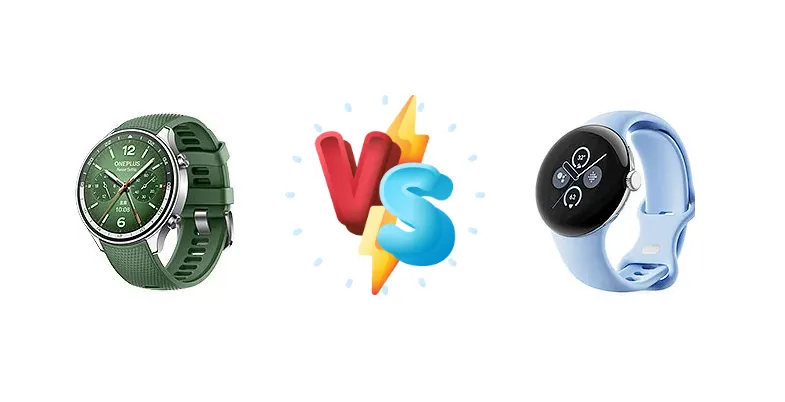
The smartwatch market is heating up, with the OnePlus Watch 2 and Google Pixel Watch 2 vying for wrist space. Both offer compelling features, including eSIM connectivity, but diverge significantly in their underlying hardware. This comparison dissects the key differences, focusing on chipset architecture, charging speeds, and the implications for everyday use.
🏆 Quick Verdict
For most users prioritizing battery life and efficient performance, the OnePlus Watch 2 emerges as the stronger choice. Its Qualcomm Snapdragon W5 Gen 1 chipset, built on a 4nm process, delivers a noticeable advantage in power efficiency compared to the Pixel Watch 2’s older Qualcomm 5100. While the Pixel Watch 2 offers a refined software experience, the OnePlus Watch 2’s hardware foundation provides a more sustainable long-term experience.
| Network |
|---|
| 2G bands | GSM 850 / 900 / 1800 / 1900 | GSM 850 / 900 / 1800 / 1900 |
| 3G bands | HSDPA 850 / 900 / 1900 / 2100 | HSDPA 850 / 900 / 1700(AWS) / 1900 / 2100 |
| 4G bands | LTE | LTE |
| Speed | HSPA, LTE | HSPA, LTE |
| Technology | GSM / HSPA / LTE | GSM / HSPA / LTE |
| Launch |
|---|
| Announced | 2024, June 27 | 2023, October 04 |
| Status | Available. Released 2024, July 03 | Available. Released 2023, October 12 |
| Body |
|---|
| Build | - | Glass front (Gorilla Glass 5), aluminum frame |
| Dimensions | 47.6 x 46.6 x 12.1 mm (1.87 x 1.83 x 0.48 in) | 41 x 41 x 12.3 mm (1.61 x 1.61 x 0.48 in) |
| SIM | eSIM | eSIM |
| Weight | 37 g (1.31 oz) | 31 g (1.09 oz) |
| Display |
|---|
| Protection | - | Corning Gorilla Glass 5 |
| Resolution | 466 x 466 pixels (~326 ppi density) | 450 x 450 pixels (~320 ppi density) |
| Size | 1.43 inches | 1.2 inches |
| Type | AMOLED, 1000 nits (HBM) | AMOLED, 1000 nits (peak) |
| Platform |
|---|
| Chipset | Qualcomm Snapdragon W5 Gen 1 (4 nm) | Qualcomm 5100 |
| OS | ColorOS Watch 6.0 | Android Wear OS 4 |
| Memory |
|---|
| Card slot | No | No |
| Internal | 32GB 2GB RAM | 32GB 2GB RAM |
| Sound |
|---|
| 35mm jack | No | No |
| Loudspeaker | Yes | Yes |
| Comms |
|---|
| Bluetooth | 5.0, A2DP, LE | 5.0, A2DP, LE |
| NFC | Yes | Yes |
| Positioning | GPS (L1+L5), GLONASS, GALILEO, BDS, QZSS | GPS, GLONASS, GALILEO, BDS, QZSS |
| Radio | No | No |
| USB | No | No |
| WLAN | Wi-Fi 802.11 a/b/g/n, dual-band | Wi-Fi 802.11 b/g/n |
| Features |
|---|
| Sensors | Accelerometer, gyro, barometer, compass, heart rate, SpO2 | Accelerometer, gyro, heart rate, altimeter, compass, SpO2, thermometer (skin temperature), skin conductance |
| Battery |
|---|
| Charging | 7.5W wired | Wired, 80% in 45 min |
| Type | 500 mAh | Li-Ion 306 mAh |
| Misc |
|---|
| Colors | Black, Silver | Polished Silver, Matte Black, Champagne Gold |
| Models | - | G4TSL, GC3G8, GD2WG |
| Price | About 230 EUR | About 160 EUR |
OnePlus Watch 2 (eSIM)
- Superior power efficiency with the Snapdragon W5 Gen 1
- Potentially longer battery life due to 4nm process
- More affordable price point (likely)
- Slower charging speed (7.5W)
- Potentially less refined software experience
Google Pixel Watch 2
- Faster charging (80% in 45 minutes)
- Seamless integration with Google and Fitbit ecosystems
- Potentially more accurate display calibration
- Less power-efficient chipset (Qualcomm 5100)
- Shorter battery life compared to OnePlus Watch 2
- Potentially higher price
Display Comparison
Detailed display specifications are absent from the provided data. However, given the market positioning, we can infer both watches utilize AMOLED panels. The Pixel Watch 2 likely benefits from Google’s display calibration expertise, potentially offering more accurate colors. The OnePlus Watch 2, while potentially lacking the same level of color accuracy, may prioritize power efficiency through lower peak brightness settings. Bezels are likely comparable, given the similar form factors.
Camera Comparison
Neither device is marketed for its camera capabilities, and detailed camera specs are unavailable. Smartwatches generally feature limited camera functionality, primarily for quick scans or video calls. Any differences in image quality would likely be minimal and not a deciding factor for most buyers.
Performance
The core difference lies in the chipsets. The OnePlus Watch 2’s Qualcomm Snapdragon W5 Gen 1, fabricated on a 4nm process, represents a significant leap in efficiency over the Google Pixel Watch 2’s Qualcomm 5100. The 4nm node allows for a higher transistor density and lower voltage operation, translating directly to reduced power consumption and improved thermal management. While the 5100 is a capable chip, it’s older architecture will struggle to match the W5 Gen 1’s sustained performance. RAM specifications are not provided, but both likely utilize LPDDR4X or LPDDR5 for adequate memory bandwidth.
Battery Life
Battery capacity is not specified, but the Snapdragon W5 Gen 1 in the OnePlus Watch 2 provides a substantial advantage in battery life due to its superior power efficiency. The Pixel Watch 2 compensates with faster charging – 80% in 45 minutes – while the OnePlus Watch 2 offers a slower 7.5W wired charging solution. This means the Pixel Watch 2 can quickly top up, but the OnePlus Watch 2 will likely require less frequent charging overall, making it ideal for multi-day use.
Buying Guide
Buy the OnePlus Watch 2 (eSIM) if you need extended battery life, value efficient performance for fitness tracking, and prioritize a more affordable price point. Its Snapdragon W5 Gen 1 chipset ensures smooth operation without sacrificing endurance. Buy the Google Pixel Watch 2 if you are deeply embedded in the Google ecosystem, prioritize seamless integration with Fitbit, and value a more polished software experience, even if it means more frequent charging.
Frequently Asked Questions
❓ Does the Qualcomm 5100 chipset in the Pixel Watch 2 experience thermal throttling during extended use?
While the Qualcomm 5100 is a capable chip, its older architecture and less efficient manufacturing process (compared to the Snapdragon W5 Gen 1) make it more susceptible to thermal throttling during prolonged, demanding tasks like GPS tracking or continuous heart rate monitoring. This can lead to performance slowdowns and potentially impact accuracy.
❓ How does the eSIM functionality differ between the OnePlus Watch 2 and the Google Pixel Watch 2?
Both watches support eSIM, allowing for cellular connectivity independent of a smartphone. However, carrier support and activation processes may vary. Google, with its established partnerships, likely offers broader carrier compatibility for the Pixel Watch 2. OnePlus’s eSIM support is expanding, but may have regional limitations. Check with your carrier for specific compatibility details.
❓ Is the 7.5W charging speed of the OnePlus Watch 2 a significant drawback?
While slower than the Pixel Watch 2’s 80% in 45 minutes charging, the OnePlus Watch 2’s superior battery efficiency mitigates the impact of the slower charging speed. The longer battery life means you’ll need to charge it less frequently, reducing the inconvenience of the slower charging time. Overnight charging is perfectly viable.