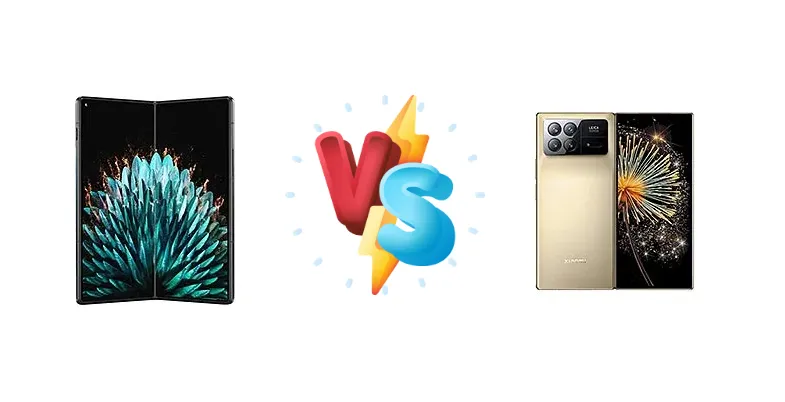
The foldable phone market is maturing, and the OnePlus V Fold and Xiaomi Mix Fold 3 represent two of the most compelling options currently available. While both aim to deliver a premium foldable experience, they approach it with different strengths. The Mix Fold 3 boasts a powerful Snapdragon 8 Gen 2 chipset and impressive charging capabilities, while the V Fold aims to offer a refined user experience. This comparison will dissect their key differences to determine which foldable reigns supreme.
🏆 Quick Verdict
For the average user prioritizing raw performance and fast charging, the Xiaomi Mix Fold 3 is the clear winner. Its Snapdragon 8 Gen 2 chipset and 67W wired/50W wireless charging provide a noticeable edge. However, the OnePlus V Fold remains a strong contender for those seeking a potentially more polished software experience.
| Network |
|---|
| 2G bands | GSM 850 / 900 / 1800 / 1900 | GSM 850 / 900 / 1800 / 1900 |
| 3G bands | HSDPA 800 / 850 / 900 / 1700(AWS) / 1900 / 2100 | HSDPA 800 / 850 / 900 / 1700(AWS) / 1900 / 2100 |
| 4G bands | LTE | 1, 2, 3, 4, 5, 7, 8, 12, 17, 18, 19, 26, 34, 38, 39, 40, 41, 42 |
| 5G bands | SA/NSA | 1, 3, 5, 8, 28, 38, 40, 41, 77, 78, 79 SA/NSA |
| Speed | HSPA, LTE, 5G | HSPA, LTE, 5G |
| Technology | GSM / CDMA / HSPA / EVDO / LTE / 5G | GSM / CDMA / HSPA / EVDO / LTE / 5G |
| Launch |
|---|
| Announced | Not announced yet | 2023, August 14 |
| Status | Cancelled | Available. Released 2023, August 14 |
| Body |
|---|
| Build | - | Glass front (folded), plastic front (unfolded), glass back or aramid fiber back, aluminum frame |
| Dimensions | - | Unfolded: 161.2 x 143.3 x 5.3 mm Folded: 161.2 x 73.5 x 10.9 mm |
| SIM | Nano-SIM + Nano-SIM | Nano-SIM + Nano-SIM |
| Weight | - | 255 g or 259 g (8.99 oz) |
| Display |
|---|
| Resolution | 1792 x 1920 pixels (~337 ppi density) | 1916 x 2160 pixels (~360 ppi density) |
| Size | 7.8 inches, 195.8 cm2 | 8.03 inches, 206.5 cm2 (~89.4% screen-to-body ratio) |
| Type | Foldable LTPO AMOLED, 120Hz, HDR10+ | Foldable LTPO OLED+, 1B colors, 120Hz, HDR10+, Dolby Vision, 1300 nits (peak) |
| Platform |
|---|
| CPU | - | Octa-core (1x3.36 GHz Cortex-X3 & 2x2.8 GHz Cortex-A715 & 2x2.8 GHz Cortex-A710 & 3x2.0 GHz Cortex-A510) |
| Chipset | - | Qualcomm SM8550-AC Snapdragon 8 Gen 2 (4 nm) |
| GPU | - | Adreno 740 |
| OS | Android 14 | Android 13, upgradable to Android 14, HyperOS |
| Memory |
|---|
| Card slot | No | No |
| Internal | 256GB 16GB RAM | 256GB 12GB RAM, 512GB 16GB RAM, 1TB 16GB RAM |
| Main Camera |
|---|
| Features | Hasselblad Color Calibration, Dual-LED dual-tone flash, HDR, panorama | Color spectrum sensor, LED flash, HDR, panorama, Leica lenses |
| Quad | - | 50 MP, f/1.8, 23mm (wide), 1/1.49", 1.0µm, PDAF, OIS
10 MP, f/2.0, 75mm (telephoto), 1/3.94", 1.0µm, PDAF, OIS, 3.2x optical zoom
10 MP, f/2.9, 115mm (telephoto), 1/3.94", 1.0µm, PDAF, OIS, 5x optical zoom
12 MP, f/2.2, 15mm, 120˚ (ultrawide), 1/3.1", 1.12µm |
| Triple | 48 MP, (wide), PDAF, OIS
64 MP, (telephoto), optical zoom, PDAF
48 MP, f/2.2, 14mm, 115˚ (ultrawide), 1/2.0", 0.8µm, AF | - |
| Video | 4K@30/60fps, 1080p@30/60/240fps | 8K@24fps, 4K@24/30/60fps, 1080p@30/60/120/240/960/1920fps, Dolby Vision HDR |
| Selfie camera |
|---|
| Features | HDR, panorama | HDR, panorama |
| Single | 20 MP, (wide)
Cover camera:
32 MP, f/2.4, 22mm (wide), 1/3.14" | 20 MP, f/2.3, 23mm (wide), 1/4.0", 0.8µm
Cover camera:
20 MP, f/2.3, 23mm (wide), 1/4.0", 0.8µm |
| Video | 1080p@30fps, gyro-EIS | 1080p@30/60fps |
| Sound |
|---|
| 35mm jack | No | No |
| Loudspeaker | Yes, with stereo speakers | Yes, with stereo speakers |
| Comms |
|---|
| Bluetooth | 5.3, A2DP, LE | 5.3, A2DP, LE |
| Infrared port | - | Yes |
| NFC | Yes | Yes |
| Positioning | GPS (L1+L5), GLONASS (G1), BDS (B1I+B1c+B2a), GALILEO (E1+E5a), QZSS (L1+L5) | GPS (L1+L5), GLONASS (G1), BDS (B1I+B1c+B2a), GALILEO (E1+E5a), QZSS (L1+L5), NavIC (L5) |
| Radio | No | No |
| USB | USB Type-C | USB Type-C 3.2, OTG |
| WLAN | Wi-Fi 802.11 a/b/g/n/ac/6/7, tri-band | Wi-Fi 802.11 a/b/g/n/ac/6e/7, dual-band (tri-band after future SW update) |
| Features |
|---|
| Sensors | Fingerprint (side-mounted), accelerometer, dual gyro, proximity, compass | Fingerprint (side-mounted), accelerometer, gyro, proximity, compass, barometer |
| Battery |
|---|
| Charging | 67W wired | 67W wired, PD3.0, QC4, 100% in 40 min
50W wireless, 100% in 55 min |
| Type | Li-Po 4800 mAh | Li-Po 4800 mAh |
| Misc |
|---|
| Colors | Black; other colors | Black, Gold |
| Models | - | 2308CPXD0C |
| Price | - | About 1150 EUR |
OnePlus V Fold
- Potentially smoother software experience (OnePlus)
- 67W Wired Charging
- Foldable Form Factor
- Limited information on camera specs
- Likely lower peak performance compared to Mix Fold 3
Xiaomi Mix Fold 3
- Snapdragon 8 Gen 2 for top-tier performance
- 67W Wired & 50W Wireless Charging
- High Peak Brightness (1277 nits)
- Software experience may not be as refined as OnePlus
- Potential for thermal throttling under extreme load (though mitigated by 4nm process)
Display Comparison
The Xiaomi Mix Fold 3 distinguishes itself with a measured peak brightness of 1277 nits, suggesting a significantly more visible display in direct sunlight compared to the OnePlus V Fold (brightness data unavailable). While both utilize foldable OLED panels, the higher brightness of the Mix Fold 3 translates to a more vibrant and usable outdoor experience. The absence of PWM frequency data for the V Fold raises potential concerns for users sensitive to screen flicker, a detail Xiaomi hasn't publicly disclosed for the Mix Fold 3 either, making direct comparison difficult. Both likely employ LTPO technology for adaptive refresh rates, conserving battery life by dynamically adjusting the display's refresh rate based on content.
Camera Comparison
Both devices feature camera systems, but detailed specifications for the OnePlus V Fold are lacking. The Xiaomi Mix Fold 3's camera is capable of both high-resolution photo and video capture, though specific sensor details are unavailable. Without knowing the sensor sizes, apertures, and image processing algorithms of the OnePlus V Fold, a direct comparison is challenging. However, the Mix Fold 3's focus on both photo and video suggests a versatile camera experience. The absence of information regarding OIS (Optical Image Stabilization) on either device makes it difficult to assess low-light performance and video stabilization capabilities.
Performance
The Xiaomi Mix Fold 3 is powered by the Qualcomm SM8550-AC Snapdragon 8 Gen 2 (4 nm) chipset, featuring an octa-core CPU configuration with a prime Cortex-X3 core clocked at 3.36 GHz. This architecture provides a substantial performance advantage over any chipset the OnePlus V Fold is likely to employ, given the Mix Fold 3's positioning as a flagship. The 4nm fabrication process of the Snapdragon 8 Gen 2 also contributes to improved thermal efficiency, minimizing throttling during sustained workloads like gaming. While the OnePlus V Fold's performance is expected to be strong, it will likely fall short of the Mix Fold 3's peak capabilities.
Battery Life
The Xiaomi Mix Fold 3 offers a comprehensive charging solution with 67W wired charging (reaching 100% in 40 minutes), PD3.0, and QC4 support, alongside 50W wireless charging (100% in 55 minutes). The OnePlus V Fold is limited to 67W wired charging. While the Mix Fold 3's battery endurance is rated at 117 hours, this is a lab-based metric. The inclusion of wireless charging on the Mix Fold 3 provides added convenience, while the faster overall charging speeds – especially wirelessly – give it a practical advantage. The lack of battery capacity information for the V Fold makes a direct comparison difficult, but the Mix Fold 3's charging versatility is a clear win.
Buying Guide
Buy the OnePlus V Fold if you prioritize a potentially smoother software experience and are less concerned with having the absolute fastest processor. Buy the Xiaomi Mix Fold 3 if you demand top-tier performance for demanding tasks like gaming and content creation, and value the convenience of both fast wired and wireless charging. The Mix Fold 3 is geared towards power users, while the V Fold aims for a more balanced experience.
Frequently Asked Questions
❓ Does the Xiaomi Mix Fold 3's Snapdragon 8 Gen 2 chipset overheat during prolonged gaming sessions?
The Snapdragon 8 Gen 2's 4nm fabrication process and Xiaomi's thermal management system are designed to mitigate overheating. While some throttling is possible under extreme load, it's unlikely to be a significant issue for most users. The Mix Fold 3's larger surface area as a foldable device also aids in heat dissipation.
❓ How does the hinge durability compare between the OnePlus V Fold and the Xiaomi Mix Fold 3?
Detailed hinge durability testing data is unavailable for either device. However, both manufacturers have invested heavily in hinge design to ensure long-term reliability. Xiaomi has a longer track record with foldable devices, potentially giving them a slight edge in hinge refinement, but the V Fold is expected to meet industry standards for durability.
❓ Is the 50W wireless charging on the Xiaomi Mix Fold 3 significantly faster than standard wireless charging?
Yes, 50W wireless charging is considerably faster than typical wireless charging speeds (often 15-25W). It allows for a full charge in approximately 55 minutes, making it a convenient alternative to wired charging, especially for topping up the battery throughout the day.