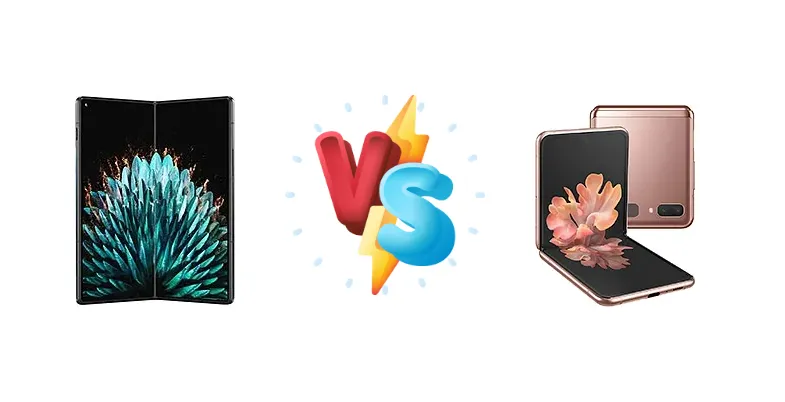
The foldable market presents a fascinating dichotomy: large-screen productivity versus ultra-portability. The OnePlus V Fold aims to replace your tablet, offering a spacious canvas, while the Samsung Galaxy Z Flip 5G prioritizes pocketability with its clamshell design. This comparison dissects their core differences, focusing on performance, charging, and the user experience each delivers.
🏆 Quick Verdict
For users prioritizing a larger screen and faster charging, the OnePlus V Fold is the clear winner. However, the Samsung Galaxy Z Flip 5G’s compact form factor and established software optimization make it ideal for those seeking ultimate portability and a more refined, albeit slower-charging, experience.
| Network |
|---|
| 2G bands | GSM 850 / 900 / 1800 / 1900 | GSM 850 / 900 / 1800 / 1900 |
| 3G bands | HSDPA 800 / 850 / 900 / 1700(AWS) / 1900 / 2100 | HSDPA 850 / 900 / 1700(AWS) / 1900 / 2100 - International, Canada |
| 4G bands | LTE | 1, 2, 3, 4, 5, 7, 8, 12, 13, 14, 18, 19, 20, 25, 26, 28, 29, 30, 38, 39, 40, 41, 66, 71 - International |
| 5G bands | SA/NSA | 1, 41, 77, 78, 79 Sub6 - China, Hong Kong |
| Speed | HSPA, LTE, 5G | HSPA 42.2/5.76 Mbps, LTE (6CA) Cat20 2000/200 Mbps, 5G |
| Technology | GSM / CDMA / HSPA / EVDO / LTE / 5G | GSM / CDMA / HSPA / EVDO / LTE / 5G |
| | - | 41, 66, 71 Sub6 - Canada |
| Launch |
|---|
| Announced | Not announced yet | 2020, July 22 |
| Status | Cancelled | Available. Released 2020, August 07 |
| Body |
|---|
| Build | - | Plastic front, glass back (Gorilla Glass 6), aluminum frame |
| Dimensions | - | Unfolded: 167.3 x 73.6 x 7.2 mm Folded: 87.4 x 73.6 x 17.3 mm |
| SIM | Nano-SIM + Nano-SIM | Nano-SIM + eSIM |
| Weight | - | 183 g (6.46 oz) |
| Display |
|---|
| Resolution | 1792 x 1920 pixels (~337 ppi density) | 1080 x 2636 pixels (~425 ppi density) |
| Size | 7.8 inches, 195.8 cm2 | 6.7 inches, 101.6 cm2 (~82.5% screen-to-body ratio) |
| Type | Foldable LTPO AMOLED, 120Hz, HDR10+ | Foldable Dynamic AMOLED, HDR10+ |
| | - | Cover display:
Super AMOLED, 1.1 inches, 112 x 300 pixels |
| Platform |
|---|
| CPU | - | Octa-core (1x3.09 GHz Cortex-A77 & 3x2.40 GHz Cortex-A77 & 4x1.80 GHz Cortex-A55) |
| Chipset | - | Qualcomm SM8250 Snapdragon 865 5G+ (7 nm+) |
| GPU | - | Adreno 650 |
| OS | Android 14 | Android 10, upgradable to Android 13, One UI 5 |
| Memory |
|---|
| Card slot | No | No |
| Internal | 256GB 16GB RAM | 256GB 8GB RAM |
| | - | UFS 3.0 |
| Main Camera |
|---|
| Dual | - | 12 MP, f/1.8, 27mm (wide), 1/2.55", 1.4µm, dual pixel PDAF, OIS
12 MP, f/2.2, 123˚ (ultrawide), 1.12µm |
| Features | Hasselblad Color Calibration, Dual-LED dual-tone flash, HDR, panorama | LED flash, HDR, panorama |
| Triple | 48 MP, (wide), PDAF, OIS
64 MP, (telephoto), optical zoom, PDAF
48 MP, f/2.2, 14mm, 115˚ (ultrawide), 1/2.0", 0.8µm, AF | - |
| Video | 4K@30/60fps, 1080p@30/60/240fps | 4K@30/60fps, 1080p@60/240fps, 720p@960fps, HDR10+ |
| Selfie camera |
|---|
| Features | HDR, panorama | HDR |
| Single | 20 MP, (wide)
Cover camera:
32 MP, f/2.4, 22mm (wide), 1/3.14" | 10 MP, f/2.4, 26mm (wide), 1.22µm |
| Video | 1080p@30fps, gyro-EIS | 4K@30fps |
| Sound |
|---|
| 3.5mm jack | - | No |
| 35mm jack | No | No |
| Loudspeaker | Yes, with stereo speakers | Yes |
| | - | 32-bit/384kHz audio
Tuned by AKG |
| Comms |
|---|
| Bluetooth | 5.3, A2DP, LE | 5.0, A2DP, LE |
| NFC | Yes | Yes |
| Positioning | GPS (L1+L5), GLONASS (G1), BDS (B1I+B1c+B2a), GALILEO (E1+E5a), QZSS (L1+L5) | GPS, GLONASS, GALILEO, BDS |
| Radio | No | No |
| USB | USB Type-C | USB Type-C 2.0, OTG |
| WLAN | Wi-Fi 802.11 a/b/g/n/ac/6/7, tri-band | Wi-Fi 802.11 a/b/g/n/ac/6, dual-band, Wi-Fi Direct |
| Features |
|---|
| Sensors | Fingerprint (side-mounted), accelerometer, dual gyro, proximity, compass | Fingerprint (side-mounted), accelerometer, gyro, proximity, compass, barometer |
| | - | Samsung Pay (Visa, MasterCard certified) |
| Battery |
|---|
| Charging | 67W wired | 15W wired
9W wireless |
| Type | Li-Po 4800 mAh | Li-Po 3300 mAh |
| Misc |
|---|
| Colors | Black; other colors | Mystic Grey, Mystic Bronze, Mystic White |
| Models | - | SM-F707B, SM-F707N, SM-F7070, SM-F707U, SM-F707U1, SM-F707W |
| Price | - | About 800 EUR |
| SAR | - | 0.80 W/kg (head) 1.01 W/kg (body) |
| SAR EU | - | 0.80 W/kg (head) 1.45 W/kg (body) |
OnePlus V Fold
- Significantly faster 67W charging
- Likely more powerful processor (Snapdragon 8 Gen 2 or newer)
- Larger, more versatile display for productivity
- Larger and heavier form factor
- Specific display and camera specs currently unknown
Samsung Galaxy Z Flip 5G
- Ultra-compact and pocketable design
- Established software optimization for foldable experience
- Vibrant Super AMOLED displays
- Slow 15W wired and 9W wireless charging
- Older Snapdragon 865+ chipset
- Limited battery capacity
Display Comparison
While specific display specs for the OnePlus V Fold are unavailable, its 'Fold' designation implies a significantly larger, foldable display compared to the Z Flip 5G’s 6.7-inch cover screen and 6.7-inch internal display. The Z Flip 5G’s displays utilize a Super AMOLED panel, known for vibrant colors. The OnePlus V Fold likely employs LTPO technology to dynamically adjust refresh rates, conserving battery. The Z Flip 5G’s smaller bezels contribute to a more immersive experience on its cover screen, but the V Fold’s larger canvas will be superior for productivity tasks. Color accuracy will likely be comparable given both brands’ focus on display quality.
Camera Comparison
The Samsung Galaxy Z Flip 5G’s camera system, while capable, is limited by its compact form factor. Details on the OnePlus V Fold’s camera are missing, but its larger size allows for potentially larger sensors and more versatile lens configurations. The Z Flip 5G’s image processing prioritizes vibrant colors and social media-ready shots. The V Fold, positioned as a premium device, likely emphasizes natural color reproduction and dynamic range. The Z Flip 5G’s 2MP macro camera is unlikely to deliver significant improvements over the main sensor, while the V Fold’s camera system is expected to be more comprehensive.
Performance
The Samsung Galaxy Z Flip 5G is powered by the Qualcomm SM8250 Snapdragon 865 5G+ (7 nm+), featuring an octa-core CPU configuration with a prime Cortex-A77 core clocked at 3.09 GHz. This chipset provides ample power for everyday tasks and moderate gaming. The OnePlus V Fold’s chipset is unspecified, but given its positioning, it’s expected to feature a more recent and powerful Snapdragon processor, likely the 8 Gen 2 or newer, offering improved CPU and GPU performance, and a more efficient 4nm process. This translates to better sustained performance and reduced thermal throttling during demanding applications. The Z Flip 5G’s LPDDR5 RAM is standard for its generation, while the V Fold likely utilizes LPDDR5X for faster data transfer speeds.
Battery Life
The Samsung Galaxy Z Flip 5G offers 15W wired and 9W wireless charging, which is relatively slow compared to modern standards. Its smaller battery capacity (around 3300mAh, estimated) necessitates conservative usage. The OnePlus V Fold boasts a significantly faster 67W wired charging, allowing for a full charge in under 40 minutes. While the V Fold’s battery capacity is unknown, the faster charging speed mitigates concerns about battery life, providing quick top-ups throughout the day. The Z Flip 5G’s wireless charging is a convenience, but its slow speed limits its practicality.
Buying Guide
Buy the OnePlus V Fold if you need a device for multitasking, content creation, or replacing a tablet, and value rapid 67W charging. Its larger form factor is a trade-off for increased screen real estate. Buy the Samsung Galaxy Z Flip 5G if you prioritize a truly pocketable phone, enjoy a unique aesthetic, and are willing to compromise on charging speed and potentially battery life for the convenience of its compact design.
Frequently Asked Questions
❓ Does the Snapdragon 865+ in the Z Flip 5G struggle with demanding games like Genshin Impact?
The Snapdragon 865+ is capable, but it will likely require reduced graphics settings and may experience some thermal throttling during extended gaming sessions. It's not a dedicated gaming chipset like newer Snapdragon offerings.
❓ How does the hinge durability compare between the OnePlus V Fold and the Samsung Galaxy Z Flip 5G?
Samsung has a significant lead in foldable hinge technology, with multiple generations of refinement. The Z Flip 5G’s hinge is known for its robustness. The OnePlus V Fold’s hinge durability is unknown, but it will be a critical factor in its long-term reliability.
❓ Is the 9W wireless charging on the Z Flip 5G practical for daily use?
9W wireless charging is quite slow and best suited for overnight charging or occasional top-ups. It’s not a replacement for wired charging, and users should expect a significantly longer charging time compared to wired options.
❓ What kind of software support can I expect from OnePlus for the V Fold compared to Samsung?
Samsung generally provides longer software support for its devices. OnePlus’s software support track record is improving, but it may not match Samsung’s commitment to multiple years of OS and security updates.