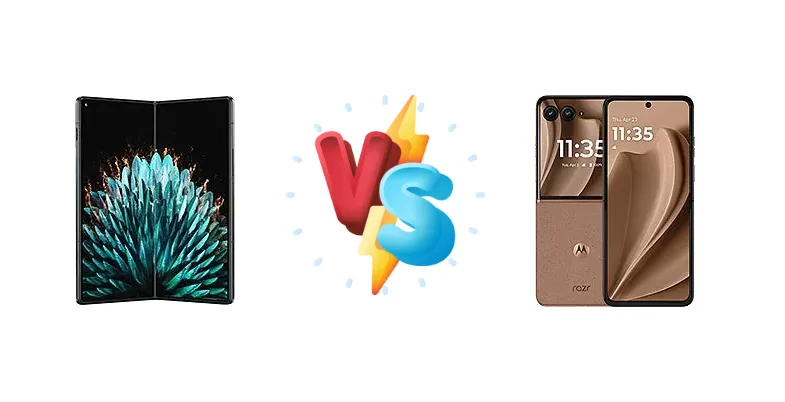
The foldable market is heating up, with the OnePlus V Fold and the upcoming Motorola Razr+ 2025 representing distinct approaches. The V Fold aims for a balanced experience, while the Razr+ 2025 focuses on delivering flagship performance in a clamshell form factor. This comparison dissects their core specifications to determine which foldable best suits your needs.
🏆 Quick Verdict
For users prioritizing sustained performance and a potentially more refined software experience, the Motorola Razr+ 2025 emerges as the winner. Its Snapdragon 8s Gen 3 chipset and impressive 10:12 hour active use battery life offer a compelling package, despite the slower 45W wired charging compared to the OnePlus V Fold.
| Network |
|---|
| 2G bands | GSM 850 / 900 / 1800 / 1900 | GSM 900 / 1800 / 1900 |
| 3G bands | HSDPA 800 / 850 / 900 / 1700(AWS) / 1900 / 2100 | HSDPA 850 / 900 / 1700(AWS) / 1900 / 2100 |
| 4G bands | LTE | 1, 2, 3, 4, 5, 7, 8, 12, 13, 14, 17, 18, 19, 20, 25, 26, 28, 29, 30, 38, 39, 40, 41, 46, 48, 66, 71 |
| 5G bands | SA/NSA | 1, 2, 3, 5, 7, 12, 14, 20, 25, 26, 28, 29, 30, 38, 40, 41, 48, 66, 70, 71, 77, 78 SA/NSA/Sub6 |
| Speed | HSPA, LTE, 5G | HSPA, LTE, 5G |
| Technology | GSM / CDMA / HSPA / EVDO / LTE / 5G | GSM / HSPA / LTE / 5G |
| Launch |
|---|
| Announced | Not announced yet | 2025, April 24 |
| Status | Cancelled | Available. Released 2025, June 03 |
| Body |
|---|
| Build | - | Plastic front (unfolded), glass front (folded, Gorilla Glass Victus), silicone polymer back (eco leather), aluminum frame (6000 series), hinge (titanium) |
| Dimensions | - | Unfolded: 171.4 x 74 x 7.1 mmFolded: 88.1 x 74 x 15.3 mm |
| SIM | Nano-SIM + Nano-SIM | Nano-SIM + eSIM |
| Weight | - | 189 g (6.67 oz) |
| Display |
|---|
| Resolution | 1792 x 1920 pixels (~337 ppi density) | 1080 x 2640 pixels (~413 ppi density) |
| Size | 7.8 inches, 195.8 cm2 | 6.9 inches, 107.6 cm2 (~84.9% screen-to-body ratio) |
| Type | Foldable LTPO AMOLED, 120Hz, HDR10+ | Foldable LTPO AMOLED, 1B colors, Dolby Vision, 165Hz, HDR10+, 3000 nits (peak) |
| Platform |
|---|
| CPU | - | Octa-core (1x3.0 GHz Cortex-X4 & 4x2.8 GHz Cortex-A720 & 3x2.0 GHz Cortex-A520) |
| Chipset | - | Qualcomm SM8635 Snapdragon 8s Gen 3 (4 nm) |
| GPU | - | Adreno 735 |
| OS | Android 14 | Android 15 |
| Memory |
|---|
| Card slot | No | No |
| Internal | 256GB 16GB RAM | 256GB 12GB RAM |
| Main Camera |
|---|
| Dual | - | 50 MP, f/1.7, 24mm (wide), 1/1.95", 0.8µm, dual pixel PDAF, OIS
50 MP, f/2.0, 47mm (telephoto), 1/2.76", 0.64µm, PDAF, 2x optical zoom |
| Features | Hasselblad Color Calibration, Dual-LED dual-tone flash, HDR, panorama | LED flash, panorama, HDR |
| Triple | 48 MP, (wide), PDAF, OIS
64 MP, (telephoto), optical zoom, PDAF
48 MP, f/2.2, 14mm, 115˚ (ultrawide), 1/2.0", 0.8µm, AF | - |
| Video | 4K@30/60fps, 1080p@30/60/240fps | 4K@30/60fps, 1080p@30/60/120/240/960fps, HDR10+, gyro-EIS |
| Selfie camera |
|---|
| Features | HDR, panorama | HDR |
| Single | 20 MP, (wide)
Cover camera:
32 MP, f/2.4, 22mm (wide), 1/3.14" | 32 MP, f/2.4, 25mm (wide), 1/3.14", 0.7µm |
| Video | 1080p@30fps, gyro-EIS | 4K@30/60fps, 1080p@30/60fps |
| Sound |
|---|
| 35mm jack | No | No |
| Loudspeaker | Yes, with stereo speakers | Yes, with stereo speakers (with Dolby Atmos) |
| Comms |
|---|
| Bluetooth | 5.3, A2DP, LE | 5.4, A2DP, LE, aptX HD, aptX Adaptive, aptX Lossless |
| NFC | Yes | Yes |
| Positioning | GPS (L1+L5), GLONASS (G1), BDS (B1I+B1c+B2a), GALILEO (E1+E5a), QZSS (L1+L5) | GPS (L1+L5), GLONASS (L1), BDS (B1I+B1c+B2a), GALILEO (E1+E5a), QZSS (L1+L5) |
| Radio | No | No |
| USB | USB Type-C | USB Type-C 2.0, OTG |
| WLAN | Wi-Fi 802.11 a/b/g/n/ac/6/7, tri-band | Wi-Fi 802.11 a/b/g/n/ac/6e/7, tri-band |
| Features |
|---|
| Sensors | Fingerprint (side-mounted), accelerometer, dual gyro, proximity, compass | Fingerprint (side-mounted), accelerometer, gyro, proximity, compass, barometer |
| Battery |
|---|
| Charging | 67W wired | 45W wired
15W wireless
5W reverse wired |
| Type | Li-Po 4800 mAh | 4000 mAh |
| Misc |
|---|
| Colors | Black; other colors | Pantone: Mocha Mousse, Midnight Blue, Hot Pink |
| Models | - | XT2451-1 |
| Price | - | $ 500.00 |
OnePlus V Fold
- Faster 67W wired charging for quick power-ups.
- Potentially more affordable price point (based on brand positioning).
- Traditional foldable form factor may appeal to some users.
- Unknown chipset performance; likely less powerful than the Snapdragon 8s Gen 3.
- Battery life likely shorter than the Razr+ 2025 based on active use data.
Motorola Razr+ 2025
- Powerful Snapdragon 8s Gen 3 chipset for demanding tasks.
- Excellent 10:12 hour active use battery life.
- Wireless and reverse wired charging options for added convenience.
- Slower 45W wired charging compared to the OnePlus V Fold.
- Potentially higher price point due to flagship components.
Display Comparison
Display specifications are currently unavailable for the OnePlus V Fold. However, given its foldable nature, it likely employs an LTPO panel to dynamically adjust refresh rates for power efficiency. The Motorola Razr+ 2025, while not detailed in the provided data, is expected to feature a high-refresh-rate foldable display, potentially exceeding the V Fold's capabilities. The key difference will likely be in the crease visibility and durability of the folding mechanism, areas where Motorola has historically focused on refinement.
Camera Comparison
Camera details for both devices are limited. Without sensor size or aperture information, a direct comparison is difficult. However, the Motorola Razr+ 2025’s chipset includes a more advanced ISP (Image Signal Processor) capable of faster image processing and improved low-light performance. The OnePlus V Fold will likely rely on software algorithms to compensate, but the hardware advantage lies with the Razr+ 2025. We anticipate both phones will feature multiple lenses, but the quality will hinge on sensor selection and image processing.
Performance
The Motorola Razr+ 2025 boasts the Qualcomm SM8635 Snapdragon 8s Gen 3 (4nm), an octa-core processor featuring a Cortex-X4 prime core clocked at 3.0 GHz. This 4nm process node offers superior thermal efficiency compared to older generation chipsets, minimizing throttling during extended gaming sessions. While the OnePlus V Fold’s chipset is unknown, the Razr+ 2025’s architecture suggests a significant performance advantage, particularly in GPU-intensive tasks. The Snapdragon 8s Gen 3’s combination of Cortex-A720 and A520 cores ensures a smooth multitasking experience.
Battery Life
The Motorola Razr+ 2025 achieves an impressive 10:12 hours of active use, indicating excellent battery optimization despite a potentially smaller battery capacity. The OnePlus V Fold offers 67W wired charging, a significant advantage over the Razr+ 2025’s 45W wired charging. However, the Razr+ 2025 compensates with 15W wireless charging and 5W reverse wired charging, offering greater versatility. The faster charging of the V Fold is beneficial for quick top-ups, but the Razr+ 2025’s endurance suggests fewer charging cycles are needed throughout the day.
Buying Guide
Buy the OnePlus V Fold if you value faster wired charging and are seeking a more traditional foldable experience. Buy the Motorola Razr+ 2025 if you prioritize raw processing power for demanding tasks like gaming and content creation, and require all-day battery life with active usage. The Razr+ is geared towards power users, while the V Fold caters to a broader audience.
Frequently Asked Questions
❓ Will the Snapdragon 8s Gen 3 in the Motorola Razr+ 2025 experience significant thermal throttling during prolonged gaming sessions?
The Snapdragon 8s Gen 3’s 4nm process node is designed to mitigate thermal throttling. While some throttling is inevitable under extreme load, it should be less pronounced than with older generation chipsets. Motorola’s thermal management system will also play a crucial role in maintaining optimal performance.
❓ How does the 45W charging on the Motorola Razr+ 2025 compare to the 67W charging on the OnePlus V Fold in real-world scenarios?
While 67W is faster on paper, the Razr+ 2025’s superior battery efficiency means the difference in 0-100% charge time may be less significant than expected. The V Fold will charge quicker initially, but the Razr+ 2025’s longer battery life reduces the frequency of needing to charge.
❓ Does the Motorola Razr+ 2025 support advanced gaming features like variable refresh rate (VRR) for smoother gameplay?
Given the Snapdragon 8s Gen 3’s capabilities and Motorola’s focus on performance, it is highly likely the Razr+ 2025 will support VRR. This feature dynamically adjusts the display’s refresh rate to match the game’s frame rate, resulting in a smoother and more responsive gaming experience.