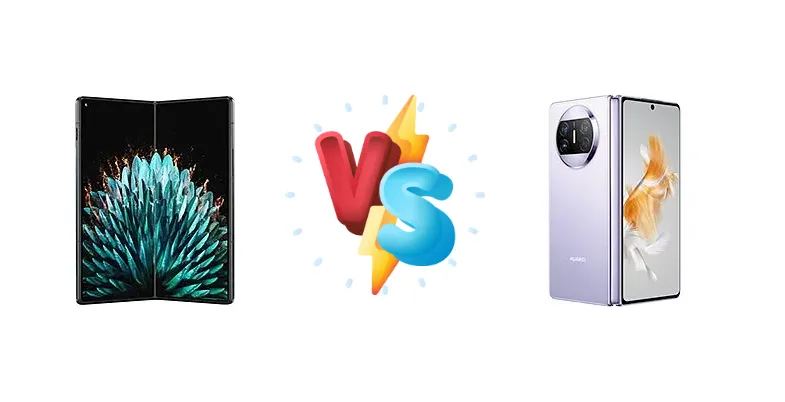
The foldable phone market is maturing, with the OnePlus V Fold and Huawei Mate X3 representing distinct approaches to the form factor. The V Fold aims to deliver a compelling foldable experience with a focus on fast charging, while the Mate X3 leverages a proven chipset and boasts impressive battery endurance. This comparison dissects their key differences to determine which foldable reigns supreme.
🏆 Quick Verdict
For most users, the Huawei Mate X3 emerges as the stronger choice. Its 81-hour endurance rating, coupled with 66W wired and 50W wireless charging, provides a significant advantage in real-world usability. While the OnePlus V Fold offers competitive 67W wired charging, it lacks wireless capabilities and doesn't match the Mate X3's stamina.
| Network |
|---|
| 2G bands | GSM 850 / 900 / 1800 / 1900 | GSM 850 / 900 / 1800 / 1900 |
| 3G bands | HSDPA 800 / 850 / 900 / 1700(AWS) / 1900 / 2100 | HSDPA 800 / 850 / 900 / 1700(AWS) / 1900 / 2100 |
| 4G bands | LTE | 1, 2, 3, 4, 5, 7, 8, 12, 17, 18, 19, 20, 26, 28, 34, 38, 39, 40, 41 |
| 5G bands | SA/NSA | - |
| Speed | HSPA, LTE, 5G | HSPA, LTE |
| Technology | GSM / CDMA / HSPA / EVDO / LTE / 5G | GSM / CDMA / HSPA / EVDO / LTE |
| | - | CDMA2000 1xEV-DO |
| Launch |
|---|
| Announced | Not announced yet | 2023, March 23 |
| Status | Cancelled | Available. Released 2023, April 08 |
| Body |
|---|
| Build | - | Glass front, glass back or eco leather back, aluminum frame |
| Dimensions | - | Unfolded: 156.9 x 141.5 x 5.3 mmFolded: 156.9 x 72.4 x 11.1 mm |
| SIM | Nano-SIM + Nano-SIM | Nano-SIM + Nano-SIM |
| Weight | - | 239 g or 241 g (8.43 oz) |
| | - | IPX8 dust/water resistant (up to 1.5m for 30 min) |
| Display |
|---|
| Protection | - | Kunlun Glass (cover display only) |
| Resolution | 1792 x 1920 pixels (~337 ppi density) | 2224 x 2496 pixels (~426 ppi density) |
| Size | 7.8 inches, 195.8 cm2 | 7.85 inches, 197.5 cm2 (~88.9% screen-to-body ratio) |
| Type | Foldable LTPO AMOLED, 120Hz, HDR10+ | Foldable OLED, 1B colors, 120Hz |
| | - | Cover display:
OLED, 120Hz, 6.4 inches, 1080 x 2504 pixels |
| Platform |
|---|
| CPU | - | Octa-core (1x3.19 GHz Cortex-X2 & 3x2.75 GHz Cortex-A710 & 4x2.0 GHz Cortex-A510) |
| Chipset | - | Qualcomm SM8475 Snapdragon 8+ Gen 1 4G (4 nm) |
| GPU | - | Adreno 730 |
| OS | Android 14 | HarmonyOS 3.1 (China), EMUI 13.1 (Europe), no Google Play Services |
| Memory |
|---|
| Card slot | No | Nano Memory (uses shared SIM slot) |
| Internal | 256GB 16GB RAM | 256GB 12GB RAM, 512GB 12GB RAM, 1TB 12GB RAM |
| | - | UFS |
| Main Camera |
|---|
| Features | Hasselblad Color Calibration, Dual-LED dual-tone flash, HDR, panorama | Laser AF, color spectrum sensor, LED flash, panorama, HDR |
| Triple | 48 MP, (wide), PDAF, OIS
64 MP, (telephoto), optical zoom, PDAF
48 MP, f/2.2, 14mm, 115˚ (ultrawide), 1/2.0", 0.8µm, AF | 50 MP, f/1.8, 23mm (wide), PDAF, OIS
12 MP, f/3.4, 125mm (periscope telephoto), PDAF, OIS, 5x optical zoom
13 MP, f/2.2, 13mm (ultrawide), AF |
| Video | 4K@30/60fps, 1080p@30/60/240fps | 4K@30/60fps, 1080p@30/60fps, gyro-EIS |
| Selfie camera |
|---|
| Features | HDR, panorama | HDR, panorama |
| Single | 20 MP, (wide)
Cover camera:
32 MP, f/2.4, 22mm (wide), 1/3.14" | 8 MP, f/2.4, (wide)
Cover camera:
8 MP, f/2.4, (wide) |
| Video | 1080p@30fps, gyro-EIS | 4K@30fps, 1080p@30fps |
| Sound |
|---|
| 3.5mm jack | - | No |
| 35mm jack | No | No |
| Loudspeaker | Yes, with stereo speakers | Yes, with stereo speakers |
| Comms |
|---|
| Bluetooth | 5.3, A2DP, LE | 5.2, A2DP, LE |
| Infrared port | - | Yes |
| NFC | Yes | Yes |
| Positioning | GPS (L1+L5), GLONASS (G1), BDS (B1I+B1c+B2a), GALILEO (E1+E5a), QZSS (L1+L5) | GPS (L1+L5), GLONASS (B1I+B1c+B2a), BDS (B1I+B1c+B2a), GALILEO (E1+E5a), QZSS (L1+L5), NavIC |
| Radio | No | No |
| USB | USB Type-C | USB Type-C 3.1, DisplayPort 1.2, OTG |
| WLAN | Wi-Fi 802.11 a/b/g/n/ac/6/7, tri-band | Wi-Fi 802.11 a/b/g/n/ac/6, dual-band, Wi-Fi Direct |
| Features |
|---|
| Sensors | Fingerprint (side-mounted), accelerometer, dual gyro, proximity, compass | Fingerprint (side-mounted), accelerometer, gyro, proximity, compass, barometer, altimeter |
| | - | BDS Satellite Message |
| Battery |
|---|
| Charging | 67W wired | 66W wired
50W wireless
7.5W reverse wireless |
| Type | Li-Po 4800 mAh | Market-dependent versions:· Li-Po 4800 mAh (Global)· Si/C Li-Ion 5060 mAh (China only) |
| Misc |
|---|
| Colors | Black; other colors | Black, White, Violet, Dark Green, Gold |
| Models | - | ALT-AL00, ALT-L29 |
| Price | - | About 1500 EUR |
| Tests |
|---|
| Battery life | - |
Endurance rating 81h
|
| Camera | - |
Photo / Video |
| Display | - |
Contrast ratio: Infinite (nominal) |
| Loudspeaker | - |
-26.3 LUFS (Good)
|
| Performance | - |
AnTuTu: 993592 (v9)
GeekBench: 4283 (v5.5), 4512 (v6)
GFXBench: 41fps (ES 3.1 onscreen) |
OnePlus V Fold
- Potentially faster chipset (depending on model)
- 67W Wired Charging is competitive
- OnePlus ecosystem integration
- No wireless charging
- Battery life unspecified and likely lower than Mate X3
- Chipset details missing
Huawei Mate X3
- Exceptional 81-hour battery endurance
- 66W Wired, 50W Wireless, and 7.5W Reverse Wireless Charging
- Proven Snapdragon 8+ Gen 1 performance
- Limited to 4G connectivity
- Camera specs are unknown
- Software experience may be less streamlined than OnePlus
Display Comparison
The Huawei Mate X3’s display achieves a measured peak brightness of 926 nits, a crucial metric for outdoor visibility, while the OnePlus V Fold’s brightness remains unspecified. Both utilize foldable OLED panels, but the Mate X3’s infinite contrast ratio suggests a superior viewing experience with deeper blacks. The absence of refresh rate data for the V Fold makes a direct comparison difficult, but the Mate X3’s panel is likely optimized for smooth scrolling and animations. The hinge mechanism, while not detailed in the provided data, is a critical factor for durability and crease visibility – a key area where Huawei has historically excelled.
Camera Comparison
Both the OnePlus V Fold and Huawei Mate X3 feature photo and video capabilities, but detailed sensor information is lacking. Without specifics on megapixel count, sensor size, or aperture, a direct comparison is impossible. However, Huawei’s history suggests a strong emphasis on computational photography and image processing, potentially giving the Mate X3 an advantage in challenging lighting conditions. The absence of details regarding OIS (Optical Image Stabilization) on either device leaves a critical question unanswered regarding video stability.
Performance
Both devices are powered by Qualcomm silicon, but differ in generation and connectivity. The Mate X3 utilizes the Snapdragon 8+ Gen 1 4G (SM8475), a proven performer with an octa-core configuration (1x3.19 GHz Cortex-X2, 3x2.75 GHz Cortex-A710, 4x2.0 GHz Cortex-A510). The V Fold’s chipset is not specified, but assuming it’s a newer generation, it *could* offer a performance edge. However, the 4nm process node of the Snapdragon 8+ Gen 1 provides excellent thermal efficiency, minimizing throttling during sustained workloads. The 4G limitation on the Mate X3 is a significant drawback for users requiring 5G connectivity.
Battery Life
The Huawei Mate X3’s standout feature is its exceptional battery endurance, rated at 81 hours – a testament to the efficiency of the Snapdragon 8+ Gen 1 and optimized software. It supports 66W wired charging, 50W wireless charging, and 7.5W reverse wireless charging, offering versatile charging options. The OnePlus V Fold, with only 67W wired charging, lacks the convenience of wireless charging. While 67W is fast, the Mate X3’s combination of wired, wireless, and reverse wireless charging, coupled with its superior endurance, provides a more complete power solution.
Buying Guide
Buy the OnePlus V Fold if you prioritize the fastest possible wired charging and are heavily invested in the OnePlus ecosystem. Its 67W charging is a boon for power users. Buy the Huawei Mate X3 if you value exceptional battery life, wireless charging convenience, and a mature foldable design. The Mate X3 is ideal for users who demand all-day performance without constantly seeking a power outlet.
Frequently Asked Questions
❓ Does the 4G limitation on the Huawei Mate X3 significantly impact its usability in areas with 5G coverage?
For users in areas with robust 5G infrastructure, the 4G limitation on the Mate X3 is a considerable drawback. Download and upload speeds will be noticeably slower compared to 5G-enabled devices, impacting streaming, gaming, and large file transfers. However, for users primarily in areas with limited or no 5G coverage, this limitation is less critical.
❓ How does the thermal management of the Snapdragon 8+ Gen 1 in the Huawei Mate X3 hold up during extended gaming sessions?
The Snapdragon 8+ Gen 1 is known for its relatively efficient thermal performance thanks to its 4nm process. While sustained gaming will inevitably generate heat, the Mate X3’s design and cooling system (details not provided) should mitigate throttling effectively. Expect playable frame rates for extended periods, though performance may slightly decrease over time.
❓ Is the lack of wireless charging on the OnePlus V Fold a dealbreaker for users accustomed to this convenience?
For users who frequently utilize wireless charging, the absence of this feature on the OnePlus V Fold is a significant omission. Wireless charging offers a convenient and cable-free charging experience, particularly in situations where a wired connection is unavailable or inconvenient. The V Fold’s reliance solely on wired charging limits its versatility in this regard.