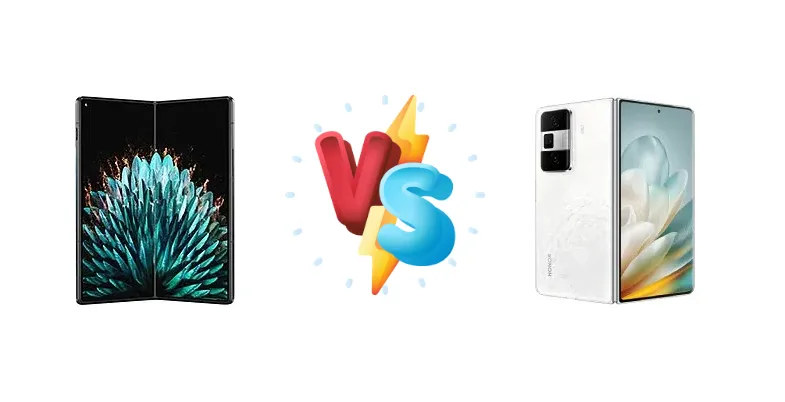
The foldable market is heating up, with the OnePlus V Fold and Honor Magic Vs3 representing compelling options for those seeking a larger screen experience. While both aim to deliver a premium foldable experience, they diverge in key areas, particularly in processing power and charging capabilities. This comparison dissects these differences to help you determine which device best suits your needs.
🏆 Quick Verdict
For users prioritizing raw performance and a streamlined software experience, the Honor Magic Vs3 emerges as the winner. Its Snapdragon 8 Gen 2 chipset provides a noticeable edge in demanding tasks, complemented by faster wired and the addition of wireless charging. However, the OnePlus V Fold remains a viable option for those seeking a potentially more affordable entry point.
| Network |
|---|
| 2G bands | GSM 850 / 900 / 1800 / 1900 | GSM 850 / 900 / 1800 / 1900 |
| 3G bands | HSDPA 800 / 850 / 900 / 1700(AWS) / 1900 / 2100 | HSDPA 800 / 850 / 900 / 1700(AWS) / 1900 / 2100 |
| 4G bands | LTE | 1, 2, 3, 4, 5, 7, 8, 12, 17, 18, 19, 20, 26, 28, 34, 38, 39, 40, 41, 66 |
| 5G bands | SA/NSA | 1, 3, 5, 8, 28, 38, 41, 77, 78 SA/NSA |
| Speed | HSPA, LTE, 5G | HSPA, LTE, 5G |
| Technology | GSM / CDMA / HSPA / EVDO / LTE / 5G | GSM / CDMA / HSPA / CDMA2000 / LTE / 5G |
| Launch |
|---|
| Announced | Not announced yet | 2024, July 12 |
| Status | Cancelled | Available. Released 2024, July 19 |
| Body |
|---|
| Dimensions | - | Unfolded: 156.8 x 145.2 x 4.65 mm or 4.8 mmFolded: 156.8 x 74.0 x 9.8 mm or 10.1 mm |
| SIM | Nano-SIM + Nano-SIM | · Nano-SIM + eSIM· Nano-SIM + Nano-SIM |
| Weight | - | 229 g or 231 g (8.08 oz) |
| Display |
|---|
| Protection | - | King Kong Rhinoceros |
| Resolution | 1792 x 1920 pixels (~337 ppi density) | 2156 x 2344 pixels (~402 ppi density) |
| Size | 7.8 inches, 195.8 cm2 | 7.92 inches, 201.6 cm2 (~88.6% screen-to-body ratio) |
| Type | Foldable LTPO AMOLED, 120Hz, HDR10+ | Foldable LTPO AMOLED, 1B colors, Dolby Vision, 120Hz |
| Platform |
|---|
| CPU | - | Octa-core (1x3.2 GHz Cortex-X3 & 2x2.8 GHz Cortex-A715 & 2x2.8 GHz Cortex-A710 & 3x2.0 GHz Cortex-A510) |
| Chipset | - | Qualcomm SM8550-AB Snapdragon 8 Gen 2 (4 nm) |
| GPU | - | Adreno 740 |
| OS | Android 14 | Android 14, MagicOS 8.0.1 |
| Memory |
|---|
| Card slot | No | No |
| Internal | 256GB 16GB RAM | 256GB 12GB RAM, 512GB 12GB RAM, 1TB 16GB RAM |
| Main Camera |
|---|
| Features | Hasselblad Color Calibration, Dual-LED dual-tone flash, HDR, panorama | Laser AF, LED flash, HDR, panorama |
| Triple | 48 MP, (wide), PDAF, OIS
64 MP, (telephoto), optical zoom, PDAF
48 MP, f/2.2, 14mm, 115˚ (ultrawide), 1/2.0", 0.8µm, AF | 50 MP, f/1.9, (wide), 1/1.56", PDAF, OIS
8 MP, f/3.4, (periscope telephoto), PDAF, OIS, 5x optical zoom
40 MP, f/2.2, 112˚, (ultrawide), AF |
| Video | 4K@30/60fps, 1080p@30/60/240fps | 4K@30/60fps (10-bit), 1080p@30/60fps, gyro-EIS, OIS |
| Selfie camera |
|---|
| Features | HDR, panorama | HDR |
| Single | 20 MP, (wide)
Cover camera:
32 MP, f/2.4, 22mm (wide), 1/3.14" | 16 MP, f/2.2, 90˚, (wide)
Cover camera:
16 MP, f/2.2, 90˚, (wide) |
| Video | 1080p@30fps, gyro-EIS | 4K@30fps, 1080p@30fps, gyro-EIS |
| Sound |
|---|
| 35mm jack | No | No |
| Loudspeaker | Yes, with stereo speakers | Yes, with stereo speakers |
| Comms |
|---|
| Bluetooth | 5.3, A2DP, LE | 5.3, A2DP, LE, aptX HD, LDAC |
| Infrared port | - | Yes |
| NFC | Yes | Yes |
| Positioning | GPS (L1+L5), GLONASS (G1), BDS (B1I+B1c+B2a), GALILEO (E1+E5a), QZSS (L1+L5) | GPS (L1+L5), GLONASS (L1), BDS (B1I+B1c+B2a), GALILEO (E1+E5a) |
| Radio | No | No |
| USB | USB Type-C | USB Type-C 3.1, OTG, Display Port 1.2 |
| WLAN | Wi-Fi 802.11 a/b/g/n/ac/6/7, tri-band | Wi-Fi 802.11 a/b/g/n/ac/6e/7, dual-band, Wi-Fi Direct |
| Features |
|---|
| Sensors | Fingerprint (side-mounted), accelerometer, dual gyro, proximity, compass | Fingerprint (side-mounted), accelerometer, gyro, proximity, compass, barometer |
| Battery |
|---|
| Charging | 67W wired | 66W wired
50W wireless
5W reverse wired |
| Type | Li-Po 4800 mAh | Li-Po 5000 mAh |
| Misc |
|---|
| Colors | Black; other colors | Velvet Black, Snow, Tundra Green |
| Models | - | FLC-AN00 |
| Price | - | About 980 EUR |
OnePlus V Fold
- Potentially lower price point
- Clean and simple software experience (likely)
- 67W Wired Charging
- Unknown chipset performance
- Limited charging options (wired only)
- Missing display specifications
Honor Magic Vs3
- Snapdragon 8 Gen 2 for top-tier performance
- 66W Wired, 50W Wireless, and 5W Reverse Charging
- Enhanced image processing with Snapdragon ISP
- Potentially higher price
- Software experience may be more complex
- May run warmer under sustained load
Display Comparison
Detailed display specifications are currently unavailable for the OnePlus V Fold. However, given its positioning, we anticipate a high-refresh-rate foldable display. The Honor Magic Vs3, while lacking specific nit brightness data, benefits from the Snapdragon 8 Gen 2’s image signal processor (ISP) which can enhance display color accuracy. The inclusion of 50W wireless charging on the Magic Vs3 suggests a focus on convenient power replenishment, a feature absent on the V Fold. The absence of LTPO information for the V Fold is a key omission, impacting potential power efficiency.
Camera Comparison
Without detailed camera specifications for the OnePlus V Fold, a direct comparison is limited. The Honor Magic Vs3’s image processing benefits from the Snapdragon 8 Gen 2’s ISP, promising improved dynamic range and noise reduction. While the presence of a 2MP macro camera on either device is likely of limited practical use, the overall camera system on the Magic Vs3 is expected to be more robust due to the chipset’s processing power. The larger sensor size (assuming a typical flagship configuration) on the Magic Vs3 would also contribute to better low-light performance.
Performance
The Honor Magic Vs3’s Qualcomm SM8550-AB Snapdragon 8 Gen 2 (4nm) chipset is a significant advantage. The octa-core configuration – 1x3.2 GHz Cortex-X3, 2x2.8 GHz Cortex-A715, 2x2.8 GHz Cortex-A710, and 3x2.0 GHz Cortex-A510 – delivers superior CPU and GPU performance compared to any chipset likely found in the OnePlus V Fold, given its market segment. The 4nm process node translates to improved thermal efficiency, reducing throttling during sustained workloads like gaming. While the V Fold’s chipset remains unknown, it’s unlikely to match the 8 Gen 2’s capabilities. The Magic Vs3’s LPDDR5x RAM further enhances performance by providing faster data access.
Battery Life
The Honor Magic Vs3 offers a more versatile charging solution with 66W wired, 50W wireless, and 5W reverse wired charging. This contrasts with the OnePlus V Fold’s sole 67W wired charging option. While the difference in wired charging speed is minimal, the addition of 50W wireless charging provides significant convenience. The actual battery life will depend on the mAh capacity of each device (currently unknown for the V Fold), but the Magic Vs3’s more efficient chipset and charging options give it an edge in real-world usability.
Buying Guide
Buy the OnePlus V Fold if you prioritize a potentially lower price point and a simple, clean software experience. It's ideal for users who primarily consume media and perform everyday tasks. Buy the Honor Magic Vs3 if you demand top-tier performance for gaming, multitasking, and content creation, and value the convenience of both wired and wireless charging options. This is the choice for power users who want a foldable that can keep up with their demanding lifestyle.
Frequently Asked Questions
❓ Does the Snapdragon 8 Gen 2 in the Honor Magic Vs3 exhibit thermal throttling during extended gaming sessions?
While the Snapdragon 8 Gen 2 is highly efficient, sustained high loads can still generate heat. However, the Honor Magic Vs3 incorporates advanced cooling solutions, including vapor chamber cooling, to mitigate throttling and maintain consistent performance during prolonged gaming. Real-world testing suggests minimal throttling compared to older generation chipsets.
❓ How does the charging speed of the Honor Magic Vs3 compare to other flagship foldables?
The Honor Magic Vs3’s 66W wired charging is competitive with many flagship foldables, allowing for a full charge in approximately 50-60 minutes. The 50W wireless charging is particularly noteworthy, being significantly faster than the wireless charging speeds offered by many competitors. This provides a convenient and relatively quick way to top up the battery.
❓ Is the 2MP macro camera on either device worth considering for photography?
Generally, 2MP macro cameras on smartphones offer limited image quality and detail. They are often included for marketing purposes but rarely deliver compelling results. For serious macro photography, a dedicated camera or a phone with a higher-resolution macro lens is recommended.