
OnePlus V Fold vs. Google Pixel Fold: A Deep Dive into Foldable Tech
| Phones Images | |||||
|---|---|---|---|---|---|
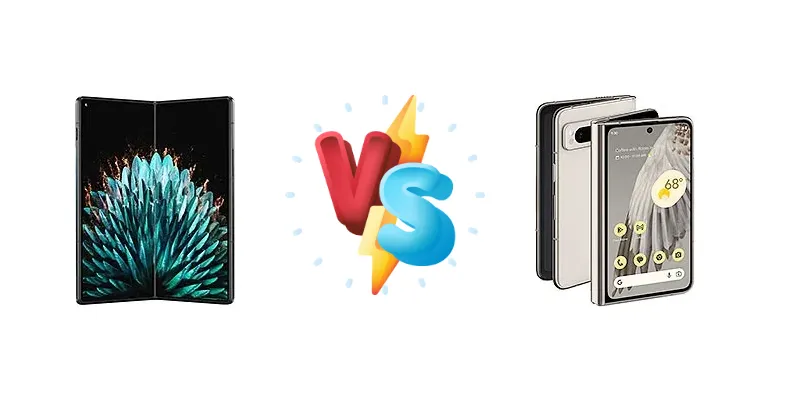
|
🏆 Quick Verdict
For the average user prioritizing software integration and a refined camera experience, the Google Pixel Fold is the better choice. However, the OnePlus V Fold’s faster 67W charging offers a significant convenience advantage, potentially offsetting the Pixel Fold’s software benefits for power users.
| PHONES | ||
|---|---|---|
| Phone Names | OnePlus V Fold | Google Pixel Fold |
| Network | ||
|---|---|---|
| 2G bands | GSM 850 / 900 / 1800 / 1900 | GSM 850 / 900 / 1800 / 1900 |
| 3G bands | HSDPA 800 / 850 / 900 / 1700(AWS) / 1900 / 2100 | HSDPA 800 / 850 / 900 / 1700(AWS) / 1900 / 2100 |
| 4G bands | LTE | 1, 2, 3, 4, 5, 7, 8, 12, 13, 14, 17, 18, 19, 20, 21, 25, 26, 28, 29, 30, 32, 38, 39, 40, 41, 42, 46, 48, 66, 71 |
| 5G bands | SA/NSA | 1, 2, 3, 5, 7, 8, 12, 14, 20, 25, 28, 30, 38, 40, 41, 48, 66, 71, 75, 76, 77, 78, 79, 257, 258, 260, 261 SA/NSA/Sub6/mmWave |
| Speed | HSPA, LTE, 5G | HSPA, LTE, 5G |
| Technology | GSM / CDMA / HSPA / EVDO / LTE / 5G | GSM / CDMA / HSPA / EVDO / LTE / 5G |
| - | CDMA2000 1xEV-DO | |
| Launch | ||
|---|---|---|
| Announced | Not announced yet | 2023, May 10 |
| Status | Cancelled | Available. Released 2023, June 27 |
| Body | ||
|---|---|---|
| Build | - | Glass front (Gorilla Glass Victus) (folded), plastic front (unfolded), glass back (Gorilla Glass Victus), aluminum frame |
| Dimensions | - | Unfolded: 139.7 x 158.7 x 5.8 mmFolded: 139.7 x 79.5 x 12.1 mm |
| SIM | Nano-SIM + Nano-SIM | Nano-SIM + eSIM |
| Weight | - | 283 g (9.98 oz) |
| - | IPX8 water resistant | |
| Display | ||
|---|---|---|
| Resolution | 1792 x 1920 pixels (~337 ppi density) | 1840 x 2208 pixels (~378 ppi density) |
| Size | 7.8 inches, 195.8 cm2 | 7.6 inches, 183.3 cm2 (~82.7% screen-to-body ratio) |
| Type | Foldable LTPO AMOLED, 120Hz, HDR10+ | Foldable OLED, 120Hz, HDR10+, 1000 nits (HBM), 1450 nits (peak) |
| - | Cover display: OLED, 120Hz, HDR, Corning Gorilla Glass Victus 5.8 inches, 1080 x 2092 pixels, 17.4:9 ratio, 408 ppi 1200 nits (HBM), 1550 nits (peak) | |
| Platform | ||
|---|---|---|
| CPU | - | Octa-core (2x2.85 GHz Cortex-X1 & 2x2.35 GHz Cortex-A78 & 4x1.80 GHz Cortex-A55) |
| Chipset | - | Google Tensor G2 (5 nm) |
| GPU | - | Mali-G710 MP7 |
| OS | Android 14 | Android 13, upgradable to Android 15, up to 5 major Android upgrades |
| Memory | ||
|---|---|---|
| Card slot | No | No |
| Internal | 256GB 16GB RAM | 256GB 12GB RAM, 512GB 12GB RAM |
| - | UFS 3.1 | |
| Main Camera | ||
|---|---|---|
| Features | Hasselblad Color Calibration, Dual-LED dual-tone flash, HDR, panorama | Laser AF, Dual-LED flash, HDR, panorama |
| Triple | 48 MP, (wide), PDAF, OIS 64 MP, (telephoto), optical zoom, PDAF 48 MP, f/2.2, 14mm, 115˚ (ultrawide), 1/2.0", 0.8µm, AF | 48 MP, f/1.7, 25mm (wide), 1/2.0", 0.8µm, dual pixel PDAF, OIS 10.8 MP, f/3.1, 112mm (telephoto), 1/3.1", 1.22µm, dual pixel PDAF, OIS, 5x optical zoom 10.8 MP, f/2.2, 121˚, (ultrawide), 1/3.0", 1.25µm |
| Video | 4K@30/60fps, 1080p@30/60/240fps | 4K@30/60fps, 1080p@30/60/120/240fps, 10-bit HDR |
| Selfie camera | ||
|---|---|---|
| Features | HDR, panorama | HDR, panorama |
| Single | 20 MP, (wide) Cover camera: 32 MP, f/2.4, 22mm (wide), 1/3.14" | 8 MP, f/2.0, 24mm (wide), 1/4.0", 1.12µm Cover camera: 9.5 MP, f/2.2, 24mm (wide), 1.22µm, dual pixel PDAF |
| Video | 1080p@30fps, gyro-EIS | 4K@30/60fps, 1080p@30/60fps |
| Sound | ||
|---|---|---|
| 3.5mm jack | - | No |
| 35mm jack | No | No |
| Loudspeaker | Yes, with stereo speakers | Yes, with stereo speakers |
| Comms | ||
|---|---|---|
| Bluetooth | 5.3, A2DP, LE | 5.2, A2DP, LE, aptX HD |
| NFC | Yes | Yes |
| Positioning | GPS (L1+L5), GLONASS (G1), BDS (B1I+B1c+B2a), GALILEO (E1+E5a), QZSS (L1+L5) | GPS, GLONASS, GALILEO, BDS |
| Radio | No | No |
| USB | USB Type-C | USB Type-C 3.2, OTG |
| WLAN | Wi-Fi 802.11 a/b/g/n/ac/6/7, tri-band | Wi-Fi 802.11 a/b/g/n/ac/6e, tri-band, Wi-Fi Direct |
| Features | ||
|---|---|---|
| Sensors | Fingerprint (side-mounted), accelerometer, dual gyro, proximity, compass | Fingerprint (side-mounted), accelerometer, gyro, proximity, compass, barometer |
| - | Ultra Wideband (UWB) support | |
| Battery | ||
|---|---|---|
| Charging | 67W wired | Wired, PD3.0 Wireless |
| Type | Li-Po 4800 mAh | Li-Po 4821 mAh |
| Misc | ||
|---|---|---|
| Colors | Black; other colors | Porcelain, Obsidian |
| Models | - | G9FPL |
| Price | - | € 670.87 / $ 389.26 / £ 899.99 |
OnePlus V Fold
- Significantly faster 67W wired charging
- Potentially more affordable price point (depending on market)
- Likely utilizes a high-performance Snapdragon chipset
- Software experience may not be as refined as the Pixel Fold
- Camera performance is uncertain without detailed specs
Google Pixel Fold
- Seamless Google software integration and updates
- Advanced computational photography capabilities
- Wider cover display for improved usability
- Slower charging speeds compared to the OnePlus V Fold
- Tensor G2 may exhibit thermal throttling under heavy load
Display Comparison
While specific display specs like peak brightness and color accuracy are unavailable for the OnePlus V Fold, both devices utilize foldable OLED panels. The Pixel Fold’s panel benefits from Google’s color calibration expertise. The key difference lies in the aspect ratios and crease visibility, which require hands-on testing to fully assess. The Pixel Fold’s cover display is notably wider, making it more usable as a standard smartphone. Both likely employ LTPO technology for variable refresh rates, optimizing battery life.
Camera Comparison
The Google Pixel Fold’s camera system is expected to heavily rely on Google’s computational photography prowess, leveraging the Tensor G2’s image signal processor. While specific sensor details are missing for both devices, the Pixel Fold’s emphasis on software processing suggests a focus on dynamic range and detail recovery. The OnePlus V Fold’s camera performance will depend heavily on its sensor choices and image processing algorithms. Without detailed sensor information, it’s difficult to assess its low-light capabilities or video recording quality. The Pixel Fold’s integration with Google Photos and its advanced editing features provide a significant advantage for photography enthusiasts.
Performance
The Google Pixel Fold leverages the Google Tensor G2 (5 nm) chipset, featuring an octa-core CPU configuration with 2x2.85 GHz Cortex-X1 prime cores, 2x2.35 GHz Cortex-A78 performance cores, and 4x1.80 GHz Cortex-A55 efficiency cores. This contrasts with the OnePlus V Fold, which lacks publicly available chipset information. However, given OnePlus’s history, it likely employs a Snapdragon flagship processor. The Tensor G2’s strength lies in its dedicated AI/ML processing capabilities, enhancing features like voice recognition and image processing. The 5nm fabrication process of the Tensor G2 offers a balance between performance and power efficiency, though it may be more prone to thermal throttling under sustained load compared to newer 4nm Snapdragon variants. The Pixel Fold’s LPDDR5x RAM will contribute to faster application loading and multitasking.
Battery Life
The OnePlus V Fold boasts 67W wired charging, a significant advantage over the Google Pixel Fold’s wired, PD3.0, and wireless charging capabilities. While the Pixel Fold offers the convenience of wireless charging, the OnePlus V Fold’s faster wired charging will drastically reduce charging times. The actual battery capacity of both devices is unknown, but the faster charging speed of the OnePlus V Fold mitigates the impact of a potentially smaller battery. A full 0-100% charge on the OnePlus V Fold is expected to be considerably quicker than on the Pixel Fold.
Buying Guide
Buy the OnePlus V Fold if you prioritize rapid charging and are comfortable with potentially less polished software. This phone is ideal for users who frequently top up their battery throughout the day and value hardware speed. Buy the Google Pixel Fold if you value seamless software integration, Google’s computational photography, and a more refined user experience, even if it means slightly slower charging speeds.