
OnePlus V Fold vs. Google Pixel 7a: A Deep Dive into Foldable vs. Flagship
| Phones Images | |||||
|---|---|---|---|---|---|
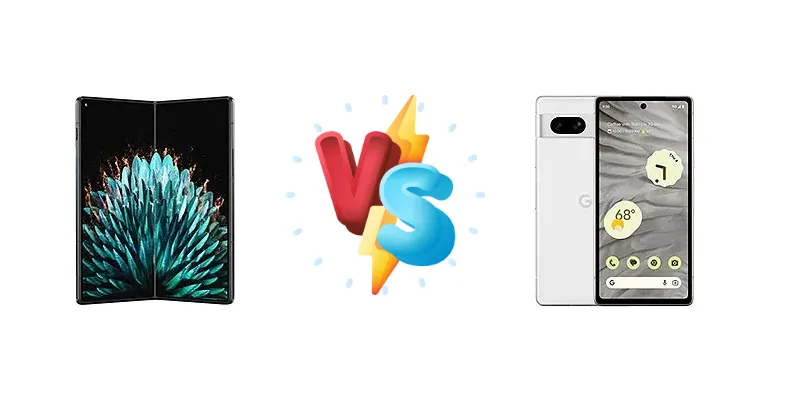
|
🏆 Quick Verdict
For the average user prioritizing camera quality, software experience, and value, the Google Pixel 7a emerges as the stronger choice. Its Tensor G2 chip delivers excellent performance, and its camera consistently produces stunning images. However, the OnePlus V Fold is the clear winner for those who absolutely require a foldable display and the productivity benefits it offers.
| PHONES | ||
|---|---|---|
| Phone Names | OnePlus V Fold | Google Pixel 7a |
| Network | ||
|---|---|---|
| 2G bands | GSM 850 / 900 / 1800 / 1900 | GSM 850 / 900 / 1800 / 1900 |
| 3G bands | HSDPA 800 / 850 / 900 / 1700(AWS) / 1900 / 2100 | HSDPA 800 / 850 / 900 / 1700(AWS) / 1900 / 2100 |
| 4G bands | LTE | 1, 2, 3, 4, 5, 7, 8, 12, 13, 14, 17, 20, 25, 26, 28, 29, 30, 38, 40, 41, 48, 66, 71 - GWKK3, G0DZQ |
| 5G bands | SA/NSA | 1, 2, 3, 5, 7, 8, 12, 14, 20, 25, 28, 30, 38, 41, 48, 66, 71, 77, 78 SA/NSA/Sub6 - GWKK3 |
| Speed | HSPA, LTE, 5G | HSPA, LTE, 5G |
| Technology | GSM / CDMA / HSPA / EVDO / LTE / 5G | GSM / HSPA / LTE / 5G |
| - | 1, 2, 3, 5, 7, 8, 12, 20, 25, 28, 38, 40, 41, 66, 75, 76, 77, 78, 79 SA/NSA/Sub6 - GHL1X, G82U8 | |
| Launch | ||
|---|---|---|
| Announced | Not announced yet | 2023, May 10 |
| Status | Cancelled | Available. Released 2023, May 10 |
| Body | ||
|---|---|---|
| Build | - | Glass front (Gorilla Glass 3), aluminum frame, plastic back |
| Dimensions | - | 152 x 72.9 x 9 mm (5.98 x 2.87 x 0.35 in) |
| SIM | Nano-SIM + Nano-SIM | Nano-SIM + eSIM |
| Weight | - | 193.5 g (6.84 oz) |
| - | IP67 dust/water resistant (up to 1m for 30 min) | |
| Display | ||
|---|---|---|
| Protection | - | Corning Gorilla Glass 3 |
| Resolution | 1792 x 1920 pixels (~337 ppi density) | 1080 x 2400 pixels, 20:9 ratio (~429 ppi density) |
| Size | 7.8 inches, 195.8 cm2 | 6.1 inches, 90.7 cm2 (~81.8% screen-to-body ratio) |
| Type | Foldable LTPO AMOLED, 120Hz, HDR10+ | OLED, HDR, 90Hz |
| - | Always-on display | |
| Platform | ||
|---|---|---|
| CPU | - | Octa-core (2x2.85 GHz Cortex-X1 & 2x2.35 GHz Cortex-A78 & 4x1.80 GHz Cortex-A55) |
| Chipset | - | Google Tensor G2 (5 nm) |
| GPU | - | Mali-G710 MP7 |
| OS | Android 14 | Android 13, upgradable to Android 15, up to 5 major Android upgrades |
| Memory | ||
|---|---|---|
| Card slot | No | No |
| Internal | 256GB 16GB RAM | 128GB 8GB RAM |
| - | UFS 3.1 | |
| Main Camera | ||
|---|---|---|
| Dual | - | 64 MP, f/1.9, 26mm (wide), 1/1.73", 0.8µm, dual pixel PDAF, OIS 13 MP, f/2.2, 120˚ (ultrawide), 1.12µm |
| Features | Hasselblad Color Calibration, Dual-LED dual-tone flash, HDR, panorama | Dual-LED flash, Pixel Shift, Auto-HDR, panorama |
| Triple | 48 MP, (wide), PDAF, OIS 64 MP, (telephoto), optical zoom, PDAF 48 MP, f/2.2, 14mm, 115˚ (ultrawide), 1/2.0", 0.8µm, AF | - |
| Video | 4K@30/60fps, 1080p@30/60/240fps | 4K@30/60fps, 1080p@30/60/120/240fps, OIS |
| Selfie camera | ||
|---|---|---|
| Features | HDR, panorama | HDR, panorama |
| Single | 20 MP, (wide) Cover camera: 32 MP, f/2.4, 22mm (wide), 1/3.14" | 13 MP, f/2.2, 20mm (ultrawide), 1.12µm |
| Video | 1080p@30fps, gyro-EIS | 4K@30fps, 1080p@30fps |
| Sound | ||
|---|---|---|
| 3.5mm jack | - | No |
| 35mm jack | No | No |
| Loudspeaker | Yes, with stereo speakers | Yes, with stereo speakers |
| Comms | ||
|---|---|---|
| Bluetooth | 5.3, A2DP, LE | 5.3, A2DP, LE |
| NFC | Yes | Yes |
| Positioning | GPS (L1+L5), GLONASS (G1), BDS (B1I+B1c+B2a), GALILEO (E1+E5a), QZSS (L1+L5) | GPS, GLONASS, GALILEO, BDS, QZSS, NavIC |
| Radio | No | No |
| USB | USB Type-C | USB Type-C 3.2 |
| WLAN | Wi-Fi 802.11 a/b/g/n/ac/6/7, tri-band | Wi-Fi 802.11 a/b/g/n/ac/6e, tri-band |
| Features | ||
|---|---|---|
| Sensors | Fingerprint (side-mounted), accelerometer, dual gyro, proximity, compass | Fingerprint (under display, optical), accelerometer, gyro, proximity, compass, barometer |
| Battery | ||
|---|---|---|
| Charging | 67W wired | 18W wired, PD3.0 7.5W wireless |
| Type | Li-Po 4800 mAh | Li-Po 4385 mAh |
| Misc | ||
|---|---|---|
| Colors | Black; other colors | Charcoal, Snow, Sea, Coral |
| Models | - | GWKK3, GHL1X, G0DZQ, G82U8 |
| Price | - | € 179.90 / $ 150.00 / £ 170.00 / ₹ 25,980 |
OnePlus V Fold
- Large, immersive foldable display
- 67W fast charging for quick power-ups
- Potential for enhanced multitasking capabilities
- Higher price point compared to the Pixel 7a
- Durability concerns associated with foldable displays
- Unknown battery capacity and chipset details
Google Pixel 7a
- Exceptional camera performance and image processing
- Compact and pocketable design
- Excellent value for money
- Slower 18W charging speed
- Smaller display size compared to the V Fold
- Less innovative form factor
Display Comparison
The OnePlus V Fold’s defining feature is its foldable display, though specific panel details are missing. This inherently offers a larger screen real estate than the Pixel 7a. The Pixel 7a boasts a measured peak brightness of 1070 nits, ensuring excellent visibility even in direct sunlight. While the V Fold’s internal display will likely exceed this, the external display’s brightness remains unknown. The Pixel 7a’s display is likely a standard OLED, while the V Fold’s foldable panel requires more complex manufacturing, potentially impacting color accuracy and durability. The foldable form factor introduces a crease, a trade-off for the larger screen.
Camera Comparison
The Google Pixel 7a is renowned for its computational photography prowess. While specific sensor details are missing, Google’s image processing algorithms consistently deliver excellent dynamic range and detail. The V Fold’s camera system is unknown, but foldable phones often prioritize versatility with multiple lenses. The Pixel 7a’s strength lies in its software-driven image quality, excelling in both photo and video capture. The V Fold will need a compelling camera setup to compete, especially considering the Pixel 7a’s established reputation. We can assume the Pixel 7a will have superior image processing due to the Tensor G2's dedicated image signal processor.
Performance
The Google Pixel 7a is powered by the Google Tensor G2 (5nm) chipset, featuring an octa-core CPU configuration with two high-performance Cortex-X1 cores clocked at 2.85 GHz. This architecture prioritizes AI and machine learning tasks, enhancing features like voice recognition and image processing. The OnePlus V Fold’s chipset is unspecified, but given its price point, it likely utilizes a Snapdragon 8+ Gen 1 or similar. The Tensor G2’s 5nm process node offers good power efficiency, but the V Fold, if equipped with a Snapdragon, may have a slight edge in raw GPU performance. The Pixel 7a’s performance is optimized for Google’s software, while the V Fold’s performance will depend heavily on its chipset and thermal management.
Battery Life
The Google Pixel 7a has an endurance rating of 76 hours, indicating strong battery life. It supports 18W wired charging with PD3.0 and 7.5W wireless charging. The OnePlus V Fold offers significantly faster 67W wired charging, allowing for a much quicker 0-100% charge time. However, the V Fold’s battery capacity is unknown. Faster charging is beneficial for users who frequently need to top up their battery, while the Pixel 7a’s longer endurance may be preferable for those who prioritize all-day battery life. The V Fold’s larger form factor *could* accommodate a larger battery, but this remains unconfirmed.
Buying Guide
Buy the OnePlus V Fold if you need a larger, more immersive display for multitasking, content creation, or media consumption, and are willing to pay a premium for the foldable form factor. Buy the Google Pixel 7a if you prioritize a compact, pocketable design, exceptional camera performance, and a clean, fast software experience, all at a significantly lower price.