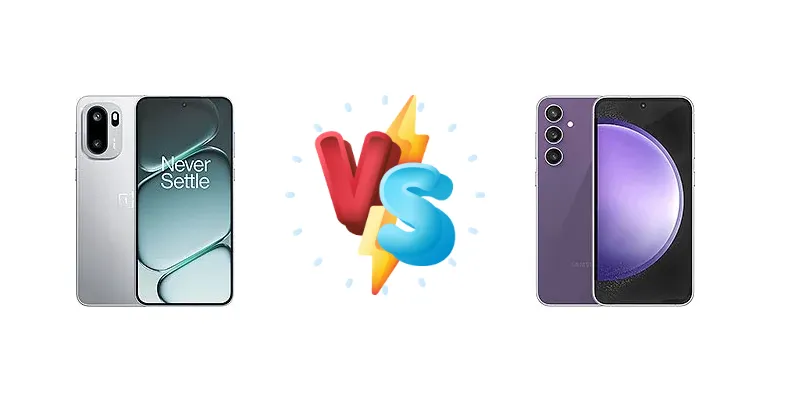
The OnePlus Turbo and Samsung Galaxy S23 FE represent compelling options in a crowded mid-to-high range smartphone market. The Turbo aggressively targets performance with the latest Snapdragon 8 Elite Gen 5, while the S23 FE aims for a more balanced experience with Samsung’s established software and camera expertise. This comparison dissects the key differences to help you choose the right device.
🏆 Quick Verdict
For users prioritizing raw performance and blazing-fast charging, the OnePlus Turbo is the clear winner. However, the Samsung Galaxy S23 FE offers a more refined software experience, wireless charging, and a proven camera system, making it a better all-rounder for the average user.
| Network |
|---|
| 2G bands | GSM 850 / 900 / 1800 / 1900 | GSM 850 / 900 / 1800 / 1900 |
| 3G bands | HSDPA 850 / 900 / 2100 | HSDPA 850 / 900 / 1700(AWS) / 1900 / 2100 |
| 4G bands | LTE | 1, 2, 3, 4, 5, 7, 8, 12, 13, 17, 20, 26, 28, 38, 40, 41, 66 - International |
| 5G bands | SA/NSA | 1, 2, 3, 5, 7, 8, 20, 28, 38, 40, 41, 66, 77, 78 SA/NSA/Sub6 - International |
| Speed | HSPA, LTE, 5G | HSPA, LTE, 5G |
| Technology | GSM / HSPA / LTE / 5G | GSM / HSPA / LTE / 5G |
| Launch |
|---|
| Announced | Not announced yet | 2023, October 04 |
| Status | Rumored | Available. Released 2023, October 05 |
| Body |
|---|
| Build | - | Glass front (Gorilla Glass 5), glass back (Gorilla Glass 5), aluminum frame |
| Dimensions | - | 158 x 76.5 x 8.2 mm (6.22 x 3.01 x 0.32 in) |
| SIM | Nano-SIM + Nano-SIM | · Nano-SIM· Nano-SIM + Nano-SIM· Nano-SIM + Nano-SIM + eSIM (max 2 at a time) |
| Weight | - | 209 g (7.37 oz) |
| Display |
|---|
| Protection | - | Corning Gorilla Glass 5 |
| Resolution | 1272 x 2800 pixels (~459 ppi density) | 1080 x 2340 pixels, 19.5:9 ratio (~403 ppi density) |
| Size | 6.7 inches, 109.1 cm2 | 6.4 inches, 100.5 cm2 (~83.2% screen-to-body ratio) |
| Type | AMOLED, 1B colors, 120Hz | Dynamic AMOLED 2X, 120Hz, HDR10+, 1450 nits (peak) |
| Platform |
|---|
| CPU | Octa-core (2x4.6 GHz Oryon V3 Phoenix L + 6x3.62 GHz Oryon V3 Phoenix M) | Octa-core (1x2.8 GHz Cortex-X2 & 3x2.50 GHz Cortex-A710 & 4x1.8 GHz Cortex-A510) - InternationalOcta-core (1x3.00 GHz Cortex-X2 & 3x2.50 GHz Cortex-A710 & 4x1.80 GHz Cortex-A510) - USA |
| Chipset | Qualcomm SM8850-AC Snapdragon 8 Elite Gen 5 (3 nm) | Exynos 2200 (4 nm) - InternationalQualcomm SM8450 Snapdragon 8 Gen 1 (4 nm) - USA |
| GPU | Adreno 840 | Xclipse 920 - InternationalAdreno 730 - USA |
| OS | Android 16, ColorOS 16 | Android 13, up to 4 major Android upgrades, One UI 8 |
| Memory |
|---|
| Card slot | No | No |
| Internal | Up to 512GB | 128GB 8GB RAM, 256GB 8GB RAM |
| Main Camera |
|---|
| Dual | 50 MP, f/1.8, 24mm (wide), PDAF, OIS
8 MP, f/2.2, 16mm, 112˚ (ultrawide), 1/4.0", 1.12µm | - |
| Features | Color spectrum sensor, LED flash, HDR, panorama | LED flash, HDR, panorama |
| Triple | - | 50 MP, f/1.8, 23mm (wide), 1/1.57", 1.0µm, dual pixel PDAF, OIS
8 MP, f/2.4, 76mm (telephoto), 1/4.5", 1.0µm, PDAF, OIS, 3x optical zoom
12 MP, f/2.2, 13mm, 123˚ (ultrawide), 1/3.0", 1.12µm |
| Video | 4K@30/60/120fps, 1080p@30/60/120fps, gyro-EIS, OIS | 8K@24fps, 4K@30/60fps, 1080p@30/60/120/240fps |
| Selfie camera |
|---|
| Features | HDR, panorama | - |
| Single | 16 MP, f/2.4, 23mm (wide), 1/3", 1.0µm | 10 MP, f/2.4, 25mm (wide), 1/3.0", 1.22µm |
| Video | 1080p@30fps, gyro-EIS | 4K@30/60fps, 1080p@30/60fps; gyro-EIS |
| Sound |
|---|
| 35mm jack | No | No |
| Loudspeaker | Yes, with stereo speakers | Yes, with stereo speakers |
| Comms |
|---|
| Bluetooth | 5.4, A2DP, LE, aptX HD | 5.3, A2DP, LE |
| Infrared port | Yes | - |
| NFC | Yes | Yes |
| Positioning | GPS (L1+L5), GLONASS (G1), BDS (B1I+B1c+B2a), GALILEO (E1+E5a), QZSS (L1+L5), NavIC (L5) | GPS, GLONASS, GALILEO, BDS |
| Radio | No | Unspecified |
| USB | USB Type-C 2.0 | USB Type-C, OTG |
| WLAN | Wi-Fi 802.11 a/b/g/n/ac/6, dual-band | Wi-Fi 802.11 a/b/g/n/ac/6e, dual-band, Wi-Fi Direct |
| Features |
|---|
| Sensors | Fingerprint (under display, ultrasonic), accelerometer, gyro, proximity, compass | Fingerprint (under display, optical), accelerometer, gyro, compass |
| Battery |
|---|
| Charging | 100W wired
Bypass charging | 25W wired, PD3.0, 50% in 30 min
15W wireless
Reverse wireless |
| Type | Si/C Li-Ion 8000 mAh | Li-Ion 4500 mAh |
| Misc |
|---|
| Colors | Black; other colors | Mint, Cream, Graphite, Purple, Indigo, Tangerine |
| Models | - | SM-S711B, SM-S711B/DS, SM-S711U1, SM-S711U, SM-S711W, SM-S7110, SM-S711N |
| Price | - | $ 219.95 / C$ 327.90 / £ 248.99 / € 272.00 / ₹ 34,999 |
| SAR | - | 0.80 W/kg (head) 0.72 W/kg (body) |
| SAR EU | - | 0.76 W/kg (head) 1.04 W/kg (body) |
OnePlus Turbo
- Unmatched performance with Snapdragon 8 Elite Gen 5
- Blazing-fast 100W wired charging
- Bypass charging for improved efficiency
- Missing wireless charging capabilities
- Camera specs are unknown and potentially less competitive
Samsung Galaxy S23 FE
- Versatile camera system with strong video recording
- Polished software experience with One UI
- Wireless charging and reverse wireless charging
- Exynos 2200/Snapdragon 8 Gen 1 chipset is less powerful than the Turbo
- Slower 25W wired charging
Display Comparison
The Samsung Galaxy S23 FE boasts a measured peak brightness of 985 nits, providing excellent visibility outdoors. While the OnePlus Turbo’s display specs are not provided, it’s likely to be slightly dimmer. Both devices likely utilize AMOLED panels, but the S23 FE’s brightness advantage is a tangible benefit. The S23 FE’s panel technology is likely to be more refined, given Samsung’s display expertise, potentially offering better color accuracy and viewing angles. The absence of refresh rate information for the Turbo makes a direct comparison difficult, but the S23 FE likely supports adaptive refresh rates for smoother scrolling and animations.
Camera Comparison
The Samsung Galaxy S23 FE’s camera system is a known quantity, offering a versatile setup with strong photo and video capabilities. While specific sensor details are missing, Samsung’s image processing algorithms are generally well-regarded. The OnePlus Turbo’s camera specs are not detailed, making a direct comparison challenging. However, given the Turbo’s focus on performance, it’s likely the camera system is optimized for speed and efficiency rather than outright image quality. The S23 FE’s OIS (Optical Image Stabilization) will provide sharper images and smoother videos, especially in low-light conditions. The inclusion of a 2MP macro camera on the S23 FE is largely a marketing gimmick and offers limited practical benefit.
Performance
The OnePlus Turbo’s Qualcomm SM8850-AC Snapdragon 8 Elite Gen 5 (3nm) represents a significant leap in performance over the Samsung Galaxy S23 FE’s Exynos 2200 (4nm) or Snapdragon 8 Gen 1 (4nm). The Turbo’s Oryon V3 Phoenix CPU cores, clocked up to 4.6 GHz, offer substantially higher single-core and multi-core performance. The 3nm process node of the Snapdragon 8 Elite Gen 5 also translates to improved thermal efficiency, reducing the likelihood of throttling during sustained workloads. The Exynos 2200, particularly, has been known to struggle with thermal management, potentially impacting long-term performance. The Turbo’s superior chipset will deliver a noticeably smoother experience in demanding games and applications.
Battery Life
The Samsung Galaxy S23 FE achieves an active use score of 8:28h, demonstrating solid battery life. The OnePlus Turbo’s battery capacity is not specified, but its 100W wired charging is a game-changer. This allows for incredibly fast charging speeds, potentially reaching a full charge in under 30 minutes. The S23 FE’s 25W charging, while supporting PD3.0 and reaching 50% in 30 minutes, is significantly slower. The Turbo’s bypass charging feature further enhances charging efficiency by directly powering the device from the charger, bypassing the battery and reducing heat. While the S23 FE offers 15W wireless and reverse wireless charging, the Turbo lacks these features.
Buying Guide
Buy the OnePlus Turbo if you need uncompromising gaming performance, the fastest wired charging available, and are comfortable with OxygenOS. It’s ideal for power users and mobile gamers. Buy the Samsung Galaxy S23 FE if you prefer a more polished software experience, a versatile camera system with strong video capabilities, and the convenience of wireless charging. It’s a better choice for everyday users who value a balanced feature set.
Frequently Asked Questions
❓ Does the Exynos 2200 in the Galaxy S23 FE overheat during prolonged gaming sessions?
The Exynos 2200 has been known to exhibit thermal throttling under sustained load. While Samsung has implemented optimizations, demanding games may still lead to reduced performance after extended play. The OnePlus Turbo’s Snapdragon 8 Elite Gen 5, built on a 3nm process, is significantly more thermally efficient and less prone to throttling.
❓ Is the 100W charging on the OnePlus Turbo safe for the battery's long-term health?
OnePlus incorporates intelligent charging algorithms and bypass charging to mitigate the potential impact of fast charging on battery health. Bypass charging reduces heat by directly powering the device, and the phone dynamically adjusts charging speed to protect the battery. While all fast charging technologies can contribute to some degradation over time, OnePlus’s implementation aims to minimize this effect.
❓ What real-world benefits does the Snapdragon 8 Elite Gen 5 offer over the Snapdragon 8 Gen 1 in the S23 FE?
The Snapdragon 8 Elite Gen 5 provides a substantial performance uplift in both CPU and GPU tasks. This translates to faster app loading times, smoother multitasking, and significantly higher frame rates in demanding games. The 3nm process also improves power efficiency, leading to better battery life and reduced heat generation.
❓ How does the camera processing differ between the OnePlus Turbo and the Samsung Galaxy S23 FE?
Given the lack of detailed camera specs for the Turbo, it's likely Samsung's S23 FE will offer more sophisticated image processing. Samsung's algorithms are known for vibrant colors and strong dynamic range, while the Turbo may prioritize speed and efficiency. The S23 FE also benefits from Samsung's extensive software features for camera control and editing.