
OnePlus Turbo vs. iPhone 14 Plus: A Head-to-Head Flagship Showdown
| Phones Images | |||||
|---|---|---|---|---|---|
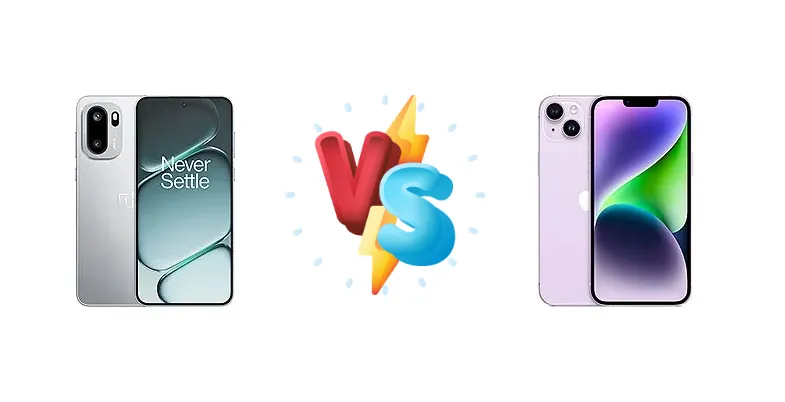
|
🏆 Quick Verdict
For users prioritizing raw performance and blazing-fast 100W charging, the OnePlus Turbo is the clear winner. However, the iPhone 14 Plus maintains its appeal with its established ecosystem, excellent battery endurance, and consistently polished software experience, making it ideal for iOS loyalists.
| PHONES | ||
|---|---|---|
| Phone Names | OnePlus Turbo | Apple iPhone 14 Plus |
| Network | ||
|---|---|---|
| 2G bands | GSM 850 / 900 / 1800 / 1900 | GSM 850 / 900 / 1800 / 1900 |
| 3G bands | HSDPA 850 / 900 / 2100 | HSDPA 850 / 900 / 1700(AWS) / 1900 / 2100 |
| 4G bands | LTE | 1, 2, 3, 4, 5, 7, 8, 12, 13, 17, 18, 19, 20, 25, 26, 28, 30, 32, 34, 38, 39, 40, 41, 42, 46, 48, 66 - A2886, A2888 |
| 5G bands | SA/NSA | 1, 2, 3, 5, 7, 8, 12, 20, 25, 26, 28, 30, 38, 40, 41, 48, 66, 70, 77, 78, 79 SA/NSA/Sub6 - A2886, A2888 |
| Speed | HSPA, LTE, 5G | HSPA, LTE, 5G, EV-DO Rev.A 3.1 Mbps |
| Technology | GSM / HSPA / LTE / 5G | GSM / CDMA / HSPA / EVDO / LTE / 5G |
| - | 1, 2, 3, 5, 7, 8, 12, 20, 25, 26, 28, 30, 38, 40, 41, 48, 66, 70, 77, 78, 79 SA/NSA/Sub6 - A2887 | |
| Launch | ||
|---|---|---|
| Announced | Not announced yet | 2022, September 07 |
| Status | Rumored | Available. Released 2022, October 07 |
| Body | ||
|---|---|---|
| Build | - | Glass front, glass back, aluminum frame |
| Dimensions | - | 160.8 x 78.1 x 7.8 mm (6.33 x 3.07 x 0.31 in) |
| SIM | Nano-SIM + Nano-SIM | · Nano-SIM + eSIM + eSIM (max 2 at a time; International)· eSIM + eSIM (8 or more, max 2 at a time; USA)· Nano-SIM + Nano-SIM (China) |
| Weight | - | 203 g (7.16 oz) |
| - | IP68 dust/water resistant (up to 6m for 30 min) Apple Pay (Visa, MasterCard, AMEX certified) | |
| Display | ||
|---|---|---|
| Protection | - | Ceramic Shield glass |
| Resolution | 1272 x 2800 pixels (~459 ppi density) | 1284 x 2778 pixels, 19.5:9 ratio (~458 ppi density) |
| Size | 6.7 inches, 109.1 cm2 | 6.7 inches, 109.8 cm2 (~87.4% screen-to-body ratio) |
| Type | AMOLED, 1B colors, 120Hz | Super Retina XDR OLED, HDR10, Dolby Vision, 800 nits (HBM), 1200 nits (peak) |
| Platform | ||
|---|---|---|
| CPU | Octa-core (2x4.6 GHz Oryon V3 Phoenix L + 6x3.62 GHz Oryon V3 Phoenix M) | Hexa-core (2x3.23 GHz Avalanche + 4x1.82 GHz Blizzard) |
| Chipset | Qualcomm SM8850-AC Snapdragon 8 Elite Gen 5 (3 nm) | Apple A15 Bionic (5 nm) |
| GPU | Adreno 840 | Apple GPU (5-core graphics) |
| OS | Android 16, ColorOS 16 | iOS 16, upgradable to iOS 26.1 |
| Memory | ||
|---|---|---|
| Card slot | No | No |
| Internal | Up to 512GB | 128GB 6GB RAM, 256GB 6GB RAM, 512GB 6GB RAM |
| - | NVMe | |
| Main Camera | ||
|---|---|---|
| Dual | 50 MP, f/1.8, 24mm (wide), PDAF, OIS 8 MP, f/2.2, 16mm, 112˚ (ultrawide), 1/4.0", 1.12µm | 12 MP, f/1.5, 26mm (wide), 1/1.7", 1.9µm, dual pixel PDAF, sensor-shift OIS 12 MP, f/2.4, 13mm, 120˚ (ultrawide) |
| Features | Color spectrum sensor, LED flash, HDR, panorama | Dual-LED dual-tone flash, HDR (photo/panorama) |
| Single | - | 12 MP, f/1.9, 23mm (wide), 1/3.6", PDAF SL 3D, (depth/biometrics sensor) |
| Video | 4K@30/60/120fps, 1080p@30/60/120fps, gyro-EIS, OIS | 4K@24/25/30/60fps, 1080p@25/30/60/120/240fps, HDR, Dolby Vision HDR (up to 60fps), stereo sound rec. |
| Selfie camera | ||
|---|---|---|
| Features | HDR, panorama | HDR |
| Single | 16 MP, f/2.4, 23mm (wide), 1/3", 1.0µm | 12 MP, f/1.9, 23mm (wide), 1/3.6", 1.0µm, PDAF SL 3D, (depth/biometrics sensor) |
| Video | 1080p@30fps, gyro-EIS | 4K@24/25/30/60fps, 1080p@25/30/60/120fps, gyro-EIS |
| Sound | ||
|---|---|---|
| 3.5mm jack | - | No |
| 35mm jack | No | No |
| Loudspeaker | Yes, with stereo speakers | Yes, with stereo speakers |
| Comms | ||
|---|---|---|
| Bluetooth | 5.4, A2DP, LE, aptX HD | 5.3, A2DP, LE |
| Infrared port | Yes | - |
| NFC | Yes | Yes |
| Positioning | GPS (L1+L5), GLONASS (G1), BDS (B1I+B1c+B2a), GALILEO (E1+E5a), QZSS (L1+L5), NavIC (L5) | GPS, GLONASS, GALILEO, BDS, QZSS |
| Radio | No | No |
| USB | USB Type-C 2.0 | Lightning, USB 2.0 |
| WLAN | Wi-Fi 802.11 a/b/g/n/ac/6, dual-band | Wi-Fi 802.11 a/b/g/n/ac/6, dual-band, hotspot |
| Features | ||
|---|---|---|
| Sensors | Fingerprint (under display, ultrasonic), accelerometer, gyro, proximity, compass | Face ID, accelerometer, gyro, proximity, compass, barometer |
| - | Ultra Wideband (UWB) support Emergency SOS via satellite (SMS sending/receiving) | |
| Battery | ||
|---|---|---|
| Charging | 100W wired Bypass charging | Wired, PD2.0, 50% in 30 min 15W wireless (MagSafe) 15W wireless (Qi2) - requires iOS 17.2 update |
| Type | Si/C Li-Ion 8000 mAh | Li-Ion 4323 mAh (16.68 Wh) |
| Misc | ||
|---|---|---|
| Colors | Black; other colors | Midnight, Purple, Starlight, Blue, Red, Yellow |
| Models | - | A2886, A2632, A2885, A2888, A2887, iphone14,8 |
| Price | - | € 391.58 / $ 329.97 / £ 335.00 |
| SAR | - | 1.14 W/kg (head) 1.15 W/kg (body) |
| SAR EU | - | 0.99 W/kg (head) 0.98 W/kg (body) |
| Tests | ||
|---|---|---|
| Battery life | - | Endurance rating 102h |
| Camera | - | Photo / Video |
| Display | - | Contrast ratio: Infinite (nominal) |
| Loudspeaker | - | -24.7 LUFS (Very good) |
| Performance | - | AnTuTu: 797976 (v9) GeekBench: 4582 (v5.1) GFXBench: 60fps (ES 3.1 onscreen) |
OnePlus Turbo
- Blazing-fast 100W charging
- More powerful Snapdragon 8 Elite Gen 5 processor
- Likely higher refresh rate display
- Camera specs are unknown
- Android ecosystem may not appeal to all
Apple iPhone 14 Plus
- Excellent battery life (102h endurance)
- Polished iOS ecosystem and software support
- Strong video recording capabilities
- Slower charging speeds
- Less powerful processor compared to Snapdragon 8 Elite Gen 5
- Limited to 60Hz display refresh rate
Display Comparison
The iPhone 14 Plus features a 6.7-inch display capable of 797 nits of peak brightness, providing good visibility outdoors. While the OnePlus Turbo’s display specs are not provided, it’s likely to offer comparable or higher brightness given the flagship positioning. The iPhone 14 Plus boasts an infinite (nominal) contrast ratio, typical of OLED panels, delivering deep blacks. The absence of LTPO technology in the iPhone 14 Plus means it’s limited to a 60Hz refresh rate, while the Turbo, given its focus on performance, is likely to include a higher refresh rate panel for smoother scrolling and gaming. This difference will be noticeable to users accustomed to higher refresh rates.
Camera Comparison
Both devices offer photo and video capabilities, but detailed sensor information is lacking for the OnePlus Turbo. The iPhone 14 Plus is known for its consistent image quality and excellent video stabilization. Without specific details on the Turbo’s camera sensors and apertures, it’s difficult to make a direct comparison. However, the iPhone’s computational photography and established image processing pipeline are strong points. The absence of information regarding OIS on the Turbo is a key omission, as this is crucial for low-light performance and stable video recording.
Performance
The OnePlus Turbo’s Qualcomm SM8850-AC Snapdragon 8 Elite Gen 5 (3nm) represents a significant leap in mobile processing. Its octa-core CPU, featuring 2x4.6 GHz Oryon V3 Phoenix L cores and 6x3.62 GHz Oryon V3 Phoenix M cores, is architecturally more advanced than the iPhone 14 Plus’s Apple A15 Bionic (5nm) with its hexa-core configuration (2x3.23 GHz Avalanche + 4x1.82 GHz Blizzard). The 3nm process node of the Snapdragon 8 Elite Gen 5 promises superior power efficiency and thermal performance compared to the A15 Bionic’s 5nm node, potentially leading to less throttling during sustained workloads. While the A15 Bionic remains a potent chip, the Turbo’s newer architecture and process technology give it a clear advantage in raw processing power.
Battery Life
The iPhone 14 Plus boasts an impressive endurance rating of 102 hours, indicating excellent battery life. While the OnePlus Turbo’s battery capacity is not specified, its 100W wired charging capability is a game-changer. This allows for significantly faster charging times compared to the iPhone 14 Plus’s 50% charge in 30 minutes via wired PD2.0, 15W MagSafe wireless, and 15W Qi2 (requiring iOS 17.2). The Turbo’s bypass charging feature further optimizes charging efficiency by directly powering the device, reducing heat and extending battery lifespan. The iPhone 14 Plus relies on a more conservative charging approach, prioritizing battery health over speed.
Buying Guide
Buy the OnePlus Turbo if you need uncompromising processing power for demanding games and applications, coupled with the convenience of incredibly fast charging. You'll also appreciate the flexibility of Android. Buy the Apple iPhone 14 Plus if you prefer the simplicity and security of iOS, value long-term software support, and prioritize all-day battery life over peak performance.