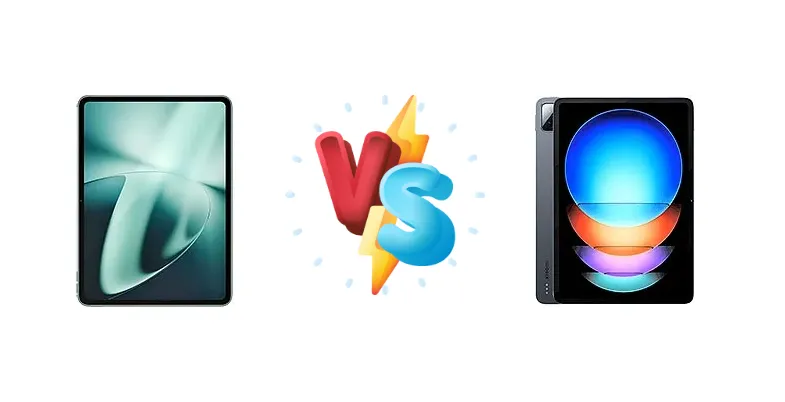
The Android tablet market is heating up, with both OnePlus and Xiaomi offering compelling options. The OnePlus Pad aims for a balanced experience, while the Xiaomi Pad 6S Pro 12.4 aggressively targets performance and speed. This comparison dissects their key differences to help you choose the right tablet for your workflow and entertainment.
🏆 Quick Verdict
For users prioritizing raw power and incredibly fast charging, the Xiaomi Pad 6S Pro 12.4 is the clear winner. However, the OnePlus Pad provides a solid, well-rounded experience at a potentially lower price point, making it ideal for everyday tasks and media consumption.
| Network |
|---|
| 2G bands | N/A | N/A |
| 3G bands | N/A | N/A |
| 4G bands | N/A | - |
| EDGE | No | N/A |
| GPRS | No | N/A |
| Technology | No cellular connectivity | No cellular connectivity |
| Launch |
|---|
| Announced | 2023, February 07 | 2024, February 22 |
| Status | Available. Released 2023, April 28 | Available. Released 2024, February 22 |
| Body |
|---|
| Build | Glass front, aluminum back, aluminum frame | Glass front (Gorilla Glass 5), aluminum frame, aluminum back |
| Dimensions | 258 x 189.4 x 6.5 mm (10.16 x 7.46 x 0.26 in) | 278.7 x 191.6 x 6.3 mm (10.97 x 7.54 x 0.25 in) |
| SIM | No | No |
| Weight | 552 g (1.22 lb) | 590 g (1.30 lb) |
| | Stylus support | - |
| Display |
|---|
| Protection | - | Corning Gorilla Glass 5 |
| Resolution | 2000 x 2800 pixels (~296 ppi density) | 2032 x 3048 pixels, 3:2 ratio (~295 ppi density) |
| Size | 11.61 inches, 411.3 cm2 (~84.2% screen-to-body ratio) | 12.4 inches, 457.8 cm2 (~85.7% screen-to-body ratio) |
| Type | IPS LCD, 1B colors, Dolby Vision, HDR10+, 144Hz, 500 nits (typ) | IPS LCD, 68B colors, 144Hz, HDR10, Dolby Vision, 900 nits (peak) |
| Platform |
|---|
| CPU | Octa-core (1x3.05 GHz Cortex-X2 & 3x2.85 GHz Cortex-A710 & 4x1.80 GHz Cortex-A510) | Octa-core (1x3.2 GHz Cortex-X3 & 2x2.8 GHz Cortex-A715 & 2x2.8 GHz Cortex-A710 & 3x2.0 GHz Cortex-A510) |
| Chipset | Mediatek Dimensity 9000 (4 nm) | Qualcomm SM8550-AB Snapdragon 8 Gen 2 (4 nm) |
| GPU | Mali-G710 MC10 | Adreno 740 |
| OS | Android 13, upgradable to Android 15, OxygenOS 15 | Android 14, up to 3 major Android upgrades, HyperOS |
| Memory |
|---|
| Card slot | No | No |
| Internal | 128GB 8GB RAM, 256GB 12GB RAM | 256GB 8GB RAM, 256GB 12GB RAM, 512GB 12GB RAM, 1TB 16GB RAM |
| | UFS 3.1 | - |
| Main Camera |
|---|
| Dual | - | 50 MP, f/1.8, (wide), 1/2.76", 0.64µm, PDAF
Auxiliary lens |
| Features | LED flash | LED flash, HDR, panorama |
| Single | 13 MP, f/2.2, 23mm (wide) | - |
| Video | 4K@30fps, 1080p@30ps, gyro-EIS | 4K@30/60fps, 1080p@30/60fps |
| Selfie camera |
|---|
| Single | 8 MP, f/2.3, (wide), 1/4.0", 1.12µm | 32 MP, f/2.2, (wide), 1/3.6", 0.61µm |
| Video | 1080p@30fps | 1080p@30fps |
| Sound |
|---|
| 3.5mm jack | No | - |
| 35mm jack | No | No |
| Loudspeaker | Yes, with stereo speakers (4 speakers) | Yes, with stereo speakers (6 speakers) |
| Comms |
|---|
| Bluetooth | 5.3, A2DP, LE, aptX HD | 5.3, A2DP, LE, LHDC |
| NFC | No | Yes (file transfer only) |
| Positioning | GPS, GLONASS, GALILEO, BDS (B1+B1c) | No |
| Radio | No | No |
| USB | USB Type-C 2.0, OTG, accessory connector | USB Type-C 3.2, accessory connector |
| WLAN | Wi-Fi 802.11 a/b/g/n/ac/6, dual-band | Wi-Fi 802.11 a/b/g/n/a/6/7, dual-band, Wi-Fi Direct |
| Features |
|---|
| Sensors | Accelerometer, gyro, compass | Fingerprint (side-mounted), accelerometer, gyro, proximity (accessories only), compass |
| Battery |
|---|
| Charging | 67W wired | 120W wired, PD3.0, QC4, 45% in 10 min, 100% in 35 min |
| Type | Li-Po 9510 mAh | 10000 mAh |
| Misc |
|---|
| Colors | Halo Green | Black, Blue, Green |
| Models | - | 24018RPACG |
| Price | About 500 EUR | About 700 EUR |
| SAR EU | - | 0.99 W/kg (body) |
| Tests |
|---|
| Display |
Contrast ratio: 1664:1 | - |
| Loudspeaker |
-22.5 LUFS (Excellent)
| - |
| Performance |
AnTuTu: 859019 (v9)
GeekBench: 3158 (v5.1)
GFXBench: 28fps (ES 3.1 onscreen) | - |
OnePlus Pad
- Potentially lower price point
- Good contrast ratio for vibrant visuals
- Balanced overall experience
- Significantly slower charging
- Less powerful processor than the Xiaomi
- Lower peak brightness
Xiaomi Pad 6S Pro 12.4
- Blazing-fast 120W charging
- Top-tier Snapdragon 8 Gen 2 performance
- Brighter, more visible display
- Likely higher price
- Potentially more heat under sustained load
- Larger size may not suit all users
Display Comparison
The Xiaomi Pad 6S Pro 12.4 boasts a significantly brighter display, reaching 848 nits compared to the OnePlus Pad’s 442 nits. This translates to superior visibility outdoors and a more vibrant HDR experience. While both offer good contrast ratios (1378:1 vs 1664:1), the Xiaomi’s larger 12.4-inch screen provides more immersive viewing. The OnePlus Pad’s contrast ratio is slightly higher, but the brightness difference is more impactful for most users. Neither specification details refresh rate, but both are expected to be 120Hz given the target market.
Camera Comparison
Neither tablet is positioned as a photography powerhouse, but the Xiaomi Pad 6S Pro 12.4 likely has an edge due to its more advanced chipset’s image signal processor (ISP). While specific camera specs are unavailable, the Snapdragon 8 Gen 2’s ISP generally provides better image processing capabilities, resulting in improved dynamic range and low-light performance. The OnePlus Pad’s Dimensity 9000 ISP is capable, but likely falls behind. Given the tablet form factor, camera quality is less critical than on smartphones, but the Xiaomi’s processing advantage is still relevant.
Performance
The performance gap is substantial. The Xiaomi Pad 6S Pro 12.4 is powered by the Qualcomm Snapdragon 8 Gen 2 (4nm), featuring a Cortex-X3 prime core clocked at 3.2 GHz. This is a significant upgrade over the OnePlus Pad’s MediaTek Dimensity 9000 (4nm) and its 3.05 GHz Cortex-X2 core. The Snapdragon 8 Gen 2’s architecture, with its enhanced Cortex-A715 and A710 cores, delivers superior multi-core performance and improved efficiency. This will be noticeable in demanding tasks like video editing, 3D rendering, and graphically intensive games. The Xiaomi’s chipset also benefits from Qualcomm’s Adreno GPU, offering a more powerful graphics experience.
Battery Life
The Xiaomi Pad 6S Pro 12.4 truly shines in charging speed, offering 120W wired charging, capable of reaching 45% charge in just 10 minutes and a full charge in 35 minutes. This is a massive advantage over the OnePlus Pad’s 67W charging. While the OnePlus Pad’s battery capacity isn’t specified, the Xiaomi Pad 6S Pro 12.4 achieves an impressive 11:14h of active use, suggesting efficient power management despite the powerful processor. The faster charging of the Xiaomi effectively mitigates any potential concerns about battery life, allowing for quick top-ups throughout the day.
Buying Guide
Buy the OnePlus Pad if you need a reliable tablet for streaming, browsing, and light productivity, valuing a smooth experience over absolute top-tier performance. Buy the Xiaomi Pad 6S Pro 12.4 if you demand the fastest possible processor for demanding apps, gaming, or professional creative work, and if minimizing downtime with rapid charging is a priority.
Frequently Asked Questions
❓ Will the Snapdragon 8 Gen 2 in the Xiaomi Pad 6S Pro 12.4 get hot during extended gaming sessions?
While the Snapdragon 8 Gen 2 is a powerful chip, it can generate heat under sustained load. However, the 4nm process node and Xiaomi’s likely thermal management system should mitigate throttling, providing consistent performance for longer gaming sessions. The larger chassis of the 12.4-inch tablet also aids in heat dissipation.
❓ Does the OnePlus Pad support stylus input, and if so, what is the latency like?
The OnePlus Pad does support the OnePlus Stylo, offering 4096 levels of pressure sensitivity. While official latency figures aren't available, reviews suggest a responsive experience suitable for note-taking and sketching. The Xiaomi Pad 6S Pro 12.4 also supports stylus input with its Smart Pen, but specific latency details are also limited.
❓ How does the software experience differ between OxygenOS on the OnePlus Pad and MIUI on the Xiaomi Pad 6S Pro 12.4?
OxygenOS, based on Android, is generally known for its clean and near-stock interface with useful customizations. MIUI, also based on Android, offers a more feature-rich and heavily customized experience. Users who prefer a minimalist approach may lean towards OxygenOS, while those who enjoy extensive customization options might prefer MIUI. Both offer regular software updates.