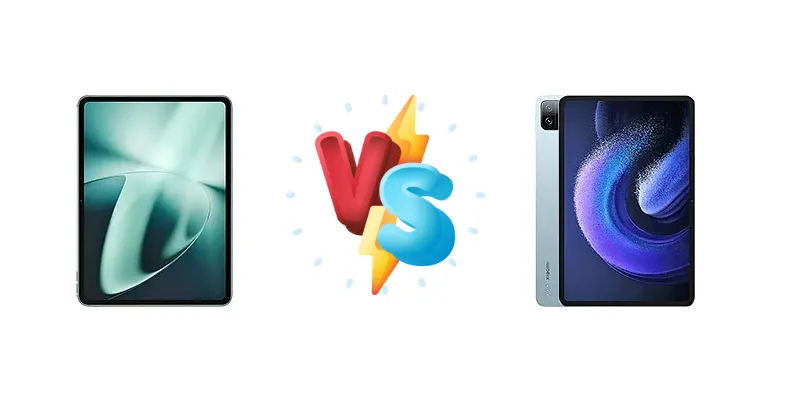
The Android tablet market is heating up, and two contenders are vying for your attention: the OnePlus Pad and the Xiaomi Pad 6. Both offer compelling features and competitive pricing, but which one truly delivers the best experience? Let's dive into a detailed comparison to help you decide.
🏆 Quick Verdict
The OnePlus Pad boasts a superior chipset and display, offering a smoother and more vibrant experience. However, the Xiaomi Pad 6 shines with its exceptional battery life and faster charging. Ultimately, the choice depends on your priorities: performance or endurance.
| Network |
|---|
| 2G bands | N/A | N/A |
| 3G bands | N/A | N/A |
| 4G bands | N/A | - |
| EDGE | No | N/A |
| GPRS | No | N/A |
| Technology | No cellular connectivity | No cellular connectivity |
| Launch |
|---|
| Announced | 2023, February 07 | 2023, April 18 |
| Status | Available. Released 2023, April 28 | Available. Released 2023, April 18 |
| Body |
|---|
| Build | Glass front, aluminum back, aluminum frame | Glass front (Gorilla Glass 3), aluminum frame, aluminum back |
| Dimensions | 258 x 189.4 x 6.5 mm (10.16 x 7.46 x 0.26 in) | 254 x 165.2 x 6.5 mm (10.0 x 6.50 x 0.26 in) |
| SIM | No | No |
| Weight | 552 g (1.22 lb) | 490 g (1.08 lb) |
| | Stylus support | Stylus support (magnetic) |
| Display |
|---|
| Protection | - | Corning Gorilla Glass 3 |
| Resolution | 2000 x 2800 pixels (~296 ppi density) | 1800 x 2880 pixels, 16:10 ratio (~309 ppi density) |
| Size | 11.61 inches, 411.3 cm2 (~84.2% screen-to-body ratio) | 11.0 inches, 350.9 cm2 (~83.6% screen-to-body ratio) |
| Type | IPS LCD, 1B colors, Dolby Vision, HDR10+, 144Hz, 500 nits (typ) | IPS LCD, 1B colors, 144Hz, HDR10, Dolby Vision, 550 nits |
| Platform |
|---|
| CPU | Octa-core (1x3.05 GHz Cortex-X2 & 3x2.85 GHz Cortex-A710 & 4x1.80 GHz Cortex-A510) | Octa-core (1x3.2 GHz Kryo 585 & 3x2.42 GHz Kryo 585 & 4x1.80 GHz Kryo 585) |
| Chipset | Mediatek Dimensity 9000 (4 nm) | Qualcomm SM8250-AC Snapdragon 870 5G (7 nm) |
| GPU | Mali-G710 MC10 | Adreno 650 |
| OS | Android 13, upgradable to Android 15, OxygenOS 15 | Android 13, MIUI Pad 14 |
| Memory |
|---|
| Card slot | No | No |
| Internal | 128GB 8GB RAM, 256GB 12GB RAM | 128GB 6GB RAM, 128GB 8GB RAM, 256GB 8GB RAM |
| | UFS 3.1 | UFS 3.1 |
| Main Camera |
|---|
| Features | LED flash | Dual-LED flash, HDR, panorama |
| Single | 13 MP, f/2.2, 23mm (wide) | 13 MP, f/2.2, PDAF |
| Video | 4K@30fps, 1080p@30ps, gyro-EIS | 4K@30fps, 1080p@30/60fps |
| Selfie camera |
|---|
| Single | 8 MP, f/2.3, (wide), 1/4.0", 1.12µm | 8 MP, f/2.2, 1/4.0", 1.12µm |
| Video | 1080p@30fps | 1080p@30fps |
| Sound |
|---|
| 3.5mm jack | No | No |
| 35mm jack | No | No |
| Loudspeaker | Yes, with stereo speakers (4 speakers) | Yes, with stereo speakers (4 speakers) |
| | - | 24-bit/192kHz audio |
| Comms |
|---|
| Bluetooth | 5.3, A2DP, LE, aptX HD | 5.2, A2DP, LE |
| NFC | No | No |
| Positioning | GPS, GLONASS, GALILEO, BDS (B1+B1c) | Unspecified |
| Radio | No | No |
| USB | USB Type-C 2.0, OTG, accessory connector | USB Type-C 3.2, accessory connector |
| WLAN | Wi-Fi 802.11 a/b/g/n/ac/6, dual-band | Wi-Fi 802.11 a/b/g/n/a/6, dual-band, Wi-Fi Direct |
| Features |
|---|
| Sensors | Accelerometer, gyro, compass | Accelerometer, gyro, proximity (accessories only) |
| Battery |
|---|
| Charging | 67W wired | 33W wired, PD3.0, QC4 |
| Type | Li-Po 9510 mAh | Li-Po 8840 mAh |
| Misc |
|---|
| Colors | Halo Green | Black, Blue, Gold |
| Models | - | 23043RP34C, 23043RP34G, 23043RP34I |
| Price | About 500 EUR | About 400 EUR |
| Tests |
|---|
| Display |
Contrast ratio: 1664:1 | - |
| Loudspeaker |
-22.5 LUFS (Excellent)
| - |
| Performance |
AnTuTu: 859019 (v9)
GeekBench: 3158 (v5.1)
GFXBench: 28fps (ES 3.1 onscreen) | - |
OnePlus Pad
- Superior Performance (Dimensity 9000)
- Excellent Display Quality
- Fast Charging (67W)
- Shorter Battery Life
- Potentially Higher Price
Xiaomi Pad 6
- Exceptional Battery Life
- More Affordable
- Balanced Overall Experience
- Less Powerful Chipset
- Lower Display Contrast
Display Comparison
The OnePlus Pad takes the display crown with a measured 442 nits brightness and a higher contrast ratio (1664:1) compared to the Xiaomi Pad 6's 500 nits and 1060:1. While both offer vibrant colors, the OnePlus Pad's display is noticeably sharper and more immersive. The Xiaomi Pad 6's display is still good, but doesn't quite match the OnePlus Pad's visual fidelity.
Camera Comparison
Camera quality is generally not a primary concern for tablets. Both devices feature decent cameras for video calls and casual snapshots, but neither excels in this area. Expect similar performance in well-lit conditions, with both struggling in low light. Specific camera specs are not readily available for both devices, so a direct comparison is difficult.
Performance
The OnePlus Pad's Mediatek Dimensity 9000 chipset is significantly more powerful than the Xiaomi Pad 6's Snapdragon 870. This translates to smoother multitasking, faster app loading times, and better performance in demanding games. The Dimensity 9000's architecture, with its Cortex-X2 core, provides a noticeable performance boost.
Battery Life
The Xiaomi Pad 6 is the clear winner in the battery department. Its active use score of 9:39h is impressive, significantly outperforming the OnePlus Pad. While the OnePlus Pad offers 67W wired charging, the Xiaomi Pad 6's 33W charging with PD3.0 and QC4 support provides a more practical and efficient charging experience for extended use.
Buying Guide
The OnePlus Pad is ideal for users who prioritize performance, a high-quality display for media consumption, and don't mind slightly slower charging. The Xiaomi Pad 6 is perfect for those seeking long battery life, a more budget-friendly option, and appreciate a balanced overall experience.
Frequently Asked Questions
❓ Which tablet is better for gaming?
The OnePlus Pad is the better choice for gaming due to its more powerful chipset and smoother performance.
❓ Is the Xiaomi Pad 6 worth buying if I prioritize battery life?
Absolutely! The Xiaomi Pad 6 offers exceptional battery life, making it ideal for users who need a tablet that can last all day.
❓ Does the OnePlus Pad support a stylus?
Yes, the OnePlus Pad supports a stylus, enhancing its productivity capabilities.
❓ What resolution are the displays on each tablet?
Both tablets feature a 2.5K resolution display, offering sharp and detailed visuals.