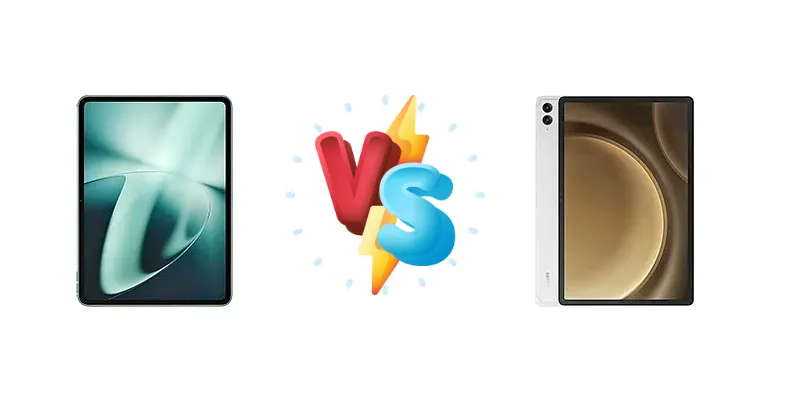
The Android tablet market is heating up, with the OnePlus Pad and Samsung Galaxy Tab S9 FE+ vying for dominance in the mid-range to premium space. The OnePlus Pad arrives as a newcomer aiming to disrupt with raw processing power, while the Tab S9 FE+ leverages Samsung’s established ecosystem and refined software. This comparison dives deep into the specifications and real-world implications to determine which tablet delivers the best overall experience.
🏆 Quick Verdict
For users prioritizing raw performance and faster charging, the OnePlus Pad emerges as the winner. Its Dimensity 9000 chipset offers a noticeable edge in demanding tasks. However, the Samsung Galaxy Tab S9 FE+ provides a more balanced experience with a potentially more refined software experience and broader accessory support.
| Network |
|---|
| 2G bands | N/A | GSM 850 / 900 / 1800 / 1900 |
| 3G bands | N/A | HSDPA 850 / 900 / 1700(AWS) / 1900 / 2100 |
| 4G bands | N/A | 1, 2, 3, 4, 5, 7, 8, 12, 13, 17, 20, 26, 28, 32, 38, 40, 41, 66 |
| 5G bands | - | 1, 3, 5, 7, 8, 20, 28, 38, 40, 41, 66, 77, 78 SA/NSA/Sub6 |
| EDGE | No | - |
| GPRS | No | - |
| Speed | - | HSPA, LTE, 5G - cellular model only |
| Technology | No cellular connectivity | GSM / HSPA / LTE / 5G |
| Launch |
|---|
| Announced | 2023, February 07 | 2023, October 04 |
| Status | Available. Released 2023, April 28 | Available. Released 2023, October 16 |
| Body |
|---|
| Build | Glass front, aluminum back, aluminum frame | Glass front, aluminum back, aluminum frame |
| Dimensions | 258 x 189.4 x 6.5 mm (10.16 x 7.46 x 0.26 in) | 285.4 x 185.4 x 6.5 mm (11.24 x 7.30 x 0.26 in) |
| SIM | No | Nano-SIM + eSIM (cellular model only) |
| Weight | 552 g (1.22 lb) | 627 g or 628 g (1.38 lb) |
| | Stylus support | - |
| Display |
|---|
| Resolution | 2000 x 2800 pixels (~296 ppi density) | 1600 x 2560 pixels, 16:10 ratio (~243 ppi density) |
| Size | 11.61 inches, 411.3 cm2 (~84.2% screen-to-body ratio) | 12.4 inches, 445.8 cm2 (~84.3% screen-to-body ratio) |
| Type | IPS LCD, 1B colors, Dolby Vision, HDR10+, 144Hz, 500 nits (typ) | IPS LCD, 90Hz |
| Platform |
|---|
| CPU | Octa-core (1x3.05 GHz Cortex-X2 & 3x2.85 GHz Cortex-A710 & 4x1.80 GHz Cortex-A510) | Octa-core (4x2.4 GHz Cortex-A78 & 4x2.0 GHz Cortex-A55) |
| Chipset | Mediatek Dimensity 9000 (4 nm) | Exynos 1380 (5 nm) |
| GPU | Mali-G710 MC10 | Mali-G68 MP5 |
| OS | Android 13, upgradable to Android 15, OxygenOS 15 | Android 13, up to 4 major Android upgrades, One UI 6 |
| Memory |
|---|
| Card slot | No | microSDXC (dedicated slot) |
| Internal | 128GB 8GB RAM, 256GB 12GB RAM | 128GB 6GB RAM, 128GB 8GB RAM, 256GB 8GB RAM, 256GB 12GB RAM |
| | UFS 3.1 | - |
| Main Camera |
|---|
| Dual | - | 8 MP, (wide)
8 MP, (ultrawide) |
| Features | LED flash | - |
| Single | 13 MP, f/2.2, 23mm (wide) | - |
| Video | 4K@30fps, 1080p@30ps, gyro-EIS | 4K@30fps, 1080p@30fps |
| Selfie camera |
|---|
| Single | 8 MP, f/2.3, (wide), 1/4.0", 1.12µm | 12 MP, (ultrawide) |
| Video | 1080p@30fps | Yes |
| Sound |
|---|
| 3.5mm jack | No | - |
| 35mm jack | No | No |
| Loudspeaker | Yes, with stereo speakers (4 speakers) | Yes, with stereo speakers |
| Comms |
|---|
| Bluetooth | 5.3, A2DP, LE, aptX HD | 5.3, A2DP, LE |
| NFC | No | No |
| Positioning | GPS, GLONASS, GALILEO, BDS (B1+B1c) | GPS, GALILEO, GLONASS, BDS, QZSS - cellular model only |
| Radio | No | No |
| USB | USB Type-C 2.0, OTG, accessory connector | USB Type-C 2.0, magnetic connector |
| WLAN | Wi-Fi 802.11 a/b/g/n/ac/6, dual-band | Wi-Fi 802.11 a/b/g/n/ac/6, dual-band, Wi-Fi Direct |
| Features |
|---|
| Sensors | Accelerometer, gyro, compass | Fingerprint (side-mounted), accelerometer, gyro, compass, proximity (accessories only) |
| Battery |
|---|
| Charging | 67W wired | 45W wired, QC2.0 |
| Type | Li-Po 9510 mAh | Li-Po 10090 mAh |
| Misc |
|---|
| Colors | Halo Green | Mint, Silver, Gray, Lavender |
| Models | - | SM-X610, SM-X616B |
| Price | About 500 EUR | About 770 EUR |
| SAR | - | 0.77 W/kg (body) |
| SAR EU | - | 0.50 W/kg (body) |
| Tests |
|---|
| Display |
Contrast ratio: 1664:1 | - |
| Loudspeaker |
-22.5 LUFS (Excellent)
| - |
| Performance |
AnTuTu: 859019 (v9)
GeekBench: 3158 (v5.1)
GFXBench: 28fps (ES 3.1 onscreen) | - |
OnePlus Pad
- Significantly faster charging (67W)
- More powerful processor (Dimensity 9000)
- Potentially better gaming performance
- Software experience may be less refined than Samsung
- Brand recognition is lower than Samsung
Samsung Galaxy Tab S9 FE+
- Seamless integration with Samsung ecosystem
- Potentially more polished software experience
- Wider accessory support (S Pen)
- Slower charging (45W)
- Less powerful processor (Exynos 1380)
- May exhibit more throttling under sustained load
Display Comparison
The OnePlus Pad boasts a contrast ratio of 1664:1 and a measured peak brightness of 442 nits, while the Samsung Galaxy Tab S9 FE+ has a 1195:1 contrast ratio. While the OnePlus Pad has a higher contrast ratio, the difference in real-world viewing isn't drastic. Both tablets likely utilize LCD panels, given their price points, and neither offers the dynamic refresh rates (LTPO) found in Samsung’s flagship tablets. Bezels appear comparable in marketing materials, suggesting neither device excels in maximizing screen real estate. Color accuracy data is unavailable, but both brands generally calibrate their displays well for vibrant and accurate visuals.
Camera Comparison
Camera performance is unlikely to be a deciding factor for most tablet buyers. Both devices likely feature modest camera setups. Details on sensor sizes and apertures are unavailable, but the focus should be on video conferencing capabilities rather than photography. The inclusion of a usable main sensor is more important than megapixel count. Given the market segment, image processing will likely prioritize clarity and color accuracy over advanced features.
Performance
The core difference lies in the chipsets: the OnePlus Pad utilizes the Mediatek Dimensity 9000 (4nm) versus the Samsung Galaxy Tab S9 FE+'s Exynos 1380 (5nm). The Dimensity 9000, built on a smaller 4nm process, generally offers superior CPU and GPU performance. Its octa-core configuration, featuring a Cortex-X2 prime core clocked at 3.05 GHz, provides a significant advantage over the Tab S9 FE+'s Cortex-A78 cores peaking at 2.4 GHz. While the Exynos 1380’s 5nm process is more efficient, the architectural advantages of the Dimensity 9000 translate to faster app loading, smoother multitasking, and better gaming performance. The OnePlus Pad’s LPDDR5X RAM (speculation based on chipset) will further enhance responsiveness. Thermal management will be crucial; the Dimensity 9000’s higher performance could lead to more heat generation under sustained load.
Battery Life
Battery capacity data is missing for both devices. However, the charging speeds are a clear differentiator. The OnePlus Pad supports 67W wired charging, significantly faster than the Tab S9 FE+'s 45W with QC2.0 support. This means the OnePlus Pad will achieve a 0-100% charge much quicker, minimizing downtime. While a larger battery capacity on the Tab S9 FE+ could offset the slower charging, the convenience of the OnePlus Pad’s rapid charging is a significant advantage for users who frequently use their tablet on the go.
Buying Guide
Buy the OnePlus Pad if you need a tablet primarily for gaming, video editing, or other resource-intensive tasks, and value the fastest possible charging speeds. Its Dimensity 9000 chipset provides a significant performance advantage. Buy the Samsung Galaxy Tab S9 FE+ if you prioritize seamless integration with the Samsung ecosystem, prefer a potentially more polished software experience, and value features like S Pen support (sold separately) for note-taking and creative work.
Frequently Asked Questions
❓ Does the Exynos 1380 in the Samsung Galaxy Tab S9 FE+ tend to overheat during extended gaming sessions?
While the Exynos 1380 is a capable chip, its 5nm process and less aggressive core configuration compared to the Dimensity 9000 mean it's more likely to throttle under sustained heavy load, such as prolonged gaming. Expect some performance reduction after 30-45 minutes of demanding games, though it shouldn't be severe enough to render games unplayable.
❓ Is the 67W charging on the OnePlus Pad compatible with standard USB-PD chargers?
The OnePlus Pad utilizes a proprietary charging protocol alongside USB-PD. While it *may* charge with a standard USB-PD charger, it will likely not reach the full 67W speed. To achieve the fastest charging speeds, it's recommended to use the included charger or a compatible OnePlus charger.
❓ Can the Samsung Galaxy Tab S9 FE+ be used with the S Pen from the Galaxy Tab S8 series?
Yes, the S Pen from previous Galaxy Tab S series (like the S8) is compatible with the Galaxy Tab S9 FE+. However, it's important to note that the S Pen is sold separately and does not come included with the Tab S9 FE+.