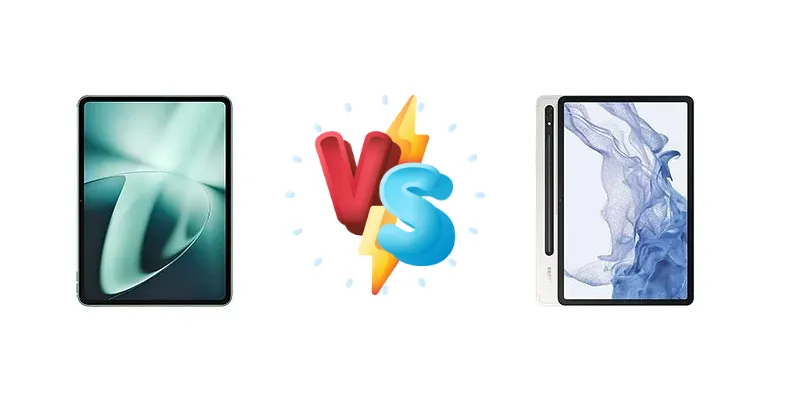
The Android tablet market is heating up, and two contenders are vying for your attention: the OnePlus Pad and the Samsung Galaxy Tab S8. Both offer premium features and performance, but cater to slightly different needs. Let's dive into a detailed comparison to help you decide which one is right for you.
🏆 Quick Verdict
The Samsung Galaxy Tab S8 edges out the OnePlus Pad thanks to its superior display, refined software, and established ecosystem. However, the OnePlus Pad offers impressive performance and faster charging at a more competitive price, making it a strong contender for budget-conscious users.
| Network |
|---|
| 2G bands | N/A | GSM 850 / 900 / 1800 / 1900 |
| 3G bands | N/A | HSDPA 850 / 900 / 1700(AWS) / 1900 / 2100 |
| 4G bands | N/A | LTE |
| 5G bands | - | SA/NSA |
| EDGE | No | - |
| GPRS | No | - |
| Speed | - | HSPA, LTE, 5G - cellular model only |
| Technology | No cellular connectivity | GSM / HSPA / LTE / 5G |
| Launch |
|---|
| Announced | 2023, February 07 | 2022, February 09 |
| Status | Available. Released 2023, April 28 | Available. Released 2022, March 22 |
| Body |
|---|
| Build | Glass front, aluminum back, aluminum frame | - |
| Dimensions | 258 x 189.4 x 6.5 mm (10.16 x 7.46 x 0.26 in) | 253.8 x 165.3 x 6.3 mm (9.99 x 6.51 x 0.25 in) |
| SIM | No | Nano-SIM (cellular model only) |
| Weight | 552 g (1.22 lb) | 503 g (Wi-Fi), 507 g (5G) (1.11 lb) |
| | Stylus support | Stylus, 6.2ms latency (Bluetooth integration, accelerometer, gyro) |
| Display |
|---|
| Protection | - | Corning Gorilla Glass 5 |
| Resolution | 2000 x 2800 pixels (~296 ppi density) | 1600 x 2560 pixels, 16:10 ratio (~274 ppi density) |
| Size | 11.61 inches, 411.3 cm2 (~84.2% screen-to-body ratio) | 11.0 inches, 350.9 cm2 (~83.6% screen-to-body ratio) |
| Type | IPS LCD, 1B colors, Dolby Vision, HDR10+, 144Hz, 500 nits (typ) | TFT LCD, 120Hz |
| Platform |
|---|
| CPU | Octa-core (1x3.05 GHz Cortex-X2 & 3x2.85 GHz Cortex-A710 & 4x1.80 GHz Cortex-A510) | Octa-core (1x3.00 GHz Cortex-X2 & 3x2.50 GHz Cortex-A710 & 4x1.80 GHz Cortex-A510) |
| Chipset | Mediatek Dimensity 9000 (4 nm) | Qualcomm SM8450 Snapdragon 8 Gen 1 (4 nm) |
| GPU | Mali-G710 MC10 | Adreno 730 |
| OS | Android 13, upgradable to Android 15, OxygenOS 15 | Android 12, up to 4 major Android upgrades, One UI 6.1.1 |
| Memory |
|---|
| Card slot | No | microSDXC (dedicated slot) |
| Internal | 128GB 8GB RAM, 256GB 12GB RAM | 128GB 8GB RAM, 256GB 8GB RAM, 256GB 12GB RAM |
| | UFS 3.1 | UFS |
| Main Camera |
|---|
| Dual | - | 13 MP, f/2.0, 26mm (wide), 1/3.4", 1.0µm, AF
6 MP, f/2.2, (ultrawide) |
| Features | LED flash | LED flash, HDR, panorama |
| Single | 13 MP, f/2.2, 23mm (wide) | - |
| Video | 4K@30fps, 1080p@30ps, gyro-EIS | 4K@30/60fps, 1080p@30fps |
| Selfie camera |
|---|
| Dual | - | 12 MP, f/2.4, 120˚ (ultrawide) |
| Features | - | HDR |
| Single | 8 MP, f/2.3, (wide), 1/4.0", 1.12µm | - |
| Video | 1080p@30fps | 4K@30/60fps, 1080p@30fps |
| Sound |
|---|
| 3.5mm jack | No | No |
| 35mm jack | No | No |
| Loudspeaker | Yes, with stereo speakers (4 speakers) | Yes, with stereo speakers (4 speakers) |
| | - | Tuned by AKG |
| Comms |
|---|
| Bluetooth | 5.3, A2DP, LE, aptX HD | 5.2, A2DP, LE |
| NFC | No | No |
| Positioning | GPS, GLONASS, GALILEO, BDS (B1+B1c) | GPS, GLONASS, BDS, GALILEO - cellular model only |
| Radio | No | No |
| USB | USB Type-C 2.0, OTG, accessory connector | USB Type-C 3.2, magnetic connector |
| WLAN | Wi-Fi 802.11 a/b/g/n/ac/6, dual-band | Wi-Fi 802.11 a/b/g/n/ac/6e, dual-band, Wi-Fi Direct |
| Features |
|---|
| Sensors | Accelerometer, gyro, compass | Fingerprint (side-mounted), accelerometer, gyro, proximity, compass |
| | - | Wireless Samsung DeX |
| Battery |
|---|
| Charging | 67W wired | 45W wired, 100% in 80 min |
| Type | Li-Po 9510 mAh | Li-Po 8000 mAh |
| Misc |
|---|
| Colors | Halo Green | Graphite, Silver, Pink Gold |
| Models | - | SM-X700, SM-X706, SM-X706B, SM-X706U, SM-X706N |
| Price | About 500 EUR | About 350 EUR |
| SAR EU | - | 0.87 W/kg (body) |
| Tests |
|---|
| Display |
Contrast ratio: 1664:1 | - |
| Loudspeaker |
-22.5 LUFS (Excellent)
| - |
| Performance |
AnTuTu: 859019 (v9)
GeekBench: 3158 (v5.1)
GFXBench: 28fps (ES 3.1 onscreen) | - |
OnePlus Pad
- Faster Charging (67W)
- Competitive Price
- Powerful Performance
- Good Display Contrast
- Lower Display Brightness
- Less Refined Software
- Less Versatile Camera
Samsung Galaxy Tab S8
- Superior Display Quality
- S Pen Support
- Refined Software Experience
- Versatile Camera System
- Stronger Ecosystem Integration
- Slower Charging (45W)
- Higher Price
- Can experience thermal throttling under heavy load
Display Comparison
The Samsung Galaxy Tab S8 boasts a brighter and more vibrant 11-inch LCD display with a 120Hz refresh rate and excellent color accuracy. While the OnePlus Pad's 11-inch display offers a good contrast ratio, it falls short in brightness (442 nits vs Tab S8's likely higher brightness) and overall visual pop. The Tab S8's display is simply more immersive.
Camera Comparison
The Samsung Galaxy Tab S8 features a more versatile camera system with a wider array of lenses and better image processing capabilities. The OnePlus Pad's cameras are adequate for basic photography, but don't offer the same level of detail or features as the Tab S8. Expect better low-light performance from the Tab S8.
Performance
Both tablets are powered by high-end chipsets – the OnePlus Pad with the Mediatek Dimensity 9000 and the Tab S8 with the Snapdragon 8 Gen 1. While the Dimensity 9000 is a strong performer, the Snapdragon 8 Gen 1 generally holds a slight edge in sustained performance and gaming optimization. Both offer smooth multitasking and responsive app usage.
Battery Life
The Samsung Galaxy Tab S8 has a larger battery capacity and generally offers slightly better battery life, despite the 45W charging speed. The OnePlus Pad's 67W charging is significantly faster, allowing for quicker top-ups. However, overall usage time is likely to be a bit longer on the Tab S8.
Buying Guide
The OnePlus Pad is ideal for users seeking a powerful tablet for gaming and media consumption without breaking the bank. The Samsung Galaxy Tab S8 is perfect for professionals and creatives who demand a top-tier display, S Pen support, and seamless integration with the Samsung ecosystem.
Frequently Asked Questions
❓ Does the OnePlus Pad support a stylus?
No, the OnePlus Pad does not officially support a stylus. While you might be able to use a third-party stylus, it won't offer the same level of precision and features as the S Pen on the Galaxy Tab S8.
❓ Which tablet is better for gaming?
Both tablets are capable of handling demanding games. The Galaxy Tab S8 might offer slightly better sustained performance due to its cooling system, but the OnePlus Pad's powerful chipset ensures a smooth gaming experience as well.