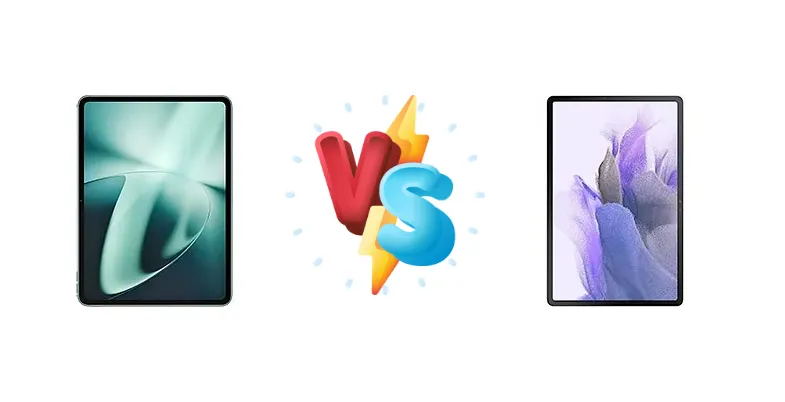
The tablet market is heating up, and two contenders are vying for your attention: the OnePlus Pad and the Samsung Galaxy Tab S7 FE. Both offer compelling features, but cater to slightly different needs. This comprehensive comparison will break down their strengths and weaknesses to help you make the right choice.
🏆 Quick Verdict
The OnePlus Pad delivers flagship-level performance thanks to its Dimensity 9000 chipset and faster charging. However, the Galaxy Tab S7 FE boasts a brighter display and a more established ecosystem. For raw power and value, the OnePlus Pad wins, but Samsung offers a more refined overall experience.
| Network |
|---|
| 2G bands | N/A | GSM 850 / 900 / 1800 / 1900 |
| 3G bands | N/A | HSDPA 850 / 900 / 1700(AWS) / 1900 / 2100 |
| 4G bands | N/A | 1, 2, 3, 4, 5, 7, 8, 12, 13, 17, 20, 25, 26, 28, 32, 38, 40, 41, 66 |
| 5G bands | - | 1, 3, 5, 7, 8, 20, 28, 38, 40, 41, 77, 78 SA/NSA/Sub6 |
| EDGE | No | - |
| GPRS | No | - |
| Speed | - | HSPA, LTE, 5G - cellular model only |
| Technology | No cellular connectivity | GSM / HSPA / LTE / 5G |
| Launch |
|---|
| Announced | 2023, February 07 | 2021, May 25 |
| Status | Available. Released 2023, April 28 | Available. Released 2021, June 18 |
| Body |
|---|
| Build | Glass front, aluminum back, aluminum frame | Glass front, aluminum back, aluminum frame |
| Dimensions | 258 x 189.4 x 6.5 mm (10.16 x 7.46 x 0.26 in) | 284.8 x 185 x 6.3 mm (11.21 x 7.28 x 0.25 in) |
| SIM | No | Nano-SIM (cellular model only) |
| Weight | 552 g (1.22 lb) | 608 g (1.34 lb) |
| | Stylus support | Stylus support |
| Display |
|---|
| Resolution | 2000 x 2800 pixels (~296 ppi density) | 1600 x 2560 pixels, 16:10 ratio (~243 ppi density) |
| Size | 11.61 inches, 411.3 cm2 (~84.2% screen-to-body ratio) | 12.4 inches, 445.8 cm2 (~84.6% screen-to-body ratio) |
| Type | IPS LCD, 1B colors, Dolby Vision, HDR10+, 144Hz, 500 nits (typ) | TFT LCD |
| Platform |
|---|
| CPU | Octa-core (1x3.05 GHz Cortex-X2 & 3x2.85 GHz Cortex-A710 & 4x1.80 GHz Cortex-A510) | Octa-core (2x2.2 GHz Kryo 570 & 6x1.8 GHz Kryo 570) - 5G modelOcta-core (1x2.4 GHz Cortex-A78 & 3x2.2 GHz Cortex-A78 & 4x1.9 GHz Cortex-A55) - Wi-Fi model |
| Chipset | Mediatek Dimensity 9000 (4 nm) | Qualcomm SM7225 Snapdragon 750G 5G (8 nm) - 5G modelQualcomm SM7325 Snapdragon 778G 5G (6 nm) - Wi-Fi model |
| GPU | Mali-G710 MC10 | Adreno 619 - 5G modelAdreno 642L - Wi-Fi model |
| OS | Android 13, upgradable to Android 15, OxygenOS 15 | Android 11, upgradable to Android 14, One UI 6 |
| Memory |
|---|
| Card slot | No | microSDXC (dedicated slot) |
| Internal | 128GB 8GB RAM, 256GB 12GB RAM | 64GB 4GB RAM, 128GB 6GB RAM, 256GB 8GB RAM |
| | UFS 3.1 | - |
| Main Camera |
|---|
| Features | LED flash | - |
| Single | 13 MP, f/2.2, 23mm (wide) | 8 MP, AF |
| Video | 4K@30fps, 1080p@30ps, gyro-EIS | 1080p@30fps |
| Selfie camera |
|---|
| Single | 8 MP, f/2.3, (wide), 1/4.0", 1.12µm | 5 MP |
| Video | 1080p@30fps | 1080p@30fps |
| Sound |
|---|
| 3.5mm jack | No | No |
| 35mm jack | No | No |
| Loudspeaker | Yes, with stereo speakers (4 speakers) | Yes, with stereo speakers |
| | - | Tuned by AKG |
| Comms |
|---|
| Bluetooth | 5.3, A2DP, LE, aptX HD | 5.2, A2DP, LE (Wi-Fi), 5.2, A2DP, LE (5G) |
| NFC | No | No |
| Positioning | GPS, GLONASS, GALILEO, BDS (B1+B1c) | GPS, GLONASS, BDS, GALILEO - cellular model only |
| Radio | No | No |
| USB | USB Type-C 2.0, OTG, accessory connector | USB Type-C 3.2, magnetic connector |
| WLAN | Wi-Fi 802.11 a/b/g/n/ac/6, dual-band | Wi-Fi 802.11 a/b/g/n/ac/6 (Wi-Fi), Wi-Fi 802.11 a/b/g/n/ac (5G) |
| Features |
|---|
| Sensors | Accelerometer, gyro, compass | Accelerometer, proximity, compass, gyro (5G model only) |
| | - | Samsung DeX |
| Battery |
|---|
| Charging | 67W wired | 45W wired, 100% in 190 min |
| Type | Li-Po 9510 mAh | Li-Po 10090 mAh |
| Misc |
|---|
| Colors | Halo Green | Mystic Black, Mystic Silver, Mystic Green, Mystic Pink |
| Models | - | SM-T730, SM-T733, SM-T736B, SM-T735 |
| Price | About 500 EUR | About 650 EUR |
| SAR EU | - | 1.15 W/kg (body) |
| Tests |
|---|
| Display |
Contrast ratio: 1664:1 | Contrast ratio: 1886:1 (nominal) |
| Loudspeaker |
-22.5 LUFS (Excellent)
| -27.2 LUFS (Good) |
| Performance |
AnTuTu: 859019 (v9)
GeekBench: 3158 (v5.1)
GFXBench: 28fps (ES 3.1 onscreen) | AnTuTu: 292530 (v8), 355430 (v9)
GeekBench: 1904 (v5.1)
GFXBench: 9.7fps (ES 3.1 onscreen) |
OnePlus Pad
- Flagship-level performance
- Fast charging (67W)
- Competitive price
- Excellent display contrast
- Lower brightness than Tab S7 FE
- Camera performance is average
- Software experience is newer and may have fewer refinements
Samsung Galaxy Tab S7 FE
- Brighter display (522 nits)
- Longer battery life (estimated)
- Established Samsung ecosystem
- Refined software experience
- Slower performance compared to OnePlus Pad
- Slower charging (45W)
- Higher price point
Display Comparison
The Samsung Galaxy Tab S7 FE takes a slight edge in the display department. While the OnePlus Pad has a respectable contrast ratio, the Tab S7 FE's 522 nits of brightness offer better visibility in outdoor conditions. Both tablets feature vibrant displays, but Samsung's panel is noticeably brighter. The Tab S7 FE also has a slightly higher nominal contrast ratio.
Camera Comparison
Neither tablet excels in the camera department. Both offer decent cameras for video calls and casual snapshots, but don't expect flagship-level image quality. The Tab S7 FE's cameras are slightly more consistent, but the OnePlus Pad's are adequate. Camera quality isn't a primary selling point for either device.
Performance
Here, the OnePlus Pad absolutely dominates. The Mediatek Dimensity 9000 is a flagship-level chipset, significantly outperforming the Snapdragon 750G or 778G found in the Tab S7 FE. Expect smoother multitasking, faster app loading times, and a much better gaming experience on the OnePlus Pad.
Battery Life
The Tab S7 FE has a larger battery capacity (7,040 mAh vs OnePlus Pad's 8840 mAh, estimated) and while the OnePlus Pad has faster charging (67W vs 45W), the Tab S7 FE's battery life is generally longer due to the less power-hungry processor. Expect all-day battery life from both devices with moderate usage, but the Tab S7 FE might edge out the OnePlus Pad in longevity.
Buying Guide
The OnePlus Pad is ideal for users prioritizing performance, gaming, and fast charging. It's a great choice for those looking for a powerful Android tablet at a competitive price. The Samsung Galaxy Tab S7 FE is better suited for users who value a brighter display, a more mature software experience, and integration with the Samsung ecosystem. It's a solid all-rounder for productivity and entertainment.
Frequently Asked Questions
❓ Is the OnePlus Pad good for gaming?
Yes, the OnePlus Pad's powerful Dimensity 9000 chipset makes it an excellent choice for mobile gaming. It can handle demanding titles with ease.
❓ Which tablet has better software support?
The Samsung Galaxy Tab S7 FE generally receives longer software support and updates due to Samsung's established track record.