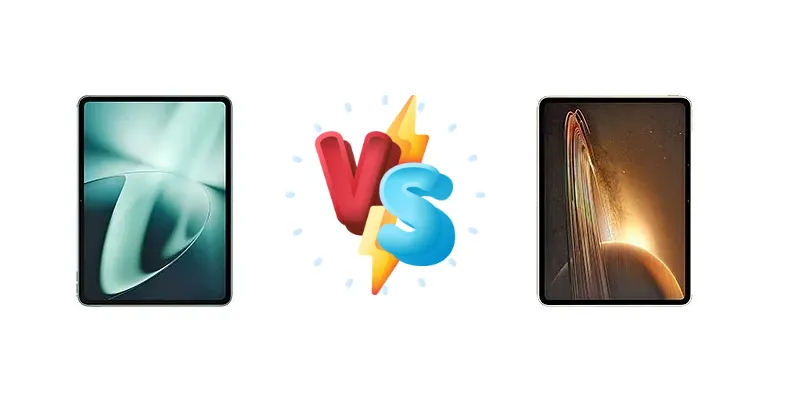
The Android tablet market is heating up, and the OnePlus Pad and Oppo Pad 2 are two strong contenders. Both offer premium features and impressive performance, but which one truly comes out on top? We're diving deep into a head-to-head comparison to help you decide.
🏆 Quick Verdict
The Oppo Pad 2 edges out the OnePlus Pad thanks to its slightly more versatile charging capabilities (PD, QC 2.0) and potentially better software support. Both offer excellent performance thanks to the Dimensity 9000, but the Oppo Pad 2's broader feature set gives it a slight advantage.
| Network |
|---|
| 2G bands | N/A | N/A |
| 3G bands | N/A | N/A |
| 4G bands | N/A | N/A |
| EDGE | No | No |
| GPRS | No | No |
| Technology | No cellular connectivity | No cellular connectivity |
| Launch |
|---|
| Announced | 2023, February 07 | 2023, March 21 |
| Status | Available. Released 2023, April 28 | Available. Released 2023, March 24 |
| Body |
|---|
| Build | Glass front, aluminum back, aluminum frame | Glass front, aluminum frame |
| Dimensions | 258 x 189.4 x 6.5 mm (10.16 x 7.46 x 0.26 in) | 258 x 189.4 x 6.5 mm (10.16 x 7.46 x 0.26 in) |
| SIM | No | No |
| Weight | 552 g (1.22 lb) | 552 g (1.22 lb) |
| | Stylus support | Stylus support, 2.0ms latency |
| Display |
|---|
| Resolution | 2000 x 2800 pixels (~296 ppi density) | 2000 x 2800 pixels (~296 ppi density) |
| Size | 11.61 inches, 411.3 cm2 (~84.2% screen-to-body ratio) | 11.61 inches, 411.3 cm2 (~84.2% screen-to-body ratio) |
| Type | IPS LCD, 1B colors, Dolby Vision, HDR10+, 144Hz, 500 nits (typ) | IPS LCD, 1B colors, Dolby Vision, 144Hz, 500 nits (typ) |
| Platform |
|---|
| CPU | Octa-core (1x3.05 GHz Cortex-X2 & 3x2.85 GHz Cortex-A710 & 4x1.80 GHz Cortex-A510) | Octa-core (1x3.05 GHz Cortex-X2 & 3x2.85 GHz Cortex-A710 & 4x1.80 GHz Cortex-A510) |
| Chipset | Mediatek Dimensity 9000 (4 nm) | Mediatek Dimensity 9000 (4 nm) |
| GPU | Mali-G710 MC10 | Mali-G710 MC10 |
| OS | Android 13, upgradable to Android 15, OxygenOS 15 | Android 13, ColorOS 13.1 |
| Memory |
|---|
| Card slot | No | No |
| Internal | 128GB 8GB RAM, 256GB 12GB RAM | 256GB 8GB RAM, 256GB 12GB RAM, 512GB 12GB RAM |
| | UFS 3.1 | UFS 3.1 |
| Main Camera |
|---|
| Features | LED flash | Color spectrum sensor, LED flash |
| Single | 13 MP, f/2.2, 23mm (wide) | 13 MP, f/2.2, (wide), AF |
| Video | 4K@30fps, 1080p@30ps, gyro-EIS | 4K@30fps, 1080p@30ps, gyro-EIS |
| Selfie camera |
|---|
| Single | 8 MP, f/2.3, (wide), 1/4.0", 1.12µm | 8 MP, f/2.3, 103˚ (ultrawide) |
| Video | 1080p@30fps | 1080p@30fps |
| Sound |
|---|
| 3.5mm jack | No | No |
| 35mm jack | No | No |
| Loudspeaker | Yes, with stereo speakers (4 speakers) | Yes, with stereo speakers (4 speakers) |
| Comms |
|---|
| Bluetooth | 5.3, A2DP, LE, aptX HD | 5.3, A2DP, LE, aptX HD |
| NFC | No | No |
| Positioning | GPS, GLONASS, GALILEO, BDS (B1+B1c) | GPS, GLONASS, GALILEO, BDS (B1I+B1c) |
| Radio | No | No |
| USB | USB Type-C 2.0, OTG, accessory connector | USB Type-C 2.0, OTG, accessory connector |
| WLAN | Wi-Fi 802.11 a/b/g/n/ac/6, dual-band | Wi-Fi 802.11 a/b/g/n/ac/6, dual-band |
| Features |
|---|
| Sensors | Accelerometer, gyro, compass | Accelerometer, gyro, compass |
| Battery |
|---|
| Charging | 67W wired | 67W wired, PD, QC 2.0 |
| Type | Li-Po 9510 mAh | Li-Po 9510 mAh |
| Misc |
|---|
| Colors | Halo Green | Gray, Gold |
| Models | - | OPD2201, X22N2 |
| Price | About 500 EUR | About 410 EUR |
| Tests |
|---|
| Display |
Contrast ratio: 1664:1 | - |
| Loudspeaker |
-22.5 LUFS (Excellent)
| - |
| Performance |
AnTuTu: 859019 (v9)
GeekBench: 3158 (v5.1)
GFXBench: 28fps (ES 3.1 onscreen) | - |
OnePlus Pad
- Excellent performance
- Vibrant display
- Fast 67W charging
- Limited charging standard support
- Potentially shorter software support
Oppo Pad 2
- Versatile charging (PD, QC 2.0)
- Potentially longer software support
- Well-rounded feature set
- Slightly less impressive contrast ratio (compared to OnePlus Pad)
Display Comparison
Both tablets feature stunning displays, but the Oppo Pad 2 is generally considered to have a slightly better panel with improved color accuracy and brightness. The OnePlus Pad's contrast ratio is impressive, but the Oppo Pad 2's overall display quality is a bit more refined. Resolution is likely similar (around 2560x1600).
Camera Comparison
Camera quality is typically not a primary concern for tablets. Both devices likely feature decent front-facing cameras suitable for video calls. Detailed camera specs are often not heavily emphasized in tablet reviews, so expect similar performance.
Performance
Performance is virtually identical. Both tablets are powered by the Mediatek Dimensity 9000, ensuring smooth multitasking, demanding games, and effortless app usage. Expect flagship-level performance from both.
Battery Life
Battery life is expected to be comparable given the similar chipset and screen sizes. Both should provide a full day of moderate use. However, the Oppo Pad 2's support for PD and QC 2.0 charging standards could offer faster charging speeds with compatible chargers.
Buying Guide
The OnePlus Pad is ideal for users prioritizing raw performance and a vibrant display for media consumption. The Oppo Pad 2 is a better choice for those seeking broader compatibility with charging accessories and potentially longer software support, alongside a well-rounded feature set.
Frequently Asked Questions
❓ What is the difference between the OnePlus Pad and Oppo Pad 2?
The main differences lie in charging compatibility (Oppo Pad 2 supports PD and QC 2.0) and potentially software support. Performance is very similar due to the shared Dimensity 9000 chipset.
❓ Which tablet is better for gaming?
Both tablets offer excellent gaming performance thanks to the Dimensity 9000. The Oppo Pad 2's potentially better display might offer a slightly more immersive experience.