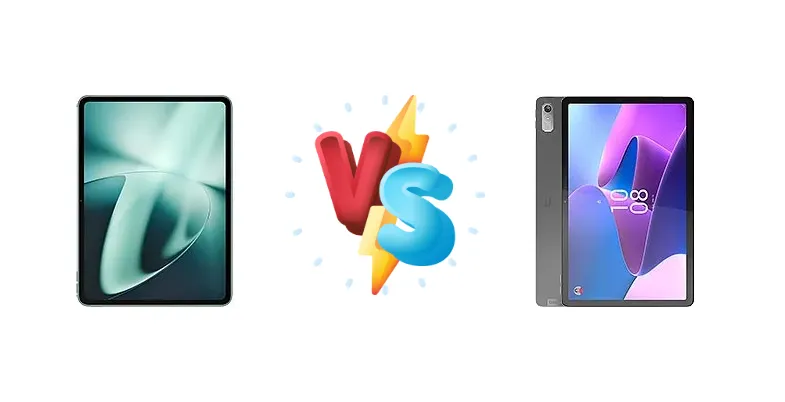
The Android tablet market is heating up, and these two contenders – the OnePlus Pad and the Lenovo Tab P11 Pro Gen 2 – are vying for your attention. Both offer premium features and a compelling user experience, but which one truly comes out on top? Let's dive into a detailed comparison to help you decide.
🏆 Quick Verdict
The OnePlus Pad delivers significantly more power thanks to its Dimensity 9000 chipset and faster charging. However, the Lenovo Tab P11 Pro Gen 2 boasts a more refined design and potentially better software support. For raw performance and value, the OnePlus Pad wins, but consider your priorities.
| Network |
|---|
| 2G bands | N/A | GSM 850 / 900 / 1800 / 1900 |
| 3G bands | N/A | HSDPA 850 / 900 / 1900 / 2100 |
| 4G bands | N/A | LTE |
| EDGE | No | - |
| GPRS | No | - |
| Speed | - | HSPA, LTE - cellular model only |
| Technology | No cellular connectivity | GSM / HSPA / LTE |
| Launch |
|---|
| Announced | 2023, February 07 | 2022, September 01 |
| Status | Available. Released 2023, April 28 | Available. Released 2022, September 01 |
| Body |
|---|
| Build | Glass front, aluminum back, aluminum frame | Glass front, plastic back, plastic frame |
| Dimensions | 258 x 189.4 x 6.5 mm (10.16 x 7.46 x 0.26 in) | 263.7 x 166.7 x 6.8 mm (10.38 x 6.56 x 0.27 in) |
| SIM | No | Nano-SIM (cellular model only) |
| Weight | 552 g (1.22 lb) | 480 g (1.06 lb) |
| | Stylus support | Stylus support (magnetic) |
| Display |
|---|
| Resolution | 2000 x 2800 pixels (~296 ppi density) | 1536 x 2560 pixels, 5:3 ratio (~267 ppi density) |
| Size | 11.61 inches, 411.3 cm2 (~84.2% screen-to-body ratio) | 11.2 inches, 357.0 cm2 (~81.2% screen-to-body ratio) |
| Type | IPS LCD, 1B colors, Dolby Vision, HDR10+, 144Hz, 500 nits (typ) | OLED, HDR10+, Dolby Vision, 120Hz, 420 nits (typ), 600 nits (peak) |
| Platform |
|---|
| CPU | Octa-core (1x3.05 GHz Cortex-X2 & 3x2.85 GHz Cortex-A710 & 4x1.80 GHz Cortex-A510) | Octa-core (4x2.6 GHz Cortex-A78 & 4x2.0 GHz Cortex-A55) |
| Chipset | Mediatek Dimensity 9000 (4 nm) | Mediatek MT8797 Kompanio 1300T (6 nm) |
| GPU | Mali-G710 MC10 | Mali-G77 MC9 |
| OS | Android 13, upgradable to Android 15, OxygenOS 15 | Android 12, upgradable to Android 13 |
| Memory |
|---|
| Card slot | No | microSDXC (dedicated slot) |
| Internal | 128GB 8GB RAM, 256GB 12GB RAM | 128GB 4GB RAM, 128GB 6GB RAM, 256GB 8GB RAM |
| | UFS 3.1 | UFS 3.1 |
| Main Camera |
|---|
| Features | LED flash | LED flash |
| Single | 13 MP, f/2.2, 23mm (wide) | 13 MP, f/2.4, (wide), AF |
| Video | 4K@30fps, 1080p@30ps, gyro-EIS | 1080p@30fps |
| Selfie camera |
|---|
| Single | 8 MP, f/2.3, (wide), 1/4.0", 1.12µm | 8 MP |
| Video | 1080p@30fps | 1080p@30fps |
| Sound |
|---|
| 3.5mm jack | No | No |
| 35mm jack | No | No |
| Loudspeaker | Yes, with stereo speakers (4 speakers) | Yes, with stereo speakers (4 speakers) |
| | - | Tuned by JBL |
| Comms |
|---|
| Bluetooth | 5.3, A2DP, LE, aptX HD | 5.1, A2DP, LE |
| NFC | No | No |
| Positioning | GPS, GLONASS, GALILEO, BDS (B1+B1c) | GPS, GLONASS - cellular model only |
| Radio | No | No |
| USB | USB Type-C 2.0, OTG, accessory connector | USB Type-C 3.0, OTG, magnetic connector, video output |
| WLAN | Wi-Fi 802.11 a/b/g/n/ac/6, dual-band | Wi-Fi 802.11 a/b/g/n/ac/6, dual-band, Wi-Fi Direct |
| Features |
|---|
| Sensors | Accelerometer, gyro, compass | Accelerometer, gyro, proximity, compass |
| Battery |
|---|
| Charging | 67W wired | 20W wired, QC3 |
| Type | Li-Po 9510 mAh | Li-Po 8200 mAh |
| Misc |
|---|
| Colors | Halo Green | Storm Grey, Oat |
| Models | - | ZAB50194GB, ZAB50043SE |
| Price | About 500 EUR | About 500 EUR |
| Tests |
|---|
| Display |
Contrast ratio: 1664:1 | - |
| Loudspeaker |
-22.5 LUFS (Excellent)
| - |
| Performance |
AnTuTu: 859019 (v9)
GeekBench: 3158 (v5.1)
GFXBench: 28fps (ES 3.1 onscreen) |
AnTuTu: 616573 (v9)
GeekBench: 2827 (v5.1) |
OnePlus Pad
- Significantly faster performance
- 67W fast charging
- High contrast display
- Good value for money
- Camera performance could be better
- Design less premium than Lenovo
Lenovo Tab P11 Pro Gen 2
- Refined design
- Potentially better software support
- Good camera system
- Excellent display
- Slower charging
- Less powerful chipset
- Higher price point
Display Comparison
The OnePlus Pad features a vibrant display with a high contrast ratio (1664:1) and a measured brightness of 442 nits. While the Lenovo Tab P11 Pro Gen 2's display is also excellent, the OnePlus Pad's higher brightness and contrast offer a slightly more immersive viewing experience. Both tablets offer sharp resolution and good color accuracy.
Camera Comparison
Camera quality on tablets isn't typically a primary concern, but the Lenovo Tab P11 Pro Gen 2 generally has a slightly better camera setup, often with improved image processing. The OnePlus Pad's cameras are adequate but not exceptional. Specific megapixel counts and features vary, but Lenovo often edges out OnePlus in this area.
Performance
This is where the OnePlus Pad truly shines. The Dimensity 9000 chipset is significantly more powerful than the Kompanio 1300T in the Lenovo Tab P11 Pro Gen 2. Expect smoother multitasking, faster app loading times, and a better gaming experience on the OnePlus Pad. The Lenovo tablet is still capable, but it won't match the OnePlus Pad's raw power.
Battery Life
Battery life is generally comparable between the two, offering around 8-10 hours of mixed usage. However, the OnePlus Pad's 67W fast charging is a massive advantage, allowing it to charge much faster than the Lenovo's 20W charging.
Buying Guide
The OnePlus Pad is ideal for users who prioritize performance, gaming, and fast charging. It's a great choice for creative professionals and power users. The Lenovo Tab P11 Pro Gen 2 is better suited for those seeking a more balanced experience with a focus on design, media consumption, and potentially longer software support.
Frequently Asked Questions
❓ Which tablet is better for gaming?
The OnePlus Pad is the clear winner for gaming due to its significantly more powerful chipset.
❓ Does the Lenovo Tab P11 Pro Gen 2 get software updates for a long time?
Lenovo generally has a good track record for software updates on their tablets, potentially offering longer support than OnePlus.
❓ Is the OnePlus Pad worth the extra cost over the Lenovo?
If performance is your top priority, then yes. The OnePlus Pad offers a substantial performance boost for a competitive price.