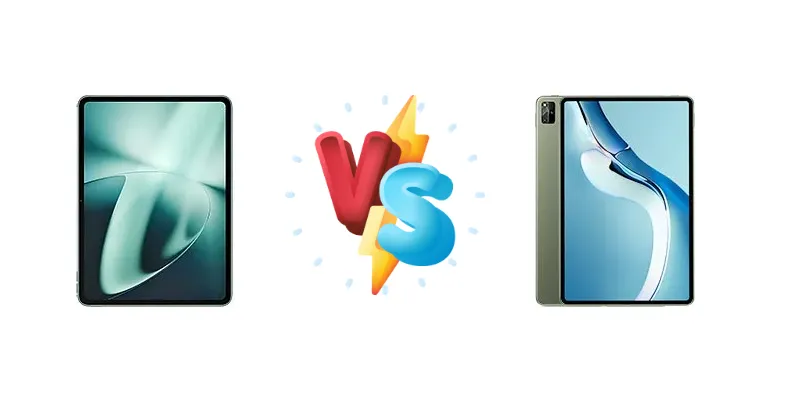
The Android tablet market is seeing a resurgence, and the OnePlus Pad and Huawei MatePad Pro 12.6 (2021) represent compelling options at different price points and with distinct philosophies. The OnePlus Pad arrives as a newcomer aiming for a balance of performance and value, while the Huawei MatePad Pro 12.6, though older, boasts a larger display and Huawei’s established tablet ecosystem. This comparison dives deep into the specifications and real-world implications of each device.
🏆 Quick Verdict
For most users, the OnePlus Pad emerges as the better choice. Its newer Dimensity 9000 chipset provides a significant performance advantage, and the 67W charging is substantially faster than Huawei’s 40W offering. While the MatePad Pro 12.6 has a larger screen, the OnePlus Pad’s brightness and modern processor make it more versatile.
| Network |
|---|
| 2G bands | N/A | GSM 850 / 900 / 1800 / 1900 |
| 3G bands | N/A | HSDPA 800 / 850 / 900 / 1700(AWS) / 1900 / 2100 |
| 4G bands | N/A | 1, 2, 3, 4, 5, 7, 8, 9, 12, 17, 18, 19, 20, 26, 28, 32, 34, 38, 39, 40, 41, 42, 66 |
| 5G bands | - | 1, 3, 5, 7, 8, 28, 38, 40, 41, 66, 77, 78, 79, 80, 84 SA/NSA |
| EDGE | No | - |
| GPRS | No | - |
| Speed | - | HSPA, LTE, 5G - cellular model only |
| Technology | No cellular connectivity | GSM / HSPA / LTE / 5G |
| Launch |
|---|
| Announced | 2023, February 07 | 2021, June 02 |
| Status | Available. Released 2023, April 28 | Available. Released 2021, June 25 |
| Body |
|---|
| Build | Glass front, aluminum back, aluminum frame | - |
| Dimensions | 258 x 189.4 x 6.5 mm (10.16 x 7.46 x 0.26 in) | 286.5 x 184.7 x 6.7 mm (11.28 x 7.27 x 0.26 in) |
| SIM | No | Nano-SIM (cellular model only) |
| Weight | 552 g (1.22 lb) | 609 g (1.34 lb) |
| | Stylus support | - |
| Display |
|---|
| Resolution | 2000 x 2800 pixels (~296 ppi density) | 2560 x 1600 pixels, 16:10 ratio (~240 ppi density) |
| Size | 11.61 inches, 411.3 cm2 (~84.2% screen-to-body ratio) | 12.6 inches, 460.3 cm2 (~87.0% screen-to-body ratio) |
| Type | IPS LCD, 1B colors, Dolby Vision, HDR10+, 144Hz, 500 nits (typ) | OLED |
| Platform |
|---|
| CPU | Octa-core (1x3.05 GHz Cortex-X2 & 3x2.85 GHz Cortex-A710 & 4x1.80 GHz Cortex-A510) | Octa-core (1x3.13 GHz Cortex-A77 & 3x2.54 GHz Cortex-A77 & 4x2.05 GHz Cortex-A55) |
| Chipset | Mediatek Dimensity 9000 (4 nm) | Kirin 9000E 5G (5 nm) - Wi-Fi modelKirin 9000 5G (5 nm) - 5G model |
| GPU | Mali-G710 MC10 | Mali-G78 MP22 - Wi-Fi modelMali-G78 MP24 - 5G model |
| OS | Android 13, upgradable to Android 15, OxygenOS 15 | HarmonyOS 2.0 |
| Memory |
|---|
| Card slot | No | Nano Memory (dedicated slot) |
| Internal | 128GB 8GB RAM, 256GB 12GB RAM | 128GB 8GB RAM, 256GB 4GB RAM, 256GB 8GB RAM, 256GB 12GB RAM, 512GB 12GB RAM |
| | UFS 3.1 | - |
| Main Camera |
|---|
| Dual | - | 13 MP, f/1.8, (wide), PDAF
8 MP, f/2.4, (ultrawide)
TOF 3D |
| Features | LED flash | LED flash, HDR, panorama |
| Single | 13 MP, f/2.2, 23mm (wide) | - |
| Video | 4K@30fps, 1080p@30ps, gyro-EIS | 4K@30fps, 1080p@30fps |
| Selfie camera |
|---|
| Single | 8 MP, f/2.3, (wide), 1/4.0", 1.12µm | 8 MP, f/2.0 |
| Video | 1080p@30fps | 1080p@30fps |
| Sound |
|---|
| 3.5mm jack | No | No |
| 35mm jack | No | No |
| Loudspeaker | Yes, with stereo speakers (4 speakers) | Yes, with stereo speakers (8 speakers) |
| Comms |
|---|
| Bluetooth | 5.3, A2DP, LE, aptX HD | 5.2, A2DP, LE |
| NFC | No | No |
| Positioning | GPS, GLONASS, GALILEO, BDS (B1+B1c) | GPS, GLONASS, BDS, GALILEO, QZSS - cellular model only |
| Radio | No | No |
| USB | USB Type-C 2.0, OTG, accessory connector | USB Type-C 3.1, OTG |
| WLAN | Wi-Fi 802.11 a/b/g/n/ac/6, dual-band | Wi-Fi 802.11 a/b/g/n/ac/6, dual-band, Wi-Fi Direct |
| Features |
|---|
| Sensors | Accelerometer, gyro, compass | Accelerometer, gyro, proximity, compass |
| Battery |
|---|
| Charging | 67W wired | 40W wired
27W wireless
10W wireless reversed
5W reverse wired |
| Type | Li-Po 9510 mAh | Li-Po 10,050 mAh |
| Misc |
|---|
| Colors | Halo Green | Matte Gray, Green, Silver |
| Models | - | WGR-W09, WGR-W19, WGR-AN19 |
| Price | About 500 EUR | About 800 EUR |
| Tests |
|---|
| Display |
Contrast ratio: 1664:1 |
Contrast ratio: Infinite (nominal) |
| Loudspeaker |
-22.5 LUFS (Excellent)
|
-23.1 LUFS (Very good)
|
| Performance |
AnTuTu: 859019 (v9)
GeekBench: 3158 (v5.1)
GFXBench: 28fps (ES 3.1 onscreen) | - |
OnePlus Pad
- Faster 67W charging
- More powerful Dimensity 9000 chipset
- Brighter display for outdoor use
- Smaller display size compared to Huawei
- Limited ecosystem integration compared to Huawei
Huawei MatePad Pro 12.6 (2021)
- Larger 12.6-inch display
- Wireless charging capabilities
- Potential for seamless Huawei ecosystem integration
- Slower 40W wired charging
- Older Kirin 9000E/9000 chipset
- Lower peak display brightness
Display Comparison
The Huawei MatePad Pro 12.6 (2021) features a larger display, but the OnePlus Pad counters with superior contrast and brightness. The MatePad Pro boasts an 'Infinite' contrast ratio (nominal), suggesting excellent black levels, but this is often marketing hyperbole. Measured at 382 nits, its peak brightness falls short of the OnePlus Pad’s 442 nits, making the OnePlus Pad more usable in bright environments. Furthermore, the OnePlus Pad’s 1195:1 contrast ratio is significantly lower than the MatePad Pro's, indicating deeper blacks and a more vibrant image. While both lack explicitly stated refresh rates, the OnePlus Pad's display technology is likely more modern, potentially offering smoother scrolling and animations.
Camera Comparison
Neither tablet excels in the camera department, but details are sparse. Given the focus on tablet use cases, camera quality isn't a primary concern. We can assume both tablets feature adequate cameras for video conferencing and casual snapshots. Without specific sensor details, it’s difficult to make a meaningful comparison. The absence of detailed camera specs suggests neither device is positioned as a photography powerhouse.
Performance
The performance gap is substantial. The OnePlus Pad’s Mediatek Dimensity 9000 (4nm) is a generation ahead of the Huawei MatePad Pro 12.6’s Kirin 9000E 5G (5nm) or Kirin 9000 (5nm). The Dimensity 9000’s Cortex-X2 core, clocked at 3.05 GHz, provides a significant single-core performance boost over the MatePad Pro’s Cortex-A77 core at 3.13 GHz. The Dimensity 9000’s more efficient 4nm process also translates to better thermal management, reducing the likelihood of performance throttling during extended gaming sessions. The MatePad Pro’s older architecture, while still capable, will struggle to keep pace with demanding applications.
Battery Life
The OnePlus Pad’s 67W wired charging is a clear advantage over the Huawei MatePad Pro 12.6’s 40W wired charging. This translates to significantly faster charging times, getting you back up and running quicker. The MatePad Pro offers 27W and 10W wireless charging, along with 5W reverse wired charging, providing flexibility, but these speeds are still slower than the OnePlus Pad’s wired charging. While battery capacity isn’t specified for either device, the faster charging of the OnePlus Pad mitigates any potential capacity disadvantage.
Buying Guide
Buy the OnePlus Pad if you prioritize performance for gaming and multitasking, and value faster charging speeds. It’s ideal for users who consume a lot of media and want a responsive tablet experience. Buy the Huawei MatePad Pro 12.6 (2021) if a larger display is paramount for productivity tasks like document editing or creative work, and you’re already invested in the Huawei ecosystem, potentially benefiting from features like seamless multi-device collaboration.
Frequently Asked Questions
❓ Does the Kirin 9000E/9000 chipset in the Huawei MatePad Pro 12.6 (2021) struggle with demanding games?
Yes, the Kirin 9000E/9000, while capable, is a generation behind the Dimensity 9000 in the OnePlus Pad. Expect lower frame rates and potential throttling in graphically intensive games, especially over extended periods. The Dimensity 9000’s more efficient 4nm process and newer architecture provide a significant advantage in sustained performance.
❓ How much faster is the 67W charging on the OnePlus Pad compared to the 40W charging on the Huawei MatePad Pro 12.6 (2021)?
The 67W charging on the OnePlus Pad will significantly reduce charging times. While exact figures depend on battery capacity (which isn't specified for either device), you can expect a 0-100% charge to be considerably quicker on the OnePlus Pad – potentially shaving off 30-60 minutes compared to the Huawei MatePad Pro 12.6.
❓ Is the larger display of the Huawei MatePad Pro 12.6 (2021) worth sacrificing performance for?
That depends on your primary use case. If you heavily rely on multitasking with multiple windows, document editing, or creative applications where screen real estate is crucial, the larger display might be beneficial. However, for general media consumption, gaming, and everyday tasks, the OnePlus Pad’s performance advantage will likely be more noticeable.