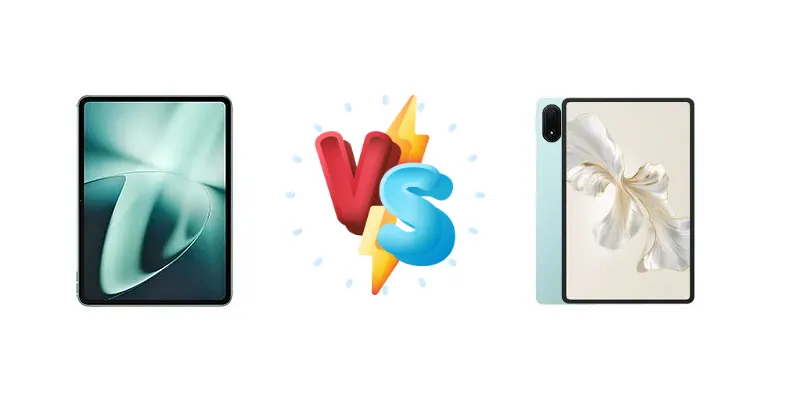
The Android tablet market is heating up, with the OnePlus Pad and Honor Pad 9 Pro offering compelling alternatives to the iPad. Both aim for a premium experience without the premium price tag, but they take different approaches. The OnePlus Pad leverages the power of the Dimensity 9000, while the Honor Pad 9 Pro opts for the Dimensity 8100. This comparison dives deep into the specifics to determine which tablet delivers the best value and performance.
🏆 Quick Verdict
For most users, the OnePlus Pad emerges as the stronger choice. Its Dimensity 9000 chipset provides a noticeable performance edge, and its higher measured peak brightness of 442 nits makes it more usable in bright environments. While the Honor Pad 9 Pro offers a respectable experience, the OnePlus Pad’s superior processing power justifies the price difference.
| Network |
|---|
| 2G bands | N/A | N/A |
| 3G bands | N/A | N/A |
| 4G bands | N/A | - |
| EDGE | No | No |
| GPRS | No | No |
| Technology | No cellular connectivity | No cellular connectivity |
| Launch |
|---|
| Announced | 2023, February 07 | 2024, July 12 |
| Status | Available. Released 2023, April 28 | Available. Released 2024, July 12 |
| Body |
|---|
| Build | Glass front, aluminum back, aluminum frame | Glass front, aluminum frame, aluminum back |
| Dimensions | 258 x 189.4 x 6.5 mm (10.16 x 7.46 x 0.26 in) | 277 x 179.9 x 6.6 mm (10.91 x 7.08 x 0.26 in) |
| SIM | No | No |
| Weight | 552 g (1.22 lb) | 589 g (1.30 lb) |
| | Stylus support | - |
| Display |
|---|
| Resolution | 2000 x 2800 pixels (~296 ppi density) | 1600 x 2560 pixels, 16:10 ratio (~249 ppi density) |
| Size | 11.61 inches, 411.3 cm2 (~84.2% screen-to-body ratio) | 12.1 inches, 424.5 cm2 (~85.2% screen-to-body ratio) |
| Type | IPS LCD, 1B colors, Dolby Vision, HDR10+, 144Hz, 500 nits (typ) | IPS LCD, 1B colors, 144Hz |
| Platform |
|---|
| CPU | Octa-core (1x3.05 GHz Cortex-X2 & 3x2.85 GHz Cortex-A710 & 4x1.80 GHz Cortex-A510) | Octa-core (4x2.85 GHz Cortex-A78 & 4x2.0 GHz Cortex-A55) |
| Chipset | Mediatek Dimensity 9000 (4 nm) | Mediatek Dimensity 8100 (5 nm) |
| GPU | Mali-G710 MC10 | Mali-G610 MC6 |
| OS | Android 13, upgradable to Android 15, OxygenOS 15 | Android 14, Magic OS 8.1 |
| Memory |
|---|
| Card slot | No | No |
| Internal | 128GB 8GB RAM, 256GB 12GB RAM | 256GB 12GB RAM, 256GB 8GB RAM |
| | UFS 3.1 | - |
| Main Camera |
|---|
| Features | LED flash | HDR |
| Single | 13 MP, f/2.2, 23mm (wide) | 13 MP, f/2.0, (wide), AF |
| Video | 4K@30fps, 1080p@30ps, gyro-EIS | 4K@30fps, 1080p@30fps |
| Selfie camera |
|---|
| Single | 8 MP, f/2.3, (wide), 1/4.0", 1.12µm | 5 MP, f/2.2, (wide) |
| Video | 1080p@30fps | 1080p@30fps |
| Sound |
|---|
| 3.5mm jack | No | - |
| 35mm jack | No | No |
| Loudspeaker | Yes, with stereo speakers (4 speakers) | Yes, with stereo speakers (8 speakers) |
| Comms |
|---|
| Bluetooth | 5.3, A2DP, LE, aptX HD | 5.2, A2DP, LE |
| NFC | No | No |
| Positioning | GPS, GLONASS, GALILEO, BDS (B1+B1c) | No |
| Radio | No | No |
| USB | USB Type-C 2.0, OTG, accessory connector | USB Type-C 2.0, OTG |
| WLAN | Wi-Fi 802.11 a/b/g/n/ac/6, dual-band | Wi-Fi 802.11 a/b/g/n/ac/6, dual-band, Wi-Fi Direct |
| Features |
|---|
| Sensors | Accelerometer, gyro, compass | Accelerometer |
| Battery |
|---|
| Charging | 67W wired | 35W wired |
| Type | Li-Po 9510 mAh | Li-Po 10050 mAh |
| Misc |
|---|
| Colors | Halo Green | Sky Blue, Star Gray |
| Price | About 500 EUR | About 290 EUR |
| Tests |
|---|
| Display |
Contrast ratio: 1664:1 | - |
| Loudspeaker |
-22.5 LUFS (Excellent)
| - |
| Performance |
AnTuTu: 859019 (v9)
GeekBench: 3158 (v5.1)
GFXBench: 28fps (ES 3.1 onscreen) | - |
OnePlus Pad
- Superior performance with Dimensity 9000
- Faster 67W charging
- Higher peak display brightness (442 nits)
- Potentially higher price
- Battery capacity not specified
Honor Pad 9 Pro
- More efficient Dimensity 8100 chipset
- Potentially lower price
- Sleek design (based on Honor's brand aesthetic)
- Slower 35W charging
- Lower peak display brightness (1195:1 contrast)
Display Comparison
The OnePlus Pad boasts a contrast ratio of 1664:1, significantly higher than the Honor Pad 9 Pro’s 1195:1, suggesting deeper blacks and a more dynamic image. More importantly, the OnePlus Pad achieves a measured peak brightness of 442 nits, crucial for outdoor visibility. While both likely utilize IPS LCD panels (based on market positioning), the OnePlus Pad’s superior brightness gives it a clear advantage for users who frequently use their tablets in well-lit conditions. Details regarding refresh rate and resolution are missing, but both are expected to be standard for this price range.
Camera Comparison
Given the tablet form factor, camera performance isn't a primary concern. However, details are lacking for both devices. We can assume both will feature a main camera and potentially an ultrawide, but sensor sizes and image processing capabilities are unknown. Without further information, it’s difficult to declare a winner. The inclusion of OIS (Optical Image Stabilization) would be a significant advantage, but this is unconfirmed for either device.
Performance
The core difference lies in the chipsets. The OnePlus Pad’s MediaTek Dimensity 9000, fabricated on a 4nm process, offers a substantial performance uplift over the Honor Pad 9 Pro’s Dimensity 8100 (5nm). The Dimensity 9000’s CPU configuration – a Cortex-X2 prime core alongside three Cortex-A710 performance cores and four Cortex-A510 efficiency cores – is architecturally superior to the Honor Pad 9 Pro’s four Cortex-A78 and four Cortex-A55 setup. This translates to faster application loading, smoother multitasking, and better sustained performance during graphically intensive games. The 4nm process also contributes to improved thermal efficiency, potentially reducing throttling under heavy load.
Battery Life
The OnePlus Pad features 67W wired charging, a significant advantage over the Honor Pad 9 Pro’s 35W charging. This means the OnePlus Pad will replenish its battery much faster, minimizing downtime. While battery capacity isn’t specified for either device, the faster charging speed of the OnePlus Pad mitigates any potential disadvantage from a slightly smaller battery. Expect a full charge on the OnePlus Pad in under an hour, while the Honor Pad 9 Pro will likely take considerably longer.
Buying Guide
Buy the OnePlus Pad if you prioritize raw performance for demanding tasks like gaming or video editing, and value a brighter, more vibrant display for media consumption. Buy the Honor Pad 9 Pro if you’re looking for a well-rounded tablet experience with a focus on efficiency and a slightly more conservative price point, and don't anticipate pushing the hardware to its absolute limits.
Frequently Asked Questions
❓ Does the Dimensity 8100 in the Honor Pad 9 Pro struggle with demanding games like Genshin Impact?
While the Dimensity 8100 is a capable chipset, it's likely to exhibit more frame drops and require lower graphics settings in demanding titles like Genshin Impact compared to the OnePlus Pad's Dimensity 9000. The 9000's superior CPU and GPU architecture provide a more comfortable gaming experience.
❓ How long does it realistically take to fully charge the OnePlus Pad with its 67W charging?
Based on similar devices with 67W charging, expect the OnePlus Pad to go from 0% to 100% in approximately 50-60 minutes. This is a significant improvement over the Honor Pad 9 Pro's 35W charging, which will likely take over 90 minutes.
❓ Is the contrast ratio difference between the OnePlus Pad and Honor Pad 9 Pro noticeable in everyday use?
Yes, the 1664:1 contrast ratio on the OnePlus Pad will result in deeper blacks and a more visually appealing image, especially when viewing content with dark scenes. The 1195:1 ratio on the Honor Pad 9 Pro will still be acceptable, but the difference will be noticeable side-by-side.