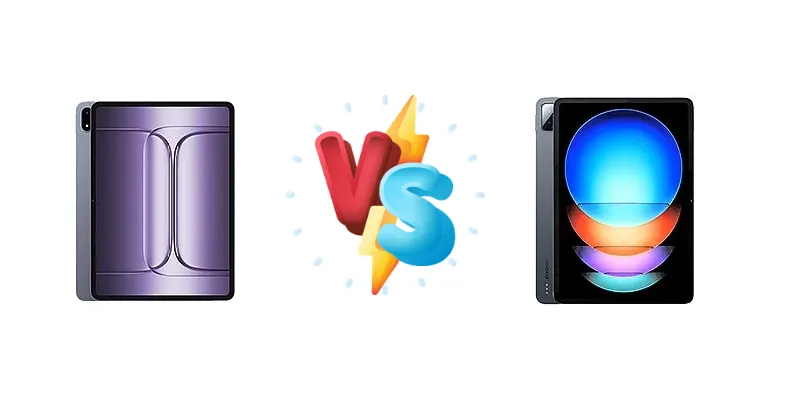
The Android tablet market is heating up, with both OnePlus and Xiaomi delivering premium experiences. The OnePlus Pad 3 arrives with the cutting-edge Snapdragon 8 Elite, promising raw performance, while the Xiaomi Pad 6S Pro 12.4 leverages the established Snapdragon 8 Gen 2 and focuses on a refined user experience with faster charging and a high-quality display. This comparison dissects the key differences to determine which tablet reigns supreme.
🏆 Quick Verdict
For the average user prioritizing a balance of features, the Xiaomi Pad 6S Pro 12.4 emerges as the stronger choice. Its significantly faster 120W charging and brighter, higher-contrast display offset the OnePlus Pad 3’s slight CPU advantage. However, power users demanding maximum CPU throughput will find the OnePlus Pad 3 compelling.
| Network |
|---|
| 2G bands | N/A | N/A |
| 3G bands | N/A | N/A |
| 4G bands | N/A | - |
| EDGE | No | N/A |
| GPRS | No | N/A |
| Technology | No cellular connectivity | No cellular connectivity |
| Launch |
|---|
| Announced | 2025, June 05 | 2024, February 22 |
| Status | Available. Released 2025, June 19 | Available. Released 2024, February 22 |
| Body |
|---|
| Build | Glass front, aluminum frame, aluminum back | Glass front (Gorilla Glass 5), aluminum frame, aluminum back |
| Dimensions | 289.6 x 209.7 x 6 mm (11.40 x 8.26 x 0.24 in) | 278.7 x 191.6 x 6.3 mm (10.97 x 7.54 x 0.25 in) |
| SIM | No | No |
| Weight | 675 g (1.49 lb) | 590 g (1.30 lb) |
| Display |
|---|
| Protection | - | Corning Gorilla Glass 5 |
| Resolution | 2400 x 3392 pixels (~315 ppi density) | 2032 x 3048 pixels, 3:2 ratio (~295 ppi density) |
| Size | 13.2 inches, 530.0 cm2 (~87.3% screen-to-body ratio) | 12.4 inches, 457.8 cm2 (~85.7% screen-to-body ratio) |
| Type | IPS LCD, 68B colors, Dolby Vision, 144Hz, 900 nits (HBM) | IPS LCD, 68B colors, 144Hz, HDR10, Dolby Vision, 900 nits (peak) |
| Platform |
|---|
| CPU | Octa-core (2x4.32 GHz Oryon V2 Phoenix L + 6x3.53 GHz Oryon V2 Phoenix M) | Octa-core (1x3.2 GHz Cortex-X3 & 2x2.8 GHz Cortex-A715 & 2x2.8 GHz Cortex-A710 & 3x2.0 GHz Cortex-A510) |
| Chipset | Qualcomm SM8750-AB Snapdragon 8 Elite (3 nm) | Qualcomm SM8550-AB Snapdragon 8 Gen 2 (4 nm) |
| GPU | Adreno 830 | Adreno 740 |
| OS | Android 15, ColorOS 15 | Android 14, up to 3 major Android upgrades, HyperOS |
| Memory |
|---|
| Card slot | No | No |
| Internal | 256GB 12GB RAM, 512GB 16GB RAM | 256GB 8GB RAM, 256GB 12GB RAM, 512GB 12GB RAM, 1TB 16GB RAM |
| Main Camera |
|---|
| Dual | - | 50 MP, f/1.8, (wide), 1/2.76", 0.64µm, PDAF
Auxiliary lens |
| Features | Color spectrum sensor, LED flash | LED flash, HDR, panorama |
| Single | 13 MP | - |
| Video | 4K@30fps, 1080p@30ps, gyro-EIS | 4K@30/60fps, 1080p@30/60fps |
| Selfie camera |
|---|
| Single | 8 MP | 32 MP, f/2.2, (wide), 1/3.6", 0.61µm |
| Video | 1080p@30fps | 1080p@30fps |
| Sound |
|---|
| 35mm jack | No | No |
| Loudspeaker | Yes, with stereo speakers (8 speakers) | Yes, with stereo speakers (6 speakers) |
| Comms |
|---|
| Bluetooth | 5.4, A2DP, LE, aptX HD | 5.3, A2DP, LE, LHDC |
| NFC | No | Yes (file transfer only) |
| Positioning | No | No |
| Radio | No | No |
| USB | USB Type-C 3.2, OTG, accessory connector | USB Type-C 3.2, accessory connector |
| WLAN | Wi-Fi 802.11 a/b/g/n/ac/6/7, dual-band | Wi-Fi 802.11 a/b/g/n/a/6/7, dual-band, Wi-Fi Direct |
| Features |
|---|
| Sensors | Accelerometer, proximity (accessories only), gyro, compass | Fingerprint (side-mounted), accelerometer, gyro, proximity (accessories only), compass |
| Battery |
|---|
| Charging | 80W wired | 120W wired, PD3.0, QC4, 45% in 10 min, 100% in 35 min |
| Type | 12140 mAh | 10000 mAh |
| Misc |
|---|
| Colors | Storm Blue | Black, Blue, Green |
| Models | OPD2415 | 24018RPACG |
| Price | About 600 EUR | About 700 EUR |
| SAR EU | - | 0.99 W/kg (body) |
OnePlus Pad 3
- Potentially higher peak CPU performance with Snapdragon 8 Elite
- Cutting-edge 3nm process technology
- Sleek design (assumed, based on OnePlus aesthetic)
- Slower charging at 80W
- Shorter battery life in active use
- Display specs not provided, potentially inferior to Xiaomi
Xiaomi Pad 6S Pro 12.4
- Faster 120W charging with PD3.0/QC4 support
- Brighter and higher contrast display (848 nits, 1378:1)
- Longer battery life (11:14h active use)
- Older generation Snapdragon 8 Gen 2 chipset
- 4nm process may throttle slightly more under sustained load
- Potentially higher price (depending on configuration)
Display Comparison
The Xiaomi Pad 6S Pro 12.4 boasts a superior display experience with its measured 848 nits of peak brightness and a 1378:1 contrast ratio. This translates to vibrant colors and excellent visibility even in bright environments. While the OnePlus Pad 3’s display specs are not provided, the Xiaomi’s panel is demonstrably brighter. The Xiaomi’s display technology likely incorporates advanced features like LTPO for adaptive refresh rates, contributing to power efficiency. Bezels appear comparable based on available imagery, but the Xiaomi’s superior contrast and brightness are clear advantages for media consumption and creative work.
Camera Comparison
Given the tablet form factor, camera performance is less critical. However, the absence of detailed camera specifications for the OnePlus Pad 3 makes a direct comparison difficult. We can assume both tablets will feature capable main sensors for casual photography and video calls. The Xiaomi Pad 6S Pro 12.4 likely benefits from Qualcomm’s image signal processor (ISP) within the Snapdragon 8 Gen 2, offering improved image processing capabilities. Without specific sensor details for the OnePlus Pad 3, the Xiaomi holds an assumed advantage based on chipset integration.
Performance
The core of the performance difference lies in the chipsets. The OnePlus Pad 3 utilizes the Qualcomm SM8750-AB Snapdragon 8 Elite (3nm), featuring an octa-core CPU with Oryon V2 Phoenix cores. This architecture is designed for peak performance, particularly in single-threaded tasks. The Xiaomi Pad 6S Pro 12.4, however, employs the Snapdragon 8 Gen 2 (4nm). While the Gen 2 is a generation older, its 4nm process offers better thermal efficiency, potentially leading to more sustained performance under heavy load. The Snapdragon 8 Elite’s Oryon cores are expected to deliver higher clock speeds (up to 4.32 GHz) but the Gen 2’s Cortex-X3 core provides strong performance as well. The Xiaomi’s use of LPDDR5x RAM (assumed, based on market segment) will further enhance memory bandwidth and responsiveness.
Battery Life
The Xiaomi Pad 6S Pro 12.4 edges out the OnePlus Pad 3 in battery life, achieving an active use score of 11:14h compared to the OnePlus’s 10:49h. This difference, while not massive, is significant. More importantly, the Xiaomi’s 120W wired charging is a game-changer. It can reach 45% charge in just 10 minutes and fully charge in 35 minutes, minimizing downtime. The OnePlus Pad 3’s 80W charging is respectable, but considerably slower. The Xiaomi’s support for PD3.0 and QC4 further enhances charging compatibility and speed.
Buying Guide
Buy the OnePlus Pad 3 if you need uncompromising CPU performance for demanding tasks like video editing or complex simulations. Its Snapdragon 8 Elite chipset offers a theoretical edge in raw processing power. Buy the Xiaomi Pad 6S Pro 12.4 if you prioritize a more polished, user-friendly experience with a stunning display, incredibly fast charging, and a longer-lasting battery in real-world use.
Frequently Asked Questions
❓ Does the Snapdragon 8 Gen 2 in the Xiaomi Pad 6S Pro 12.4 throttle under sustained gaming loads?
While the Snapdragon 8 Gen 2 is a generation older than the 8 Elite, its 4nm process and efficient thermal design in the Xiaomi Pad 6S Pro 12.4 mitigate throttling effectively. Expect consistent performance during extended gaming sessions, though some minor thermal throttling is possible.
❓ How significant is the charging speed difference between 80W and 120W in real-world use?
The 120W charging on the Xiaomi Pad 6S Pro 12.4 is a substantial advantage. Reaching 45% charge in 10 minutes and 100% in 35 minutes significantly reduces downtime compared to the OnePlus Pad 3’s 80W charging, making it ideal for users who need to quickly top up their tablet.
❓ Is the difference in active use battery life (10:49h vs 11:14h) noticeable in everyday use?
While the difference of approximately 25 minutes may not seem huge, it accumulates over time. Users who frequently use their tablets for extended periods will appreciate the Xiaomi Pad 6S Pro 12.4’s slightly longer battery life, reducing the need for frequent charging.