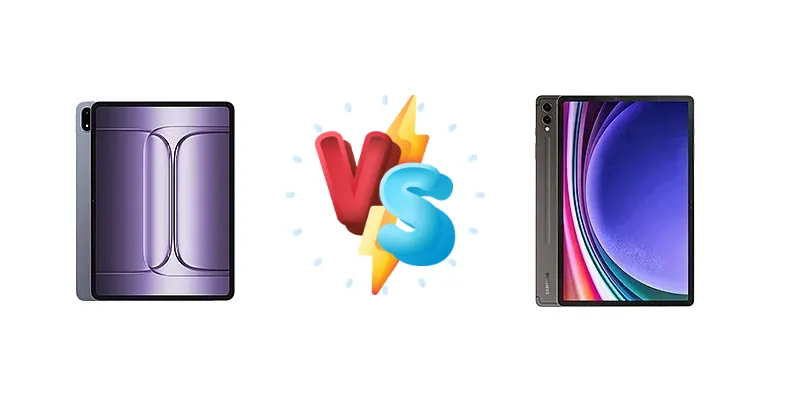
The Android tablet market is heating up. The Samsung Galaxy Tab S9+ has long been the benchmark for premium experiences, but OnePlus enters the fray with the Pad 3, armed with Qualcomm’s latest Snapdragon 8 Elite chipset. This comparison dissects the key differences, focusing on performance, battery life, and whether OnePlus can truly challenge Samsung’s dominance.
🏆 Quick Verdict
For users prioritizing raw processing power and sustained performance, the OnePlus Pad 3 emerges as the winner. Its Snapdragon 8 Elite, built on a 3nm process, offers a noticeable advantage. However, the Samsung Galaxy Tab S9+ remains a compelling choice for those deeply embedded in the Samsung ecosystem and valuing established features.
| Network |
|---|
| 2G bands | N/A | GSM 850 / 900 / 1800 / 1900 |
| 3G bands | N/A | HSDPA 850 / 900 / 1700(AWS) / 1900 / 2100 |
| 4G bands | N/A | 1, 2, 3, 4, 5, 7, 8, 12, 13, 17, 20, 25, 26, 28, 32, 38, 40, 41, 66 |
| 5G bands | - | 1, 3, 5, 7, 8, 20, 28, 38, 40, 41, 66, 77, 78 SA/NSA/Sub6 |
| EDGE | No | - |
| GPRS | No | - |
| Speed | - | HSPA, LTE, 5G - cellular model only |
| Technology | No cellular connectivity | GSM / HSPA / LTE / 5G |
| Launch |
|---|
| Announced | 2025, June 05 | 2023, July 26 |
| Status | Available. Released 2025, June 19 | Available. Released 2023, August 11 |
| Body |
|---|
| Build | Glass front, aluminum frame, aluminum back | Glass front, aluminum frame, aluminum back |
| Dimensions | 289.6 x 209.7 x 6 mm (11.40 x 8.26 x 0.24 in) | 285.4 x 185.4 x 5.7 mm (11.24 x 7.30 x 0.22 in) |
| SIM | No | Nano-SIM + eSIM (cellular model only) |
| Weight | 675 g (1.49 lb) | 586 g (581 g Wi-Fi) (1.29 lb) |
| Display |
|---|
| Protection | - | Corning Gorilla Glass |
| Resolution | 2400 x 3392 pixels (~315 ppi density) | 1752 x 2800 pixels, 16:10 ratio (~266 ppi density) |
| Size | 13.2 inches, 530.0 cm2 (~87.3% screen-to-body ratio) | 12.4 inches, 446.1 cm2 (~84.3% screen-to-body ratio) |
| Type | IPS LCD, 68B colors, Dolby Vision, 144Hz, 900 nits (HBM) | Dynamic AMOLED 2X, 120Hz, HDR10+ |
| Platform |
|---|
| CPU | Octa-core (2x4.32 GHz Oryon V2 Phoenix L + 6x3.53 GHz Oryon V2 Phoenix M) | Octa-core (1x3.36 GHz Cortex-X3 & 2x2.8 GHz Cortex-A715 & 2x2.8 GHz Cortex-A710 & 3x2.0 GHz Cortex-A510) |
| Chipset | Qualcomm SM8750-AB Snapdragon 8 Elite (3 nm) | Qualcomm SM8550-AC Snapdragon 8 Gen 2 (4 nm) |
| GPU | Adreno 830 | Adreno 740 |
| OS | Android 15, ColorOS 15 | Android 13, up to 4 major Android upgrades, One UI 6 |
| Memory |
|---|
| Card slot | No | microSDXC (dedicated slot) |
| Internal | 256GB 12GB RAM, 512GB 16GB RAM | 256GB 12GB RAM, 512GB 12GB RAM |
| Main Camera |
|---|
| Dual | - | 13 MP, f/2.0, 26mm (wide), 1/3.4", 1.0µm, AF
8 MP, f/2.2, (ultrawide) |
| Features | Color spectrum sensor, LED flash | LED flash, HDR, panorama |
| Single | 13 MP | - |
| Video | 4K@30fps, 1080p@30ps, gyro-EIS | 4K@30fps, 1080p@30fps |
| Selfie camera |
|---|
| Features | - | HDR |
| Single | 8 MP | 12 MP, f/2.4, 120˚ (ultrawide) |
| Video | 1080p@30fps | 4K@30fps, 1080p@30fps |
| Sound |
|---|
| 35mm jack | No | No |
| Loudspeaker | Yes, with stereo speakers (8 speakers) | Yes, with stereo speakers (4 speakers) |
| Comms |
|---|
| Bluetooth | 5.4, A2DP, LE, aptX HD | 5.3, A2DP, LE |
| NFC | No | No |
| Positioning | No | GPS, GLONASS, BDS, GALILEO - cellular model only |
| Radio | No | No |
| USB | USB Type-C 3.2, OTG, accessory connector | USB Type-C 3.2, magnetic connector |
| WLAN | Wi-Fi 802.11 a/b/g/n/ac/6/7, dual-band | Wi-Fi 802.11 a/b/g/n/ac/6e, tri-band, Wi-Fi Direct |
| Features |
|---|
| Sensors | Accelerometer, proximity (accessories only), gyro, compass | Fingerprint (under display, optical), accelerometer, gyro, proximity, compass |
| Battery |
|---|
| Charging | 80W wired | 45W wired |
| Type | 12140 mAh | Li-Po 10090 mAh |
| Misc |
|---|
| Colors | Storm Blue | Beige, Graphite |
| Models | OPD2415 | SM-X810, SM-X816B |
| Price | About 600 EUR | About 1000 EUR |
| SAR EU | - | 1.35 W/kg (body) |
OnePlus Pad 3
- Superior chipset performance with Snapdragon 8 Elite (3nm)
- Significantly faster 80W charging
- Potentially longer battery life due to 3nm efficiency
- Display specifications currently unknown
- Camera details are missing, making comparison difficult
Samsung Galaxy Tab S9+
- Mature software experience with Samsung DeX
- Established ecosystem and accessory support
- High-quality Dynamic AMOLED 2X display (known from previous models)
- Snapdragon 8 Gen 2 (4nm) is less efficient than Snapdragon 8 Elite
- Slower 45W charging
Display Comparison
While display specs are missing for the OnePlus Pad 3, the Samsung Galaxy Tab S9+ is known for its vibrant Dynamic AMOLED 2X display. The Snapdragon 8 Gen 2’s ISP is optimized for this panel, delivering accurate colors and high brightness. The 4nm process of the Gen 2 allows for efficient power delivery to the display, contributing to overall battery life. We anticipate the OnePlus Pad 3 will need a comparable panel to compete, as the chipset alone doesn't guarantee a superior visual experience.
Camera Comparison
Camera details are absent for the OnePlus Pad 3, but tablets generally prioritize front-facing cameras for video conferencing. The Samsung Galaxy Tab S9+ likely maintains a competitive camera setup, focusing on image quality and video stabilization. Given the tablet form factor, the emphasis isn't on flagship-level photography, but rather on reliable performance for calls and casual snapshots. Without specifics on the OnePlus Pad 3, it's difficult to assess its camera capabilities.
Performance
The core of this comparison lies in the chipsets. The OnePlus Pad 3’s Snapdragon 8 Elite (3nm) features a unique octa-core configuration with Oryon V2 Phoenix cores, promising significant performance gains over the Samsung Galaxy Tab S9+'s Snapdragon 8 Gen 2 (4nm). The 3nm node is crucial; it allows for higher transistor density and improved power efficiency, translating to less thermal throttling during sustained workloads. The Oryon cores are designed for peak performance, potentially exceeding the Cortex-X3 in the Gen 2. This difference will be most noticeable in demanding games and professional applications.
Battery Life
The OnePlus Pad 3 boasts an impressive active use battery score of 10:49h, while the Samsung Galaxy Tab S9+’s score is not provided. However, the OnePlus Pad 3’s 80W wired charging significantly outpaces the Samsung’s 45W charging. This faster charging speed is a major advantage, allowing for quicker top-ups and reduced downtime. The Snapdragon 8 Elite’s 3nm process also contributes to improved power efficiency, potentially extending battery life despite the lack of specific mAh information. The combination of efficient power management and rapid charging gives the OnePlus Pad 3 a clear edge.
Buying Guide
Buy the OnePlus Pad 3 if you need uncompromising performance for demanding tasks like gaming, video editing, or multitasking, and value the latest chipset technology. Buy the Samsung Galaxy Tab S9+ if you prioritize seamless integration with Samsung devices, a mature software experience with DeX, and a wider range of accessories and ecosystem support.
Frequently Asked Questions
❓ Will the Snapdragon 8 Elite in the OnePlus Pad 3 handle demanding games like Genshin Impact at max settings?
The Snapdragon 8 Elite's Oryon cores and 3nm process are specifically designed for high-performance gaming. It should comfortably handle Genshin Impact at maximum settings with consistent frame rates, minimizing throttling compared to the Snapdragon 8 Gen 2.
❓ How much faster is the 80W charging on the OnePlus Pad 3 compared to the 45W charging on the Samsung Galaxy Tab S9+?
80W charging will significantly reduce charging times. While exact figures depend on battery capacity, expect the OnePlus Pad 3 to charge from 0-100% considerably faster – potentially 30-50% quicker – than the Samsung Galaxy Tab S9+.
❓ Does the Snapdragon 8 Elite's efficiency translate to noticeably cooler operation during extended use?
Yes, the 3nm process of the Snapdragon 8 Elite is a key factor in thermal management. It generates less heat than the 4nm Snapdragon 8 Gen 2, resulting in cooler operation and reduced throttling during prolonged gaming or video editing sessions.