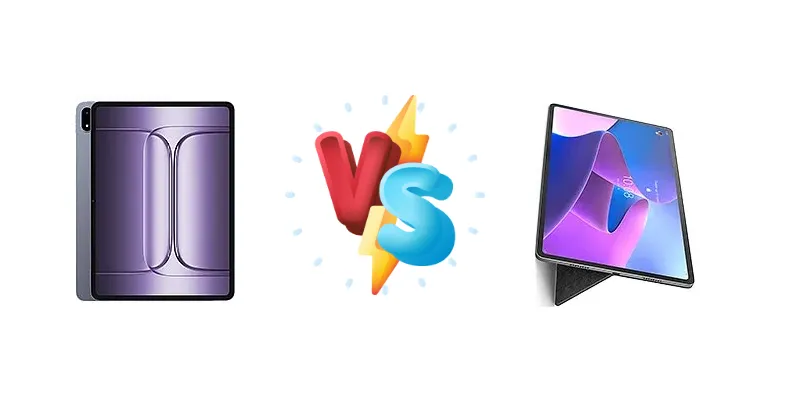
The Android tablet market is heating up, with the OnePlus Pad 3 entering the fray as a performance-focused contender against the established Lenovo Tab P12 Pro. This comparison dissects the core differences – a new-generation Snapdragon 8 Elite versus a refined Snapdragon 870 – to determine which tablet delivers the best experience for demanding users and everyday tasks.
🏆 Quick Verdict
For users prioritizing raw performance and future-proofing, the OnePlus Pad 3 is the clear winner thanks to its Snapdragon 8 Elite chipset and faster 80W charging. However, the Lenovo Tab P12 Pro remains a compelling option for those seeking a well-rounded experience with a proven track record and potentially lower price.
| Network |
|---|
| 2G bands | N/A | GSM 850 / 900 / 1800 / 1900 |
| 3G bands | N/A | HSDPA 850 / 900 / 1900 / 2100 |
| 4G bands | N/A | 1, 2, 3, 4, 5, 7, 8, 19, 20, 26, 28, 34, 38, 39, 40, 41 |
| 5G bands | - | 1, 3, 7, 8, 20, 28, 38, 41, 77, 78 SA/NSA/Sub6 |
| EDGE | No | - |
| GPRS | No | - |
| Speed | - | HSPA, LTE, 5G - cellular model only |
| Technology | No cellular connectivity | GSM / HSPA / LTE / 5G |
| Launch |
|---|
| Announced | 2025, June 05 | 2021, September 08 |
| Status | Available. Released 2025, June 19 | Available. Released 2021, November 19 |
| Body |
|---|
| Build | Glass front, aluminum frame, aluminum back | - |
| Dimensions | 289.6 x 209.7 x 6 mm (11.40 x 8.26 x 0.24 in) | 285.6 x 184.5 x 5.6 mm (11.24 x 7.26 x 0.22 in) |
| SIM | No | Nano-SIM (cellular model only) |
| Weight | 675 g (1.49 lb) | 565 g (1.25 lb) |
| | - | Stylus support |
| Display |
|---|
| Resolution | 2400 x 3392 pixels (~315 ppi density) | 1600 x 2560 pixels, 16:10 ratio (~240 ppi density) |
| Size | 13.2 inches, 530.0 cm2 (~87.3% screen-to-body ratio) | 12.6 inches, 460.3 cm2 (~87.4% screen-to-body ratio) |
| Type | IPS LCD, 68B colors, Dolby Vision, 144Hz, 900 nits (HBM) | AMOLED, 120Hz, HDR10+, Dolby Vision, 600 nits (HBM) |
| Platform |
|---|
| CPU | Octa-core (2x4.32 GHz Oryon V2 Phoenix L + 6x3.53 GHz Oryon V2 Phoenix M) | Octa-core (1x3.2 GHz Kryo 585 & 3x2.42 GHz Kryo 585 & 4x1.80 GHz Kryo 585) |
| Chipset | Qualcomm SM8750-AB Snapdragon 8 Elite (3 nm) | Qualcomm SM8250-AC Snapdragon 870 5G (7 nm) |
| GPU | Adreno 830 | Adreno 650 |
| OS | Android 15, ColorOS 15 | Android 11 |
| Memory |
|---|
| Card slot | No | microSDXC (dedicated slot) |
| Internal | 256GB 12GB RAM, 512GB 16GB RAM | 128GB 6GB RAM, 256GB 8GB RAM |
| Main Camera |
|---|
| Dual | - | 13 MP, (wide), AF
5 MP, (ultrawide) |
| Features | Color spectrum sensor, LED flash | - |
| Single | 13 MP | - |
| Video | 4K@30fps, 1080p@30ps, gyro-EIS | 4K@30fps, 1080p@30fps |
| Selfie camera |
|---|
| Single | 8 MP | 8 MP, (wide)
8 MP, IR TOF 3D, (biometrics sensor only) |
| Video | 1080p@30fps | 1080p@30fps |
| Sound |
|---|
| 3.5mm jack | - | No |
| 35mm jack | No | No |
| Loudspeaker | Yes, with stereo speakers (8 speakers) | Yes, with stereo speakers (4 speakers) |
| | - | JBL speakers |
| Comms |
|---|
| Bluetooth | 5.4, A2DP, LE, aptX HD | 5.2, A2DP, LE |
| NFC | No | Yes (wireless charging and data transfer only) |
| Positioning | No | GPS, GLONASS, BDS - cellular model only |
| Radio | No | Unspecified |
| USB | USB Type-C 3.2, OTG, accessory connector | USB Type-C 3.1 |
| WLAN | Wi-Fi 802.11 a/b/g/n/ac/6/7, dual-band | Wi-Fi 802.11 a/b/g/n/ac/6, dual-band, Wi-Fi Direct |
| Features |
|---|
| Sensors | Accelerometer, proximity (accessories only), gyro, compass | Fingerprint (side-mounted), accelerometer, gyro, proximity |
| Battery |
|---|
| Charging | 80W wired | 45W wired, QC4 |
| Type | 12140 mAh | Li-Po 10200 mAh |
| Misc |
|---|
| Colors | Storm Blue | Storm Grey |
| Models | OPD2415 | TB-Q706Z, TB-Q706F |
| Price | About 600 EUR | About 520 EUR |
OnePlus Pad 3
- Significantly faster processor with Snapdragon 8 Elite
- More efficient 3nm process for better battery life and reduced throttling
- Ultra-fast 80W wired charging
- Potential for higher price
- Newer device, potential for early software bugs
Lenovo Tab P12 Pro
- Proven performance with Snapdragon 870
- Mature software experience
- Potentially lower price point
- Older 7nm process, less efficient
- Slower 45W charging
Display Comparison
While display specs are missing for the Lenovo Tab P12 Pro, its Pro designation suggests a high-quality panel. The OnePlus Pad 3’s display details are also absent, but the focus here is on the chipset. The Snapdragon 8 Elite’s image signal processor (ISP) will likely contribute to better display processing, potentially enhancing color accuracy and dynamic range. The Lenovo Tab P12 Pro, being an older model, may lack the latest display technologies like variable refresh rates found in newer tablets.
Camera Comparison
Camera specifications are unavailable for both devices. However, given the tablet form factor, camera quality is typically not a primary concern for most users. The Snapdragon 8 Elite’s advanced ISP in the OnePlus Pad 3 could offer improved image processing capabilities, but without sensor details, it’s difficult to assess the real-world difference. We anticipate both tablets will offer adequate cameras for casual snapshots and video calls.
Performance
The OnePlus Pad 3’s Qualcomm SM8750-AB Snapdragon 8 Elite, built on a 3nm process, represents a significant leap over the Lenovo Tab P12 Pro’s Snapdragon 870 (7nm). The Snapdragon 8 Elite’s octa-core CPU, featuring Oryon V2 Phoenix cores clocked up to 4.32 GHz, promises substantially faster processing speeds compared to the 870’s Kryo 585 cores peaking at 3.2 GHz. This translates to quicker app launches, smoother multitasking, and a more responsive user experience, particularly in demanding applications. The 3nm node also implies superior thermal efficiency, potentially reducing throttling during sustained workloads. The Snapdragon 870 is still a capable chip, but the 8 Elite offers a generational advantage.
Battery Life
The OnePlus Pad 3 achieves a commendable 10:49 hours of active use, showcasing the efficiency of the Snapdragon 8 Elite and its 3nm fabrication. The Lenovo Tab P12 Pro’s battery life is unknown, but its older chipset and 7nm process likely result in lower efficiency. Crucially, the OnePlus Pad 3 supports 80W wired charging, significantly faster than the Lenovo Tab P12 Pro’s 45W charging with Quick Charge 4. This means the OnePlus Pad 3 can replenish its battery much quicker, minimizing downtime.
Buying Guide
Buy the OnePlus Pad 3 if you need uncompromising performance for gaming, video editing, or multitasking, and value the fastest possible charging speeds. Buy the Lenovo Tab P12 Pro if you prioritize a refined, mature software experience, a potentially lower price point, and a balance between performance and battery life for everyday productivity and media consumption.
Frequently Asked Questions
❓ Will the Snapdragon 8 Elite in the OnePlus Pad 3 handle demanding games like Genshin Impact at max settings?
Yes, the Snapdragon 8 Elite is a flagship-level chipset designed to handle even the most graphically intensive games with ease. Its advanced GPU and efficient thermal design should allow for sustained high frame rates without significant throttling, providing a smooth and immersive gaming experience.
❓ Does the Lenovo Tab P12 Pro still receive software updates and security patches?
Lenovo typically provides software updates for its tablets for a period of time after release. However, as the Tab P12 Pro is an older model, its update support may be limited compared to the newer OnePlus Pad 3. Check Lenovo's official website for the latest update information.
❓ How much faster is 80W charging compared to 45W charging on the OnePlus Pad 3 versus the Lenovo Tab P12 Pro?
80W charging can significantly reduce charging times. While exact times depend on battery capacity, the OnePlus Pad 3 will likely charge from 0-100% considerably faster – potentially in under an hour – compared to the Lenovo Tab P12 Pro, which could take over 1.5 hours with its 45W charging.